Showing posts with label Black authors. Show all posts

Monday, January 17, 2022

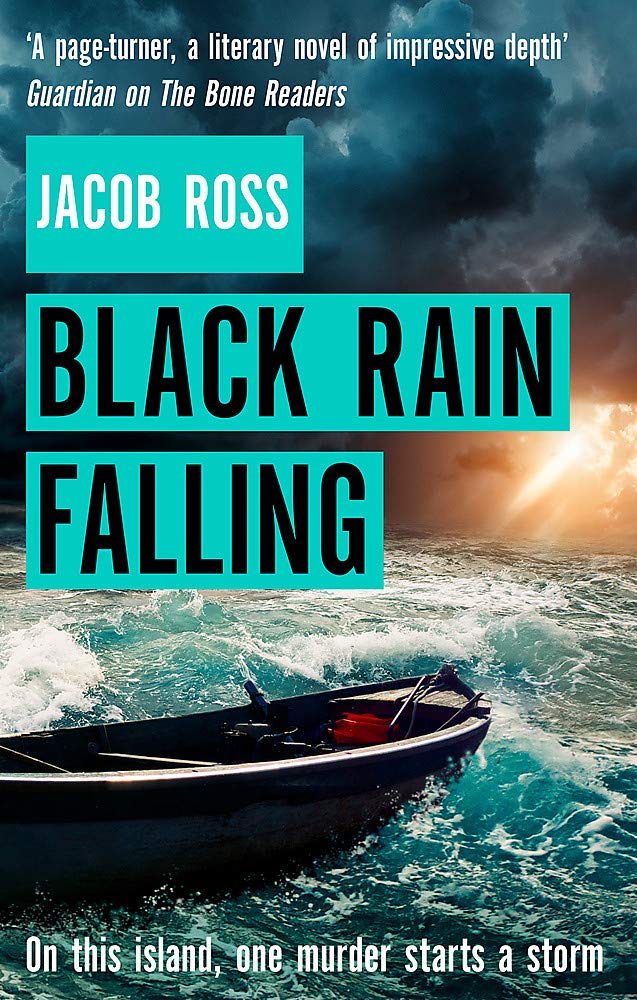
BOOK REVIEW: Black Rain Falling (DC Digger, #2) by Jacob Ross

Black Rain Falling is the sequel to The Bone Readers, the first two in what is apparently designed to be four novels collectively called the Camaho Quartet. These books were written by Jacob Ross, a Grenadian-born, award-winning author and poet who lives in Britain. They are police procedural novels, crime thrillers set on an island called Camaho (which is clearly a thinly disguised version of Grenada) featuring two psychologically wounded and ethically complicated detective protagonists in Detective Constables Michael "Digger" Digson and Kathleen Stanislaus and a host of colorful supporting characters and criminals.

The Bone Readers was memorable for its immersive depiction of island life while unspooling a captivating, suspenseful story and introducing the reader to DC Digger and DC Stanislaus (who is invariably referred to as "Miss Stanislaus" in the text). In Black Rain Falling, the stakes are higher for our main characters as Miss Stanislaus fatally shoots in self defense a known criminal (who was also responsible for her traumatic sexual assault when she was a teenager) and Digger’s frenemy/boss/rival Malan Greaves uses this incident to make his move to advance his career while crippling Digger’s and Stanislaus’ by dissolving the special criminal justice investigative unit that all three of them worked at by having them all transferred to a new police station where he gets a promotion and Digger's enemies get easier access to him.

However, the central mystery in Black Rain Falling is about how the international drug trade is bringing increased crime that is beginning to impact life on Camaho and neighboring islands. For example, there is a shockingly violent killing, an abundance of “hush money” and an incredibly powerful speedboat that can be used to ferry drugs between multiple islands. Digger and Stanislaus are trying to puzzle out the connections between these pieces before the corrupt powers that be strip them of their ability to do anything about it. 

By the end of the book both Digger and Stanislaus, who have complicated and ambivalent relationships with their fathers will need to rely on familial connections in order to persevere and ultimately succeed.

As with the first book, the reader can come for the compelling characters and thrilling plot but what really sets these mysteries apart from others in the genre is 1) Digger and Stanislaus’ chemistry and teamwork; 2) the verisimilitude of the depiction of the island setting of Camaho (Grenada) and 3) Ross' lyrical writing; the author is an award-winning poet and it shows in the quality of the prose.

Overall, Black Rain Falling is another excellent police procedural written by Jacob Ross, set in the Caribbean with two compelling characters in DC Digger and Miss Stanislaus whom I hope to spend a lot more time with in future installments of the Camaho Quarter.

Title: Black Rain Falling.
Author: 
Jacob Ross.
Format: Kindle.
Length: 432 pages.
Publisher: Mullholland Books.
Date Published: March 5, 2020.
Date Read: December 30, 2021.

GOODREADS RATING: ★★★★★  (5.0/5.0).

OVERALL GRADE: A- (3.67/4.0).

PLOT: A-.
IMAGERY: A.
IMPACT: A-.
WRITING: A.

Thursday, April 01, 2021

BOOK REVIEW: Heaven, My Home (Highway 59, #2) by Attica Locke

Heaven, My Home is the second in a series of police procedural books about a Black Texas Ranger written by Attica Locke (who is also well-known for her trenchant writing on television shows such as Little Fires Everywhereand Empire). The main character in the books is Darren Matthews, and the central tension of the books come from the conflicts and circumstances that arise when one of the very few Black man in a predominantly white prestigious crime-fighting organization like the Texas Rangers has to interact with rednecks in rural sections of the state.

In Bluebird, Bluebird, Darren was involved in trying to solve a pair of murders with racial overtones (the bodies of a black man and a white woman are found dumped separately in a nearby river a few days apart) in a very small town up Highway 59 from Dallas. In the sequel, Heaven, My Home, Darren is asked to drive up Highway 59 to the Southern gothic tourist destination of Jefferson to find a missing 10-year-old kid, Levi King. Levi just happens to be the son of jailed notorious white supremacist Bill King and was last seen alive by Leroy Page, an elderly Black man who happens to own most of the property near Lake Caddo in an area called Hopetown where Native Americans, African Americans and poor Whites have been squatting for years. The child’s grandmother Rosemary King is the richest person in the nearby town of Jefferson but doesn’t seem that worried about her kin’s well-being, but Rosemary does seem fixated on getting her greedy hands on the Leroy’s deed to Hopetown.

If the story in Heaven, My Home doesn’t seem complicated enough there are still several unresolved issues from the first book. Because of this, Darren is currently being blackmailed by his own ne’er-do-well mother to keep quiet that she has a piece of evidence that if it were revealed Darren knew existed and were given to authorities might not only lead to him losing his job, but potential indictment and prosecution. Additionally, while Darren’s marriage started off in an “it’s complicated” phase in the first book, it morphs into the slow-motion train wreck stage when he starts noticing oddly charged interactions between his best friend and wife and this leads him to reach out to the widow he was powerfully (and chastely) attracted to in the first book.

The writing is delightful in both books and the mysteries are compelling, if somewhat implausibly racially charged, in both cases. One would think these features would make these books resonate with he but, surprisingly, they don’t. Primarily, I just don’t sympathize (or empathize) with Darren. He makes (and made) some bad choices in this book and the previous one. He’s clearly a (barely) functional alcoholic. Of course, there’s a long history of detectives being alcoholic, addicted messes (looking at you, John Rebus!) but here the setting of backwoods Texas repels instead of propelling me.

I hope Ms. Locke writes more books in the Highway 59 series, and I think I will probably get around to reading them, although I won’t feel an urgent need to do so.

Title: Heaven, My Home.
Author: 
Attica Locke.
Format: Kindle.
Length: 336 pages.
Publisher: Mullholland Books.
Date Published: September 17, 2019.
Date Read: February 20, 2021.

GOODREADS RATING: ★★★½☆  (3.5/5.0).

OVERALL GRADE: A-/B+ (3.5/4.0).

PLOT: B+.
IMAGERY: A-.
IMPACT: A-.
WRITING: A-.

Thursday, March 25, 2021

BOOK REVIEW: Bluebird, Bluebird (Highway 59, #1) by Attica Locke

Bluebird, Bluebird is the first book by Attica Locke that I have read. It’s a police procedural, murder mystery novel based in Texas. The main character, Darren Matthews, is one of the very few Black Texas Rangers. I wasn’t aware before reading this book that the Rangers are sort of like a State-based version of the FBI. In other words they have the ability to make a “state” case out of crimes that can supersede local jurisdiction. Matthews is one of the very few Black people in a predominantly white organization and this reality and how he (and his colleagues) deal with race animates a significant portion of the book. And  this story is taking place in Texas, with an infamously racist past and unambiguously racist present.

As with most interesting protagonists of mystery novels, Matthews is a complicated character. He has problems at work and at home. His wife has basically kicked him out, because she doesn’t approve of his job as a Ranger when he just needs one more year of law school to be an upstanding attorney like she is. (Matthews left University of Chicago Law School and returned home to East Texas where he was raised by his twin uncles after the grotesque hate-infused murder of James Byrd made headlines and inspired federal hate crimes legislation.) He’s basically been suspended from his job as a Ranger due to his improperly close relationship with an elderly Black man who the police view as a suspect in the suspicious shooting of a racist redneck who before he died had been harassing the suspect’s granddaughter.

So we aren’t surprised at the beginning of Bluebird, Bluebird when Matthews agrees to do a favor for a (white) friend of his who is also a federal agent to (unofficially) and drive up Highway 59 from the Big City to take a look at the appearance of a Black male body that has recently washed up in Lark, a backwater town in East Texas, population 187. Matthews soon finds out the deceased is Michael Wright, a lawyer from Chicago but. The situation becomes even more complicated than it first appeared when soon after the first body appeared, a second body shows up, and this time it’s a white girl, a local waitress named Missy Dale known for her predilection for spending time in the company of Black men. Surely the two must be related, and there’s no way that the linked deaths of a Black man and white woman won’t be a dangerous powder keg in a hick town like Lark which is known for its long history with the Klan. Are the deaths some kind of hate crime? But the conceit of the book is that the bodies showed up in reverse order. Wouldn't you think it would be the white girl who would be killed first, and then the Black guy she cavorted with killed by the Klan afterwards?

Soon after Matthews arrives in Lark, so does the widow of the Black man, her name is Randie and she’s trying to find out what happened to her estranged husband. The parallels with Matthews and his personal situation are obvious. The relationship between Randie and Darren is complicated. She’s not from “around here” (and Matthews is) so he takes it on himself to show her around and promises himself to try and see she gets justice by solving the mystery of her husband's killing. But, as a knight in shining armor, Darren is more than a little tarnished. He’s got a drinking problem and he’s a little too fond of telling little white lies to people in order to get his way. As a Black Ranger with a badge in a town full of meth-heads, rednecks and extreme poverty he’s got a lot going against him in order to fulfill the ill-advised promise he made to the grieving widow.

The story in Bluebird, Bluebird is interesting because of the complex connections the author, Attica Locke, weaves between the characters (and suspects) in this little town where everyone knows everyone, and secrets have and stories have festered for decades. Both bodies  washed up within walking distance of a roadside hole-in-the-wall restaurant right off Highway 59 run by an elderly Black woman named Geneva Sweet who admits to seeing both Missy and Michael within several hours of their deaths. Geneva also has a complicated history. Her husband and son, both named Joe Sweet, are dead from violence within the last ten years, about 2 years apart. That's a lot of suspicious death in a town this small. Another important character is Wallace Jefferson III, an old white guy who literally owns all the land in town, lives a stone’s throw away from Geneva’s Sweets and clearly once (and maybe still) has had an impossible attraction to Geneva, who a long time ago used to be the hired help in the Jefferson Southern Gothic mansion.

Overall, Bluebird, Bluebird is an interesting, atmospheric novel which poses thoughtful and thought-provoking questions about race, family and the ties that bind people together, both emotional and obligatory. As a mystery novel it’s less successful and I’m not sure Darren Matthews is someone I really want to spend much more time with, but I am willing to spend more time with Locke’s spare, evocative prose and look forward to reading the next entry in the series Heaven, My Home.

Title: Bluebird, Bluebird.
Author: 
Attica Locke.
Format: Kindle.
Length: 320 pages.
Publisher: Mullholland Books.
Date Published: September 10, 2017.
Date Read: February 20, 2021.

GOODREADS RATING: ★★★★☆  (4.0/5.0).

OVERALL GRADE: A- (3.67/4.0).

PLOT: B+.
IMAGERY: A-.
IMPACT: A-.
WRITING: A.

Thursday, February 25, 2021

BOOK REVIEW: The Rage of Dragons (The Burning, #1) by Evan Winter

The Rage of Dragons is the debut novel by Evan Winter, one of the few African-American authors working in the epic fantasy genre. This 2019 work made quite a splash, and when I read it in February 2021 it had well over 16,000 ratings with a very impressive 4.37 average on Goodreads’ 5-point scale. I had made the decision to try and read as many Black authors as I could during Black History Month and selecting Winter’s well-regarded fantasy novel from my burgeoning Kindle TBR pile seemed like a no-brainer.

Most of my reading these days is in genre fiction, but typically I would say I spend more time reading crime fiction, then science fiction and rarely fantasy. However I was impressed very early on by Winter’s characterization of the protagonist of The Rage of Dragons, Tau Solarin. I was even more impressed by the world-building in the novel.

The story in The Rage of Dragons is set in a satisfyingly complex society which has two primary castes: Lessers and Nobles. The two are physically distinctive, although it is clear that both groups would be racialized as “Black” in our contemporary society. Almost all Nobles are taller, faster, stronger than most Lessers. Both are part of the Chosen people or Omehei. Omehei society appears to have a level of technological advancement equivalent to the Bronze Age on Earth. In addition to a society chock full of complicated moral questions Winters adds dragons and a spiritual realm that allows certain Gifted Omehei to practice powerful, specific magical effects such as Enraging (making someone physically bigger and stronger), Enervating (stripping someone of their will and ability to act on their own), Edifying (communicating information over long distances) and Entreating (taking over conscious control of another living thing’s body). Winter situates his story in a historical context where the Omehei have spent 200 “cycles” (presumably solar years) trying to keep control over land on the Xiddan Peninsula that they think they should get to keep because it’s where they landed after they were hunted and nearly exterminated in a land called Osonte located far across the sea by creatures they call The Cull. Omehei believe they were "Chosen" by the Goddess to survive the Cull and their faith in her is why some have been "gifted" with powers and why they survived the rough sea passage from Osonte and also believe they have a right to claim Xiddan as their own.  Unfortunately, it was already occupied by another group of humans, who (rightly, IMO) view the Omehei as invaders and colonizers and have been fighting for generations to expel or exterminate the Omehei. The Omehei also seem to be able to convince dragons to fight on their side fairly regularly and this behavior is viewed as further evidence the Omehei are "chosen by the Goddess."

The Rage of Dragons is an intricate, multi-layered story with several fascinating creations combined together to produce a compelling setting for what is at its heart a fairly traditional plot ("Local boy makes good"). These layers include class (there’s a very explicit and strongly enforced caste system among the Omehei AND a Royal sovereign!); race (almost all the Omehei are described as having skins of various hues ranging from tan to pitch-black); religion (belief in a spiritual world called Isihogo, the realm of demons, as well as an omnipotent, omnipresent, invisible "Goddess."); magic (the previously mentioned Gifted abilities); and war (the Omehei are in a generations-long battle with the original inhabitants of the Xiddan peninsula whom they call “hedeni” who they think are over abundant, light-skinned heathens and savages).

The main character Tau is an 18-year-old Lesser whose best friend Jabari is a Petty Noble and Winter does an excellent job of depicting the unequal opportunities and futures Lessers and Nobles have in Omehei society. Through an unfortunate interaction with a less open-minded Noble than Jabari, Tau’s father is killed early in the book in order to assuage a Noble ego and Tau vows revenge on three specific Noblemen who he sees as ultimately responsible for his father’s thoughtless murder.

The primary animating force of Tau's actions in The Rage of Dragons is revenge against his “betters” and he sets off to prove that he will literally do whatever it takes, no matter how painful or difficult, in order to have an opportunity to strike back at the men who destroyed his family. This makes Tau a sympathetic but also problematic figure. There’s an entire arc of the story which is about how Tau becomes a great warrior, not through some innate or genetic or magical ability but through intense, obsessive hard work, day-in and day-out. This is a nice choice by the author, because although Winter is duplicating a common trope of epic fantasies (the downtrodden orphan who grows up to become more powerful than anyone or he could ever have dreamed) he also subverts the trope by making it clear Tau is NOT the biggest, smartest or “most special” character in the book. Tau makes mistakes and wrong choices, more than once, but these humanize him and greatly strengthened my interest and connection with the character.

I only have a few quibbles with The Rage of Dragons (obviously, since I gave it the highest possible rating of five out of five stars on Goodreads). First of these quibbles are the too-frequent, detailed descriptions of hand-to-hand combat and fight scenes. In some sense it follows because Tau is in military training for more than half the book, but I think the number of paragraphs describing precisely how, who and with what Tau is fighting could have been reduced by half (or more!) with very little reduction in my enjoyment of the book. My second quibble is with the ending and the author’s penchant of raising the stakes by literally killing off multiple major characters in the last 5% of the book; some of the characters killed had been around since the first 5% of the book. This is incredibly gutsy, I guess, and I understand the dilemma the author is in. If he puts all of the characters in peril (or at the very least the vast majority of the ones we care about) and never kills off any, then the peril isn’t real, and the reader may feel cheated. But if he kills off major characters that we have known for the vast majority of the book in a shocking denouement towards its conclusion then it feels overwhelming and the reader feels somewhat cheated for investing in certain relationships that had built up as the story progressed. Winter made the latter choice in The Rage of Dragons and it definitely increased the emotional wallop the book delivers, so maybe he made the "right" choice in this case. I’m not sure there really exists an optimal choice for an author here.

Overall, The Rage of Dragons is an incredibly well-written and powerful debut novel. As I said at the beginning, epic fantasy is not particularly one of my favorite genres but I was thoroughly entertained and entranced by this book and look forward to reading The Fires of Vengeance as soon as the price for the Kindle edition goes on sale!

Title: The Rage of Dragons (The Burning, #1).
Author: 
Evan Winter.
Format: Kindle.
Length: 544 pages.
Publisher: Orbit.
Date Published: July 16, 2019.
Date Read: February 16, 2021.

GOODREADS RATING: ★★★★★ (5.0/5.0).

OVERALL GRADE: A (4.0/4.0).

PLOT: A-.
IMAGERY: A.
IMPACT: A+.
WRITING: A.
LinkWithin

Blog Widget by LinkWithin