Showing posts with label Succulent Sunday. Show all posts

Sunday, June 24, 2012

SUCCULENT SUNDAY: Eriosyce paucicostata ssp floccosa

​Eriosyce paucicostata ​ssp ​floccosa​ is reportedly known only from the region of Blanco Encalada in the coastal mountains of Antofagasta, Chile. It has been known under many synonyms, especially ​Neoporteria floccosa ​and ​Neochil​enia floccosa.

This young specimen has white spines and wool obscuring the green body. Some individuals are not covered quite so completely.

Flowers have the appearance of antique paper, with the outer petals a darker pink, fading to pale pink for the inner petals.


Eriosyce paucicostata ssp floccosa are noted for long hairs under the flowers. Full grown plants look somewhat different, but the plant pictured in habitat is just as completely covered by long spines, wool, and hairs. (This photo is at cactushabitat.com.)
Eriosyce paucicostata ssp floccosa in habitat from http://cactushabitat.com/Chile/AntofagastaRegionII/Botijavalley/neoporteriafloccosa.html

Sunday, June 10, 2012

SUCCULENT SUNDAY: Copiapoa hypogaea

Continuing the theme of "odd miniatures", Copiapoa hypogaea is a spiral, brown or bronzed disc-shaped cactus, 3 or 4cm in the wild or larger 7cm in cultivation.

The pictured plant shows the larger, luxurious, 7cm size of its cushy lifestyle. In habitat, most of the body is under the ground's surface. Spines are small and relatively harmless. Some individuals lack spines entirely. Flowers are yellow and reportedly somewhat fragrant, though I didn't notice much fragrance wafting from the pictured plant.

More unusual is the 'Lizard Skin' variety with a wrinkly epidermis found in only one of the two subpopulations of C hypogaea in the wild. Pictured here is the more typical variety.
 
Native to area near Chañaral (Coastal Chile, 02 Antofagasta).

Sunday, June 03, 2012

Coryphantha compacta, synonym Coryphantha palmeri

Active today is this lovely Coryphantha palmeri, native to Chihuahua, Durango, and Tamaulipas, Mexico.


Reported used in shamanic rituals, Coryphantha palmeri makes a nice container specimen, too.

Monday, May 28, 2012

SUCCULENT SUNDAY HOLIDAY: Astrophytum cv 'Onzuka'

I've had mixed results with genus Astrophytum. I've lost some of these cacti to mysterious, chunk-devouring pests—I suspect rats, but it could be squirrels or birds. I've lost others to rot… perhaps underwatering, dead roots, and then rot growing on the dead roots.

This individual Astrophytum cv 'Onzuka' is doing really well so far. It overshadows its 3-inch pot with a full 3.5-inch diameter. I'll repot it soon. I've heard from an advanced grower that he cuts off the taproot at a certain age, forcing the stem to grow smaller, less rot-prone roots. Sounds radical but I seem to recall he claimed everyone in Japan does this.

It's hard not to like Astrophytum cv 'Onzuka'. It has strange, white-speckled skin, its body is oddly geometric, and its flower is understated but beautiful.


Speaking of Japan, that's where this justifiably popular cultivar of Astrophytum myriostigma is said to originate.

Sunday, May 06, 2012

SUCCULENT SUNDAY: Rebutia neocumingii, syn Weingartia neocumingii

Bolivian cactus Rebutia neocumingii was known under genus name Weingartia from its description by Backeberg in 1950 until Weingartia was combined under Rebutia by Hunt in 1987. Its flowers can be yellow, orange or red depending on locality. It's normally solitary and unbranched, though the individual pictured is sprouting additional heads. Typically this species has much longer spines; this plant was obtained as form brevispina. It is about 7.5 cm across; at full growth, it can reach 10cm across and up to 20cm in height.
Rebutia neocumingii obrtained as Weingartia neocumingii brevispina.
Plant grown and photographed by Mr Sentient Meat.

Sunday, April 29, 2012

SUCCULENT SUNDAY: Parodia microsperma from Bolivia and Argentina

Returning from a month-long hiatus, I worried many Sentient Meat plants would be dead. Luckily I had few casualties, and many of the survivors put on noticeable growth in my absence. Since spring is the most active season, many are now in riotous flower... like today's Parodia microsperma.

This plant was obtained without a label, and I had believed it was Parodia herzogii. Consulting Anderson The Cactus Family and other references, I learned this is not wrong, but the accepted name for this type is Parodia microsperma. I also learned this type has been published under literally dozens of different name, all likely synonyms for this basic species.

It has a reputation as a showy plant, and this individual indeed puts on a show. Flowers range from yellow to deep orange (like this one) and even blood-red.

Parodia microsperma and its many synonyms are native to southern Bolivia and northern Argentina.

Sunday, March 18, 2012

SUCCULENT SUNDAY: Turbinicarpus valdezianus pseudopectinatus

Turbinicarpus valdezianus is one of the smallest and slowest-growing cactus—small even within genus Turbinicarpus, not known for their tremendous size. The diminutive body is the size and shape of a thimble. The spines are minute, almost microscopic, and flattened against the body in harmless tight formation—more like scales than armament. Flowers are pink, often striped; occasionally white.
Turbinicarpus valdezianus
Turbinicarpus valdezianus is found in Coahuila, San Luis Potosí, Nuevo León, and Zacatecas.

Turbinicarpus valdezianus showing more of body
Correction: The plant was originally identified as Turbinicarpus valdezianus. A fallen label was discovered; this plant is actually the related Turbinicarpus pseudopectinatus.

Sunday, March 11, 2012

SUCCULENT SUNDAY: Parodia buiningii, synonym Notocactus buiningii

This week Parodia buiningii takes us to South America. Each plant is an excuse to learn more about botany and geography, bouncing from continent to continent as the inspiration strikes. A succulent species represents millions of years of adaptation to specific ecological pressures in Mexico or the rest of North America, Africa, Madagascar... or this week, Uruguay and Brazil.

Parodia buiningii is also known by its synonym Notocactus buiningii. (All Notocactus species have been included under the genus Parodia, where they form a distinct clade: a group of related plants with evidence of descending from a common ancestor.) 

Parodia buiningii is one of the most handsome members of the group formerly known as genus Notocactus: geometric ribs, glaucous blue-green skin, and needle-sharp spines the color of tortoise shell. This Parodia buiningii has advanced flower buds with characteristic brown wool. They look almost like fuzzy antlers on a young deer or strange rabbit ears. The flowers will be yellow. This individual is probably a few years old and measures approximately 3 inches across.

Notocactus buiningii grown and photographed by Mr Sentient Meat
Which country is it really from, you ask—Uruguay or Brazil? Well, Parodia buiningii is found near the unusual dual-nationality city: Rivera, the capital of the Rivera Department of Uruguay and (Santana do) Livramento, a city in the state of Rio Grande do Sul, Brazil. In an uncommon arrangement, citizens of either country within the city can cross the border freely. Customs and checkpoints are located outside the city.

Parodia buiningii is reportedly rare in its habitat, the environs of these twin cities, Rivera, Uruguay, and Livramento, Brazil.

Closeup of same Notocactus buiningii grown and photographed by Mr Sentient Meat

Sunday, March 04, 2012

SUCCULENT SUNDAY: Stenocactus multicostatus

Called "brain cactus", the genus Stenocactus hails from Mexico. It's distinguished by its wavy ribs. Also called Echinofossulocactus, this genus varies widely in size, spination, and number of ribs.

Today's species, Stenocactus multicostatus ("many-ribbed") enjoys wide distribution in Mexico: Chihuahua, Coahuila, Durango, Nuevo Léon, San Luis Potosí, and Zacatecas. True to its name, it seldom has fewer than 120 ribs. Notice the flat, stout central spines.

Stenocactus multicostatus
Within that natural variation, this individual shows flowers typical of stenocactus: short, funnel- or bell-shaped; white with purple-pink midstripe.

Stenocactus multicostatus flowers seen from above

See Also

Stenocactus multicostatus at Cactus-Art.Biz

Sunday, February 26, 2012

SUCCULENT SUNDAY: Mammillaria pectinifera

Even if you limit yourself to the most seductive cacti from genus Mammillaria, you still have dozens of strange and wonderful plants to choose from. Mammillaria pectinifera (Latin for "comb-bearing") has such minute, harmless spines that they appear like legs on tiny bugs—reminiscent of the spines on Mammillaria hernandezii (profiled previously). The spine beds are elongated vertically, like so many miniature millipedes marching in tight formation.

Surprisingly, Mammillaria pectinifera is closely related to M. carmenae (which looks completely different & is also profiled on Sentient Meat), M. glassii, M. picta, M. plumosa, and M. prolifera. Together these species plants form a clade, a group of types likely descending from a common ancestor. They differ markedly from each other in size, spines, and other features.

Mammillaria pectinifera, endangered miniature cactus native to Puebla, Oaxaca. Plant grown and photographed by Mr Sentient Meat
My plant is just over an inch in diameter. This is its first bloom under my care. The flowers are an elegant pale pink. Overall the plant is neat and understated in appearance.

Mammillaria pectinifera, same plant viewed close up, plant grown and photographed by Mr Sentient Meat
Mammillaria pectinifera's appeal may be its downfall. It is reported to be nearly extinct due to over-collection within its native Puebla, Oaxaca, Mexico. Consequently, it's protected under CITES I, the most stringent protocol of international protection.

Sunday, February 19, 2012

SUCCULENT SUNDAY: Eriosyce senilis

Like last week's copiapoa, this week's eriosyce comes from Chile on South America's arid Pacific coast. Eriosyce senilis ssp. senilis has long, curly white spines resembling a scraggly old beard. It hails from the Rio Choapa valley in the Coquimbo region of Chile.

Eriosyce senilis starting full bloom
This individual has a dark maroon body—about 3 inches wide—a striking contrast with the long, white spines. Frilly shocking-magenta flowers emerge like trumpets.


Eriosyce senilis flower closeup

Sunday, February 12, 2012

SUCCULENT SUNDAY: Copiapoa tenuissima, spirals of woolly areoles on maroon bodies

February, 2012, is too mild in Southern California to be called "the dead of winter". While some plants have slowed down drastically, others have reawakened and are pushing new flower buds. My Copiapoa tenuissima is pictured in full bloom with yellow flowers sharply contrasting against the dark maroon body.

In early February, the most active cacti and succulents are plants from regions with winter rainfall (or fog), typically near western coasts. Copiapoa tenuissima follows this general rule since it comes from around Chile's Pacific Ocean (western) port city of Antofagasta.

Look at the 10 or 11 new heads branching off from the central body. These can be re-rooted and grown as new plants, though it takes a while for a detached head to grow new roots.

The currently accepted name is Copiapoa humilis subspecies tenuissima, since the original description of Copiapoa tenuissima was invalid. I'm mildly dissatisfied with this classification for sentimental reasons: Copiapoa humilis is a rough and lumpy species which grows fast and messy. By contrast, this Copiapoa tenuissima seems to be rather elegant.

See Also

Hunt, David. 2006. The New Cactus Lexicon. dh books. The Manse, Chapel Lane, Milborne Port, Sherborne DT9 5DL, England.

Sunday, February 05, 2012

SUCCULENT SUNDAY: Euphorbia obesa v symmetrica—the UFO has landed

Chief among the pleasures of succulents are their otherworldly shapes and colors. Euphorbia obesa is a very familiar shape... familiar, that is, in a beach ball or balloon! This oblate spheroid is not a common shape in the world of plants.

This UFO-shaped plant is dioecious (unisexual). I think the plant pictured is male, but I'm not completely sure. On my to-learn list is better positive identification of the sex of euphorbia blooms (called cyathia).

Euphorbia obesa var symmetrica
With any luck, I'll have a breeding pair of these choice succulents from southern Africa. Here's my second plant. Look at the cute second body! This kind of branching is quite unusual in this species:


Euphorbia obesa grows wild in the Graaff-Reinet district in the Eastern Cape. The form pictured here (subspecies symmetrica) is found in the Willowmore district, where it's protected voluntarily by some farmers, partly with the effort of enthusiasts from the Euphorbia Study Group of Warrington, England.

The subspecies symmetrica is distinguished from the base type by a rather technical distinction: it produces multiple peduncles from single flowering eyes. Amateur growers and fans of this plant also know that Euphorbia symmetrica stays compact, rather than elongating and growing tall like the species type, Euphorbia obesa.
--
See Also
Euphorbia obesa ssp symmetrica at Cactus-Art.Biz

Sunday, January 29, 2012

SUCCULENT SUNDAY: Mammillaria carmenae, blonde bombshell

If you were marooned on a... ahem... DESERT island and could only grow one genus of cactus... okay humor me here... don't you think it would probably be...


Mammillaria

Mammillaria is a large genus with about 140–180 species, depending on who's listing them. So if you're stuck on that hypothetical desert island, you won't be limiting your options very much.

Pilbeam (1999) recognizes 181 Mammillaria species and of these Hunt (1999) accepts 145. Any way you split this genus, it is one of the most varied in the Cactaceae, and it also has wide distribution: southward as far as Colombia and Venezuela and northward extending into the American Southwest. The greatest richness and diversity of Mammillaria varieties is in Mexico.

Mammillaria carmenae is native to Tamaulipas, Mexico.

Mammillaria carmenae, a particularly blonde and pink-flowered individual cared for and photographed by Mr Sentient Meat. Spines can vary from yellow to white. Flowers can be white, pink or pink-tinged white.
Mammillaria is a very diverse group; however none of these cacti are giant trees. They are all small-to-medium-size "globular" (roundish) cacti. Some are solitary; others grow into large clumps. They all have distinctive bumps which remind scientists of breasts enough to earn the name mammillae—thus the genus name (or as they say in the lingo, the generic epithet).

Mammillaria carmenae, same plant, different angle
The plant pictured is fully grown at around 3 inches tall and 2 inches in diameter. This species is known to grow in clusters, so it's probably time for me to move it to a larger pot where it can spread out and grow more bodies.

Mammillaria carmenae has pale yellow to white spines, and each areole (at the tip of each mammilla) has over 100 spines, obscuring the surface of the plant almost entirely. It reminds me a bit of Mammillaria candida (profiled recently) or Mammillaria lasiacantha (in the collection but not profiled yet). Surprisingly, these similar-looking cousins are not its closest relatives.

Instead, according to molecular studies by Butterworth and Wallace (2002), Mammillaria carmenae is most closely related to M pectinifera, a bizarre subminiature which is about to bloom in my yard. I hope to profile it soon. You'd never guess these two are so closely related. M pectinifera (means "comb-bearing") resembles a strange, round top with spine-beds (areoles) like tiny, multilegged creatures. You'll see!

See Also

ANDERSON, E. F. 2001. The cactus family. Timber Press, Portland, Oregon, USA.

HUNT, D. 1999. CITES Cactaceae checklist. Royal Botanic Gardens, Kew, Richmond, UK.

BUTTERWORTH, C.;  WALLACE, R.  2002. "Phylogenetic studies of Mammillaria (Cactaceae)—Insights from chloroplast sequence variation and hyptothesis testing using the parametric bootstrap". American Journal of Botany 91(7): 1086–1098. 2004.

PILBEAM, J. 1999. Mammillaria. Nuffield Press, Oxford, UK.

Also... coming soon, Mr Sentient Meat, chief plant profiler for Succulent Sunday, is very excited to be upgrading his library with the top, current, go-to reference for cactus:
HUNT, D. 2006. New cactus lexicon. dh books. Sherborne, England, UK.

[I can practically feel your excitement from here. —Mr S M]

Sunday, January 22, 2012

SUCCULENT SUNDAY: Kalanchoe eriophylla, thou woolliest of leaves

Also posted at SentientMeat.Net
I confess a personal weakness. I cannot resist the wildlife of Madagascar. Lemurs, aloes, bryophyllums, kalanchoes... This may be exoticism, orientalism, or some other unhealthy fascination. Probably the only cure—as with the phobias—is to confront the object of my obsession and see Madagascar in person. Soon, baby, soon.

Kalanchoe eriophylla grown & photographed by Mr Sentient Meat
The genus Kalanchoe is found in almost all of Madagascar's many regions and climates, except the central plains. Kalanchoe comprises about 100 species, of which 60 are endemic to Madagascar.
Many species of Kalanchoe have adapted a woolly or fuzzy tomentum: fibrous, protective leaf covering. Of these, Kalanchoe eriophylla (from Greek words for woolly and leaves) may be the woolliest of all. Its covering is even denser than that of the more common "Panda Plant" Kalanchoe tomentosa.

E.J. Lucas reports this wool is Kalanchoe eriophylla's adaptation to high montane Madagascar—moderate temperatures but punishing ultraviolet. Whatever the cause, Kalanchoe eriophylla is highly attractive and extremely pettable. In person, it's almost irresistible. What's more, it is adapted to a scrambling existence on mountainsides, so its stems can re-root along their length. This makes it fairly easy to propagate, though too much water or heat can kill it quickly.

Kalanchoe eriophylla pale-pink flower borne on long stalks with fuzzy sepals, photo by Pilar at Infojardin
Kalanchoe eriophylla was originally described (the word botanists prefer over discovered) in 1857 from a plant collected by Bojer on Mt Antogona, Imerina province. Reference specimens have been collected for herbariums from the central Madagascar Ankaratra massif, and the areas surrounding Tananarive, Imerina province. As recently as 1995, the species was reported "very abundant". Pieces are sold in markets and worn by Malagasy people as a good-luck charm, particularly in business or acquiring riches.

One of several common Malagasy names for Kalanchoe eriophylla is "Felatanantsifoana", meaning "palm of the hand never empty".


Kalanchoe eriophylla flower closeup, photo Creative Commons copyright 2009 Zoya Akulova

See Also

Lucas, E. J. (2002), Plate 452. Kalanchoe Eriophylla Crassulaceae. Curtis's Botanical Magazine, 19: 232–236. doi: 10.1111/1467-8748.00354
Kalanchoe eriophylla at Encyclopedia of Life

Sunday, January 15, 2012

SUCCULENT SUNDAY: Adromischus marianiae forma herrei: vivid, almost volcanic

It's slow, it's tiny, and yet it's one of my favorite plants. It is species Adromischus marianiae forma herrei in a vivid, dark-maroon form—deeply textured, almost like red coral or volcanic rock. This form was found by Bruyns in the Kourkammaberg mountain range, as reported in the book titled simply Adromischus, by Pilbeam, Rodgerson and Tribble, 1998.

Adromischus marianiae forma herrei, a seductive form reportedly found in the Kourkammaberg mountain range, 30 miles S of Maerport
The genus Adromischus is part of the Crassulaceae (stonecrop or orpine family) found growing with other leaf succulents in dry areas all over southern Africa. Adromischus is closely related to other southern Africa Crassulaceae: Tylecodon, Cotyledon—and it's not far from Kalanchoe. Adromischus (known as "adros" by afficionados) are found in every province of S Africa and in southern Namibia. Like this plant, they are all subshrubs or smaller. Luckily they do not seem to be in serious danger of extinction, though habitat loss can always threaten to wipe out specific forms occurring in tiny areas.

This species A marianiae forma herrei and its close relatives are found in westerly parts of Western Cape and Northern Cape.


The same plant from a different angle, grown and photographed by Mr Sentient Meat and twice a 3rd prize winner
I raised this plant from a tiny individual of 3 small leaves to the 14-leaf specimen you see here. It's still just over 3 inches from tip to tip. Although it has won a couple awards, I can't claim any great skill with this drop-dead gorgeous plant. I do watch it carefully, but I'm guessing that my Los Angeles climate and my rather negligent hand with the watering bucket just happen to favor it.

Adromischus marianiae is a large and complex species with many different subspecies or forms stretching hundreds of miles north-south in western South Africa. The size, shape and color of the succulent leaves varies widely, even within the "herrei" form. Some have leaves of a pale bluish green with maroon spots, others have red leaves, still others are nearly black. They grow rather slowly; they are small; some of them are rather difficult to grow well unless the climate is just right. Many of these forms are highly desirable and sometimes difficult to find.

The outstanding red-brown population of A. marianiae “herrei”, in the Harras area, W. Steinkopf. Photo at Adromischus Displayed, http://myweb.tiscali.co.uk/adrodisp/marianiae-herrei.htm , copyright Derek Tribble

See Also

Pilbeam, J.;  Rodgerson, C.; Tribble, D. 1998. Adromischus. Cirio Publishing Services Ltd. Southampton. ISBN: 0 9520382 4 8.
Adromischus marianiae forma herrei at Adromischus Displayed, by Derek Tribble

Sunday, January 08, 2012

SUCCULENT SUNDAY: Mammillaria candida—snowballs of the desert

Some cacti have evolved so successfully that they have adapted to life across a wide region. Now in darkest winter, it's time to talk about the "Snowball Cactus" which is just such a cactus: Mammillaria candida. (Scheidweiler 1838). The spine covering on Mammillaria candida is so dense that the cactus does appear like a big snowball or puffball. The flowers can be light pink, dark pink, white with dark midveins... or even yellow!

Its habitat stretches across several states in northeastern Mexico: Coahuila, Nuevo León, San Luis Potosí, and Tamaulipas.

Mammillaria candida grown and photographed by Sentient Meat
Unlike some puffball-like mammillaria, Mammillaria candida has spines which really mean business. I thought it looked soft and friendly so I started to repot it without gloves. I thought if I moved slowly and gently I could just turn it upside down with one hand and rest it ever-so-lightly in my other hand. Big mistake! After trying this maneuver gingerly a couple times, I gave up. I can try again in the spring. With gloves.

Mammillaria candida (syn M. ortizrubiona) ML 656 - Photo : Michel Lacoste at Mammillarias.net
M candida is sometimes separated from the rest of Mammillaria into its own genus, Mammilloydia, because its seeds are not pitted and lack the perisperm found in all other mammillaria. Recent molecular studies, however, place M. candida squarely within Mammillaria, a huge genus which includes many cacti much more distantly related than Mammillaria candida.

Mammillaria candida - Photo : Willy at Mammillarias.net

See Also

Mammillarias.net gallery of species starting with C

Tuesday, December 27, 2011

SUCCULENT SUNDAY: Ortegocactus—lonely, lumpy & light green

Ortegocactus has an unusual, lumpy surface and distinctive, pale-green skin.

Ortegocactus, a genus with only one species: macdougallii
It's not very scientific to sort plants by how interesting they look. After all, why should a plant's place in science—the accidents of its evolution—also tickle our human sense of beauty? Why should a plant with scientific interest also match the desires of home growers of cacti and succulents?

Ortegocactus closeup. Note the furrows in the tubercle tops in this mature individual.
What does surprise me is how often plants which stick out in the science of plant naming—plants from a monospecific genus—are also interesting to look at.

Ortegocactus in habitat, photo by Amante Darmanin at cactuscristatemania.blogspot.com
A monospecific genus is a genus with only one species. Sometimes this is an isolated population with millions of years of adaptation to a particular evolutionary niche—long enough to diverge from other genera. In other cases, plants from a monospecific genus may be highly variable in size and shape (or habit) and may occur over a wide region. The physical differences between populations are simply too slight, too insignificant to warrant different species names (aka specific epithets).

Ortegocactus habitat. Photo by Amante Darmanin at CactusCristateMania.blogspot.com
Ortegocactus is a monospecific genus thought to be isolated for much of its recent evolution. In habitat, Ortegocactus macdougallii is known from one small area—the limestone scree and escarpments of a hill known as El Cántaro, 4km west of San José Lachiguiri, Oaxaca, Mexico.
The exact position of Ortegocactus in the cactus evolutionary tree has been debated. Recent molecular phylogenetic work by Butterworth places it close to genus Neolloydia and Cochemiea and to the series Ancistracanthae within the enormous genus Mammillaria, now seen to be polyphyletic.

The municipality of San José Lachiguiri lies between 16 ° 22' north latitude and 96 ° 21' west longitude at 1670 meters above sea level.

See Also

Ortegocactus at Desert-Tropicals.com
Ortegocactus at Cactus-Art.Biz
Ortegocactus at WelcomeToCactusLand.Com
Ortegocactus at CactusCristateMania.blogspot.com
San José Lachiguiri at the Encyclopedia of Mexico Municipalities, State of Oaxaca
Butterworth, Charles A. and Wallace, Robert S. 2004. Phylogenetic studies of Mammillaria (Cactaceae)—insights from chloroplast sequence variation and hypothesis testing using the parametric bootstrap. American Journal of Botany. 91:1086-1098.
Addendum: quote from Butterworth's paper and commentary:
Clade A [a group which appears to have evolved from a single population] includes sampled members of the genera Coryphantha, Escobaria, and Pelecyphora, which form sister lineages to sampled taxa of Hunt’s and Lu ?thy’s series Ancistracanthae and subgenus Cochemiea, respectively, thus clearly demonstrating paraphyly within Mammillaria. Furthermore, within the core group of series Ancistracanthae sensu Hunt and subgenus Cochemiea sensu Lu ?thy, our phylogeny places Ortegocactus macdougallii and Neolloydiaconoidea. Discovered by MacDougall in the early 1950s and described by Alexander (1961), Ortegocactus macdougallii has been contentious in its placement in relation to other members of tribe Cacteae. Bravo-Hollis and Sanchez-Mejorada (1991) sank this genus into Neobesseya, members of which are now commonly accepted as species of Escobaria (Hunt, 1992, 1999; Barthlott and Hunt, 1993). Hunt and Taylor (1986, 1990) suggested that Ortegocactus may be referable to the genus Mammillaria, although an official transfer to Mammillaria was not made. Barthlott and Hunt (1993) also commented on the similarities of Ortegocactus and Mammillaria, going so far as to suggest that Ortegocactus is reminiscent of M. schumannii. Butterworth et al. (2002) also suggested that Ortegocactus shared a greater affinity with members of Mammillaria than with Escobaria or Coryphantha. The data presented in this paper do indeed show that O. macdougallii is embedded within members of Mammillaria, its closest Mammillaria relatives including M. schumannii. However, at present the transfer of Ortegocactus to Mammillaria would be inappropriate because of the polyphyletic nature of Mammillaria as seen in our analyses.
Translation: Ortegocactus appears to share the same lineage of many Mammillaria, so much so that its DNA (and the model we reconstruct from this DNA of Ortegocactus evolution) would justify calling it a Mammillaria... EXCEPT that other genera also have this same problem, too—Neolloydia, Cochemiea, some Coryphantha and Escobaria. They all seem to be closely embedded within the evolutionary tree of what we otherwise call Mammillaria. So it would be hasty to rename Ortegocactus until we figure out what to do with ALL these naming problems.

Sunday, December 18, 2011

SUCCULENT SUNDAY: Argyroderma, pale Martian globes with purple topknot

Also posted at SentientMeat.Net

This Argyroderma startled me the other day. I hadn't noticed the bud forming until it I saw its shocking purple petals fully unfurled and sticking straight up.

Argyroderma grown by Mr Sentient Meat
You'll have to take my word that this flower is a purple of such intensity and depth that I've rarely seen a color to rival it. Cameras have a hard time capturing intense magenta and deep purple; my camera is no exception. In real life the petals are a much darker, deeper purple—rather than the hot magenta in this photo. You almost begin to doubt your own eyesight... as if someone has fiddled with the color knobs of the world.

Argyroderma, same bloom fully open the following day
Argyroderma is native to the quartz fields of the Knersvlakte north of Vanrhynsdorp in southern Namaqualand, in South Africa's Northern Cape. All known species in Argyroderma are from this same region.

Like all its relatives known by the monickers "Split Rock" or "Living Stone", Argyroderma is a mesemb—a member of the ice plant family Aizoaceae, formerly Mesembryanthemaceae. Try saying that 3 times fast. I have yet another geeky confession: sometimes I walk around the house repeating this family name to myself: mess-emm-bree-ann-them-AY-see-ee. If I had to explain myself, I guess I'm practicing so that I don't stumble if I have to say it in public. Try it again yourself: meh-semm-bree-ann-theh-MAY-see-ee.

This particular plant was sold to me as Argyroderma 'Purple'. I'm guessing it's cultivated from Argyroderma delaetii, a solitary species which in Nature can have white, yellow, purple, or occasionally even red flowers—in the same population.

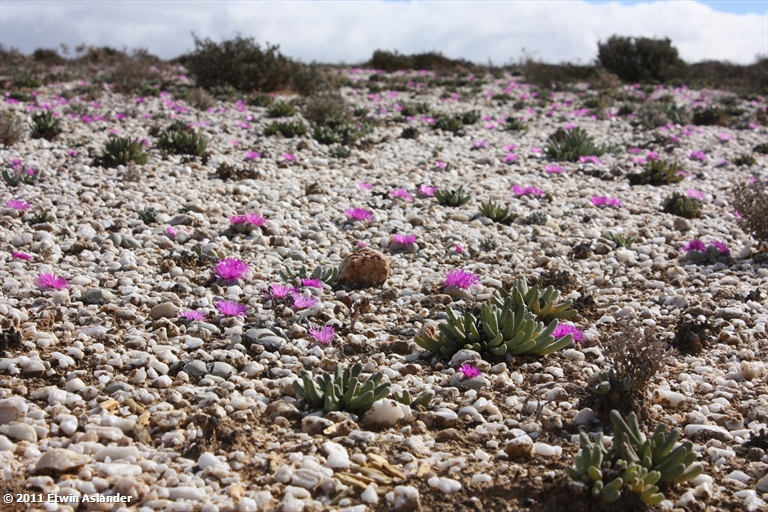
Argyroderma blooming in habitat, photo by Etwin Aslander
See Also

Argyroderma delaetii at CactusArt.Biz 

Court, Doreen. (Third Edition, 2010). Succulent Flora of Southern Africa. Cape Town, South Africa: Struik Publishers. ISBN-10: 1770075879. ISBN-13: 978-1770075870.

Sunday, December 11, 2011

SUCCULENT SUNDAY: Monadenium ellenbeckii fma caulopodium: lime-green octopus decked for the holidays

Today was my local plant club's holiday party. I was called on to offer a little light entertainment, so I sang my favorite secular holiday tune: "You're A Mean One, Mr. Grinch".

For the plant exchange—an ingenious ceremony, really—I contributed a rather handsome little Agave xylonocantha. Handsome... but not showy. I confess with a little chagrin that my little A xylonocantha was not an early pick from the table; larger, more beautiful plants were on offer.

As soon as my plant finally was picked up from the table, it was my turn to pick my choice of the remaining plants. Luckily this terrific little Monadenium ellenbeckii forma caulopodium was still available. It took me a while to notice it, but the more I focused on it, the more it grew on me. Pretty!... and well grown.

It even bears a slight resemblance to Himself, that very villainous Grinch.

See also
San Gabriel Cactus and Succulent Society, my local club

LinkWithin

Blog Widget by LinkWithin