Showing posts with label Eastern Caribbean. Show all posts

Monday, January 17, 2022

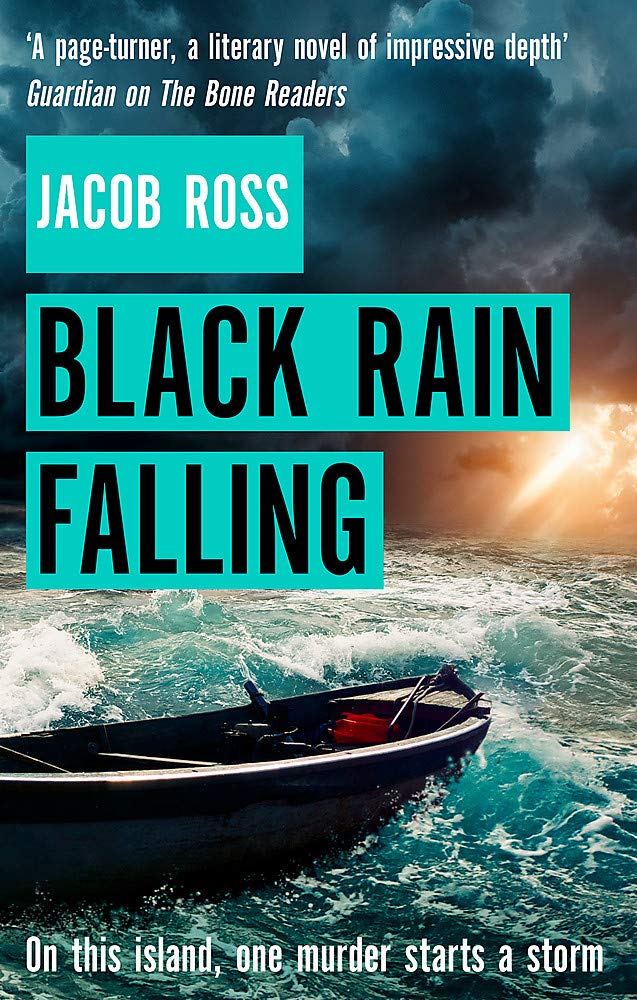
BOOK REVIEW: Black Rain Falling (DC Digger, #2) by Jacob Ross

Black Rain Falling is the sequel to The Bone Readers, the first two in what is apparently designed to be four novels collectively called the Camaho Quartet. These books were written by Jacob Ross, a Grenadian-born, award-winning author and poet who lives in Britain. They are police procedural novels, crime thrillers set on an island called Camaho (which is clearly a thinly disguised version of Grenada) featuring two psychologically wounded and ethically complicated detective protagonists in Detective Constables Michael "Digger" Digson and Kathleen Stanislaus and a host of colorful supporting characters and criminals.

The Bone Readers was memorable for its immersive depiction of island life while unspooling a captivating, suspenseful story and introducing the reader to DC Digger and DC Stanislaus (who is invariably referred to as "Miss Stanislaus" in the text). In Black Rain Falling, the stakes are higher for our main characters as Miss Stanislaus fatally shoots in self defense a known criminal (who was also responsible for her traumatic sexual assault when she was a teenager) and Digger’s frenemy/boss/rival Malan Greaves uses this incident to make his move to advance his career while crippling Digger’s and Stanislaus’ by dissolving the special criminal justice investigative unit that all three of them worked at by having them all transferred to a new police station where he gets a promotion and Digger's enemies get easier access to him.

However, the central mystery in Black Rain Falling is about how the international drug trade is bringing increased crime that is beginning to impact life on Camaho and neighboring islands. For example, there is a shockingly violent killing, an abundance of “hush money” and an incredibly powerful speedboat that can be used to ferry drugs between multiple islands. Digger and Stanislaus are trying to puzzle out the connections between these pieces before the corrupt powers that be strip them of their ability to do anything about it. 

By the end of the book both Digger and Stanislaus, who have complicated and ambivalent relationships with their fathers will need to rely on familial connections in order to persevere and ultimately succeed.

As with the first book, the reader can come for the compelling characters and thrilling plot but what really sets these mysteries apart from others in the genre is 1) Digger and Stanislaus’ chemistry and teamwork; 2) the verisimilitude of the depiction of the island setting of Camaho (Grenada) and 3) Ross' lyrical writing; the author is an award-winning poet and it shows in the quality of the prose.

Overall, Black Rain Falling is another excellent police procedural written by Jacob Ross, set in the Caribbean with two compelling characters in DC Digger and Miss Stanislaus whom I hope to spend a lot more time with in future installments of the Camaho Quarter.

Title: Black Rain Falling.
Author: 
Jacob Ross.
Format: Kindle.
Length: 432 pages.
Publisher: Mullholland Books.
Date Published: March 5, 2020.
Date Read: December 30, 2021.

GOODREADS RATING: ★★★★  (5.0/5.0).

OVERALL GRADE: A- (3.67/4.0).

PLOT: A-.
IMAGERY: A.
IMPACT: A-.
WRITING: A.

Thursday, February 18, 2021

BOOK REVIEW: The Bone Readers (DC Digger, #1) by Jacob Ross

The Bone Readers by Jacob Ross is an excellent book in the police-procedural, murder-mystery genre with a great hook: it’s set on a small (fictional) island adjacent to Trinidad and Barbados called Camaho.

The author was born and raised in Grenada (which is an actual island adjacent to Trinidad and Barbados), and so was I! Ross uses his familiarity and comfort with the culture, geography, and language of the West Indies to infuse this story with the verisimilitude of Island life. You can almost taste the mangoes, smell the spicy curry and feel the bumps when driving on the badly paved roads!

The main character in The Bone Readers is Michael “Digger” Digson. In the great tradition of the crime fiction protagonists, Digger has a troubled past and a complex personality. Early on in the book we discover that he’s an “outside child” (illegitimate son) of an important man on the island, the Commissioner of Police. This is a curious coincidence because it is only through some unusual circumstances that Digger became a police officer himself. Basically, he was bullied into doing it by DC Chilman, an apparently alcoholic detective very near retirement with an eye for rudderless youths with the potential and talent to become excellent police officers. Digger lives by himself, in the house left to him by his grandmother, who has raised him since the awful day a little over a decade ago when Digger was a little boy that his mom kissed him and said “Don’t worry, Sweetman, I home a lil later” and never came home again. In fact, her body was never even found but it’s pretty clear she was killed as part of a public protest in 1999 that was violently settled by the police at the time. Part of the reason why Digger agreed to become a cop was so that he could research his mother’s death and disappearance and discover the details of the role his father may have played in her death. 

If you think Digger has a complex personality, Ross is just getting started. Many of the other players in the novel, such as DC Chilman, Miss Stanislaus and Malan Greaves are also fascinating characters. They all have complicated relationships with each other and oftentimes with Digger. As I have said in reviewing other books, a key factor in the assessment of the quality of a genre book is the multifaceted nature of how the secondary characters are depicted. Since most police procedurals are very similar what makes the reader continue to enjoy them and read volume after volume in a long-running genre series are the changes and developments that happen to characters that readers can identify with and/or care about. From this perspective, The Bone Readers is very high-quality first entry in what I hope becomes an extended series of books.

DC Chilman, we discover, has an outside child himself and a surprisingly durable relationship with the Minister of Justice (the most important law enforcement official in the island country.) Malan Greaves is Digger’s boss; he takes over supervision of the Camaho police station after Chilman retires. Malan has his own foibles. He’s married but he’s constantly flirting (and more) with women and is all too eager to engage in violence himself to “keep the peace.” This behavior is forced to change with the arrival of Miss Stanislaus on the force, who wants nothing to do with Malan but notes everything he does. Miss Stanislaus is brilliant, with Sherlockian powers of observation and deduction. But she also has a troubled past, and although her professional and personal disdain for Malan is quite clear, her attitude towards Digger is quite different. They make an intriguing couple, and an effective team.

The pace of the story is somewhat languorous, like the pace of island life, but this doesn’t make The Bone Readers any less compelling. The central mysteries are all “cold cases’ of varying degree. There’s the case of who killed Digger’s mom, which he is obsessed with, for obvious reasons. There’s also the case of a missing young man named Nathan that Chilman is obsessed with and makes Digger (and Malan) promise to focus on after their mentor retires. In their investigation of Nathan’s disappearance, Miss Stanislaus and Digger find out about someone else who has disappeared, a teenaged girl named Alice, and Miss Stanislaus notices that something is very peculiar about the church that Nathan and Alice attended. The Old Hope Spiritual Baptist Church is run by a charismatic (and corpulent) preacher named Deacon Bello who happens to be a spiritual advisor to several very important men on the island, including, it turns out, the Minister of Justice. Miss Stanislaus joins the church and starts living at their compound with several other women and young children, any of whom appear to be curiously similar. However things get hectic when Deacon Bello ends up dead at the hands of Miss Stanislaus using an official police weapon she had never been officially issued.

Overall, reading The Bone Readers, especially for someone who was born (and partially raised) in the Caribbean, is a rare treat and joyful experience. The book shimmies and shimmers with the sounds and sights of the islands. The dialogue has the rhythms and cadences of island patois, and the descriptions reflect the unique look and feel of "home." There are so many familiar (and unfamiliar) little details that produce feelings of nostalgia and pride (“Yes! This is how we/they do!”) which is a very unusual experience for me to have while reading crime fiction, but a welcome one. I think even for people without a familial connection to the islands, the novelty of the setting and the richness of the story will be attractive and compelling. I hope to spend A LOT more time with Miss Stanislaus and DC Digger solving mysteries on Camaho, so I hope Mr. Ross writes more books, and soon!

Title: The Bone Readers.
Author: 
Jacob Ross.
Kindle: 273 pages.
Publisher:
 Peepal Tree Press.
Date Published: November 8, 2016.
Date Read: February 3, 2021

GOODREADS RATING: ★★★★  (5.0/5.0).

OVERALL GRADE: A/A+ (4.17/4.0).

PLOT: A.
IMAGERY: A+.
IMPACT: A+.
WRITING: A.

Saturday, December 21, 2013

QUEER QUOTE: Barbados PM Responds Positively To LGBT Rights Inquiry


After the horrible news of the passage of virulently anti-gay legislation in Uganda that could lead to sentences of life imprisonment for homosexuality, it is nice to report some good news from another part of the world where people of color predominate.

In Barbados, which is one of the 77 countries which still has a sodomy law, Prime Minister Freundel J. Stewart has responded respectfully and positively to an inquiry from one of the few organized LGBT advocacy groups in the Eastern Caribbean country.

The following excerpt from his letter is today's Queer Quote:
I wish to acknowledge receipt of your letter dated November 5, 2013. In your letter,  you requested that Barbados, in the person of the Prime Minister, seek at this year's Commonwealth Heads of Government Meeting in Sri Lanka to have included in the agenda of the Meeting in 2015, an item on the rights of gays, lesbians, bisexuals and transgendered persons. 
Although matters of State did not allow me to attend the 2013 meeting, I wish to assure you that Barbados remains committed to the principles enshrined in the Universal Declaration of Human Rights and will continue, therefore, to lend its voice to calls both regional and international fora for the elimination of all forms of discrimination including discrimination against persons of differing sexual orientation.
This response is reminiscent of the letter the Prime Minister of Trinidad and Tobago wrote last year expressing her "personal" support for LGBT rights.

Anyway, it is indicative of a modicum of progress on LGBT rights in the region. Perhaps in addition to calling for an end to discrimination in regional and international fora PM Stewart might want to insure that his country has enacted legal prohibitions against LGBT discrimination.

Jus' sayin'.

Thursday, December 12, 2013

77 Countries Around The World Have Laws Banning Homosexuality


The disappointing news that India had recriminalized sodomy through a  court ruling yesterday has drawn attention to the fact that there are now 77 countries around the world that have laws banning homosexuality around the world. India's unfortunate action alone impacted over 1/6th of the world's population!

Business Insider has the full list of countries where LGB people are de facto (and de jure) criminals:
  1. Afghanistan
  2. Algeria
  3. Angola
  4. Antigua and Barbuda
  5. Bangladesh
  6. Barbados
  7. Belize
  8. Bhutan
  9. Botswana
  10. Brunei
  11. Burundi
  12. Cameroon
  13. Comoros
  14. Dominica
  15. Egypt
  16. Eritrea
  17. Ethiopia
  18. Gambia
  19. Ghana
  20. Grenada
  21. Guinea
  22. Guyana
  23. India
  24. Iran
  25. Jamaica
  26. Kenya
  27. Kiribati
  28. Kuwait
  29. Lebanon
  30. Liberia
  31. Libya
  32. Malawi
  33. Malaysia
  34. Maldives
  35. Mauritania
  36. Mauritius
  37. Morocco
  38. Mozambique
  39. Myanmar
  40. Namibia
  41. Nauru
  42. Nigeria
  43. Oman
  44. Pakistan
  45. Palau
  46. Papua New Guinea
  47. Qatar
  48. Samoa
  49. São Tomé and Principe
  50. Saudi Arabia
  51. Senegal
  52. Seychelles
  53. Sierra Leone
  54. Singapore
  55. Solomon Islands
  56. Somalia
  57. South Sudan
  58. Sri Lanka
  59. St Kitts & Nevis
  60. St Lucia
  61. St Vincent & the Grenadines
  62. Sudan
  63. Swaziland
  64. Syria
  65. Tanzania
  66. Togo
  67. Tonga
  68. Trinidad and Tobago
  69. Tunisia
  70. Turkmenistan
  71. Tuvalu
  72. Uganda
  73. United Arab Emirates
  74. Uzbekistan
  75. Yemen
  76. Zambia
  77. Zimbabwe


Hat/tip to Joe.My.God

Monday, October 07, 2013

QUEER QUOTE: Same-Sex Marriages In Trinidad

The English-speaking Caribbean is somewhat notorious for its outdated policies and attitudes towards LGBT equality, with extant sodomy laws and violent homophobia present in the most prominent of the Caribbean countries like Barbados, Trinidad and Jamaica.

In Trinidad, there is an active discussion about same-sex marriage going on because it was reported  in the media that Trinidadian gay men have been going to the United States to get married and then returning home to the Island to have "lavish" commitment ceremonies celebrating their unions, which are not recognized under Trinidadian law.

Interestingly, in a recent report about same-sex marriage there was a quote from the past Chief Justice of the Trinidadian High Court which was surprisingly approving.
The marriage of a gay couple who exchange wedding vows abroad is not valid locally, former Chief Justice Satnarine Sharma said. Sharma, who once presided over a landmark High Court case on the rights of unmarried persons in relationships, also said in his view the laws in place are “unfair”. He noted that partners in unmarried straight couples are afforded common-law rights but gays in committed relationships are not.  
“A common-law wife who has been living with a man for forty years gets certain rights,” Sharma said. “In a case I presided over, I held that in this country we cannot treat unmarried couples in and unfair manner because the practice is so common here culturally. At the same time, we do not recognise homosexual relations. I am certain the principles of a common-law relationship would not be applied because it would be regarded as being against public policy.”  
Sharma continued, “It might be unfair but it has not been tested in the courts. Some people might find the idea of two men living together for their entire lives repugnant. Some people might not. I personally do not find it repugnant. If a man wants to do that with another man that is their business. That is the nature of love, which does not offend. Such a love does not hurt anyone.” 
That last sentiment from Mr. Sharma is today's Queer Quote! Let us hope that it is a reflection of a thaw in the cold shoulder that LGBT people have been receiving in the Caribbean. As a person who considers himself of Caribbean descent (having been born in Grenada) I intend to follow advances on LGBT rights in the area closely.

LinkWithin

Blog Widget by LinkWithin