Showing posts with label diversity. Show all posts

Thursday, December 23, 2021

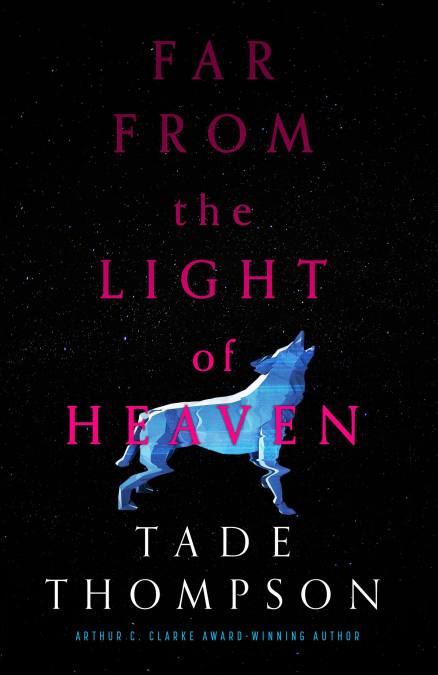
BOOK REVIEW: Far from the Light of Heaven by Tade Thompson


Far From The Light of Heaven is my first Tade Thompson book. Thompson is a Nigerian-British author best known for the Wormwood Trilogy featuring the books Rosewater, The Rosewater Insurrection, and The Rosewater Redemption. He won the Arthur C. Clarke award for Rosewater in 2019. This series is set in Nigeria in 2066 and is often referred to as part of the Afrofuturism movement.  I have only read a few Afrofuturism books (Lagoon by Nnedi Okrafor comes to mind) but so far I haven’t been that impressed (although I am a big fan of N.K. Jemisin's award-winning Broken Earth trilogy). The description of Rosewater as genre mashup of “Africanfuturism, cyberpunk, biopunk, Afropunk, zombie-shocker, [and] love story” is not appealing to me so I haven’t read it yet, although I do typically like genre mash-ups (like the apocalyptic police procedural The Last Policeman by Ben Winters). However, Far From The Light of Heaven piqued my interest when I saw the official summary for the book:


The colony ship Ragtime docks in the Lagos system, having traveled light-years to bring one thousand sleeping souls to a new home among the stars. But when first mate Michelle Campion rouses, she discovers some of the sleepers will never wake.


Answering Campion’s distress call, investigator Rasheed Fin is tasked with finding out who is responsible for these deaths. Soon a sinister mystery unfolds aboard the gigantic vessel, one that will have repercussions for the entire system—from the scheming politicians of Lagos station, to the colony planet Bloodroot, to other far-flung systems, and indeed to Earth itself.


From this we can tell that there are two primary protagonists in the story, Rasheed and Michelle (Shell). We are introduced to Shell first, meeting her on Earth even before she boards the Ragtime as first mate. Surprisingly, even though we meet Rasheed last, I identified with him more than her.


Their motivations for why they act the way they do in response to the extraordinary series of events that befall them on Ragtime are very different from each other. Shell is responsible for the welfare of the one thousand passengers in suspended animation and is shattered that 31 of them have been dismembered on her watch (even though it happened while she was sleeping for 10 years like all the other humans on the spaceship). But (somewhat bizarrely, I think) she insists on maintaining her exercise and sleep schedule while the ship (especially the A.I. which is the actual captain of Ragtime) becomes more and more erratic. In the end, I didn’t really connect with Shell or empathize with her. Rasheed on the other hand we are introduced to with the context that he has a problematic incident in his past that involves an on-duty killing of an alien. He's the assigned investigator to the incident on the ship and he’s single mindedly focused on discovering who committed the murders (even when paying more attention to surviving his time on Ragtime becomes more and more urgent). I was more interested in what happens to him (and his partner Salvo, a humanoid android or Artificial). 


There are other important characters in the book but I don’t want to mention them because to do so would reveal spoilers. However, I will say one strength of the book is the diversity of its characters. As a mystery-science fiction genre mashup, Far From The Light of Heaven works much better as science fiction than as mystery. We do find out who committed the crime(s) but there’s really no way we could have figured it out from the information provided to the reader.


Overall, I am glad that I read Far From The Light of Heaven although I don’t think it’s outstanding or very memorable. That’s fine, not everything has to be a barn burner or award-winning. An entertaining genre novel with a diverse cast and a vision of the far future that is centered around the existence of black people (or people of African descent) is a net good in of itself, in my view.

Title: Far From The Light of Heaven.
Author: 
Tade Thompson.
Format: Kindle.
Length: 385 pages.
Publisher: Orbit.
Date Published: October 26, 2021.
Date Read: December 19, 2021.

GOODREADS RATING: ★★★½☆  (3.5/5.0).

OVERALL GRADE: B+ (3.33/4.0).

PLOT: B+
IMAGERY: B.
IMPACT: B+.
WRITING: A-.

Thursday, April 08, 2021

BOOK REVIEW: The Space Between Worlds by Micaiah Johnson

The Space Between Worlds by Micaiah Johnson is an original, unique debut novel about love, family, identity, destiny, multiple universes, societal collapse, and climate change. It’s in a genre that I would call “science fantasy” since it involves science fiction ideas like travel between worlds and the devastating effects of climate change as well as fantasy tropes like a goddess named Nyame who lives in the space between the worlds and the devolution of human society into multiple task-centered tribes.

The main character in The Space Between Worlds is Cara (usually short for Caramenta), a lesbian from a downtrodden part of the world called Ashtown. Cara is a “traverser,” someone who can travel between the 380 known copies of our Earth that can be accessed in the multiverse using technology which is basically akin to magic. Of course there are an infinite number of alternate Earths but we can only visit this arbitrary number because that’s how many we can detect that “resonate” with ours. Climate change and societal collapse have devastated our Earth so we use our access to these other Earth to supplement our access to resources. Human beings can only travel from one earth to another if on the earth they travel to their doppelgänger is dead. So, people who grow up in circumstances that make their survival very unlikely (i.e. they are most likely dead on the other Earth) are now incredibly valuable. Cara is dead on all but eight other Earths so there’s a lot of traversing that she can do safely from our world to 372 others. This makes her one of the most desirable traversers. The reason Cara is dead on so many Earths is that she’s the daughter of a drug-addicted mom and eventually became the paramour of Adranik, the violent emperor of Ashtown. However on our earth, referred to as Earth 0, Cara lives in the palatial Wiley City and works for the Eldridge Institute, whose brilliant but probably psychotic founder figured out the “technology” to send people between worlds. All we know is that when Cara is in the space between worlds she senses the presence of a godlike figure that traversers call Nyame and  when she wakes up after having travelled (the process involves loses consciousness) she has painful bruises all over her body.

The worlds that Johnson have created in The Space Between Worlds are all impacted by end-stage capitalism (Cara is only a resident of Wiley City because of her employment with Eldridge. She is eligible for citizenship in four years, but if she loses her job before then, she can be deported all the way back to the slum of Ashtown.); rampant climate change (outside of Wiley City, clean food and water are scarce, the air is metallic and on “bright days” the sun is literally strong enough to blind and burn you); and societal collapse (Cara’s adopted family have their own church, there’s another tribe or guild for sex workers called the House, and another for assassins called the Runners).

Ultimately the effectiveness of the book is sourced in the issues it raises about identity, family and love. Cara is in love with her “handler,” a woman named Dell who is a citizen of Wiley City and who has long-standing family wealth. The sinusoidal nature of the strength and intimacy of their relationship is one of the central plot points. Another main idea, which is likely to be more compelling to some readers, is the question of identity and the nature of destiny. Cara interacts with various people in her life on multiple versions of Earth, so she’s aware that her destiny is/was often death, but she also sees the same people, even those she thinks she knows intimately, having subtly different (and sometimes disturbingly similar) personalities and possibilities on different Earths. This raises the centrality of the question of destiny: are our futures predestined regardless of minor differences between scenarios? Do relationships outlast different realities? Can people change?

In some sense, The Space Between Worlds is a time-travel story. It’s contours and have the same shape of coexisting possibilities branching off from a single reality as a result of the ability to travel between Earths existing in the multiverse. Overall, I was impressed by the complexity and creativity of this debut more then I was enthralled by it. Apart from Cara, I didn’t really care what happened to the other characters, even the ones that Cara cared about. I feel like the setting of the story was more interesting than the plot occurring in it and I would have been interested in another plot imbedded in the same world (or worlds). As a science fiction book it barely works due to the paucity of included scientific elements. However, as a work of speculative fiction it is very effective, as the questions of how our world could have devolved into Cara’s Earth 0 are compelling. It’s clear that Micaiah Johnson is an author to watch and I will be paying attention to what she writes next.

Title: The Space Between Worlds.
Author: 
Micaiah Johnson.
Format: Kindle.
Format: 322 pages.
Publisher: Del Rey.
Date Published: August 4, 2020.
Date Read: February 20, 2021.

GOODREADS RATING: ★★★★☆  (4.0/5.0).

OVERALL GRADE: B+ (3.33/4.0).

PLOT: B.
IMAGERY: A-.
IMPACT: B+.
WRITING: B+.

Thursday, May 28, 2020

BOOK REVIEW: The Fated Sky (Lady Astronaut, #2) by Mary Robinette Kowal


The Fated Sky is the sequel to a book I mostly enjoyed (The Calculating Stars) but my enjoyment of this Hugo award-winning novel was leavened with some qualms and niggling concerns. While I liked getting to know the main character Elma York and was thrilled with the prominent appearance of mathematical concepts like the Fibonacci series and prime numbers, there always seemed to be “something off” about the ethos of the first book. The premise is very clever: suppose the Space Race started a decade earlier due to an external animating force caused by a cataclysmic event which makes the necessity of humanity colonizing the solar system more urgent because the Earth will become increasingly more inhospitable in the next century. This time shift means that the social tensions based around race and gender that actually happened in our 1960s and 1970s occur in the book’s timeline of the 1950s in the context of the Space Race.

The  main character, Elma York,  is a white Jewish woman who is something of a mathematical savant. She and her husband Nathaniel get jobs with the International Aerospace Coalition (IAC). She becomes a celebrity as the “Lady Astronaut” and thus is given leeway to break barriers and violate cultural mores without repercussions someone of her status would be expected to suffer.

In the first book it was somewhat titillating to see these issues addressed (even awkwardly and somewhat ineptly) in the context of a speculative fiction novel but on further reflection I don’t think the overall result is positive and this becomes increasingly clear in the second book.

The problem for me with both The Calculating Stars  and The Fated Sky is that in most social situations the reader is more aware of the racial or cultural implications than Elma is. This device of Elma’s cluelessness is one that the author uses to demonstrate the illogic of discrimination and animus repeatedly to the reader.

I would argue that while the author uses the device effectively she also repeats and frequently re-inscribes racist and sexist tropes (inadvertently, I think) while trying to illustrate how wrong these are to the reader.

In The Fated Sky there are numerous examples of this problem. For example, Elma is on a ship to Mars with 4 men and 3 women when she finds a (used) condom. Of course she assumes that one of the men (probably the captain, whom she has a very difficult relationship with and is a known philanderer) is forcing himself on one of the other women (both of whom are women of color). It doesn’t even occur to her that it could be evidence of sexual activity between two of the men! But there are numerous problem with this scenario. 1) (why) would 2 (presumably straight) men having sex on a 3-year space journey be using condoms (especially in an era where contraception was basically illegal and HIV/AIDS didn't exist)? 2) why would an allegedly intelligent astronaut not know to not throw a condom away in the toilet and  cause a disruptive plumbing incident? 3) why would the author later kill off one of the gay characters in a freak accident? Does the author not know about the vicious trope of the doomed homosexual who always dies before the end of the story? Despite revealing society’s homophobia through Elma’s cluelessness the author has reproduced it through her treatment of the two male characters who loved (in multiple senses of the word) each other. While it is true by martyring one of the gay characters she raises the profile of the remaining gay character but there's no way to dispel the conclusion that by having a freak fatal accident occur to one of the gay characters is a re-enactment of the "doomed homosexual" trope.

There are (many) other examples of how the author does this in The Fated Sky  with both gender and race (Elma is sometimes quick to notice and call out patriarchal/sexist behavior but then some of her favorite and most lauded activities involve her prowess in the kitchen!) One interesting aspect of the book that is a highlight, is the portrayal of multiple Jewish celebrations (even in space!). The sensitivity by which a minority religion is portrayed is incongruous to how ethnic and racial minorities are depicted. For example, race is the primary fault line in the time being portrayed in the books but as I have said before, the author uses the main character's outsider status to illustrate to the reader how ignorance/unfamiliarity with the lived experience of others can highlight the salience and pervasiveness of racism and sexism. But the problem is that these encounters are only ever presented to the reader through Elma's perspective, which tends to marginalize the agency of the characters who are racial (and ethnic) minorities.

Overall, I was somewhat dubious about reading the second book in the series after reflecting more on the deficiencies of the first (which won the Hugo Award for Best Novel). But the large number and the high average Goodreads ratings of both books convinced me to give it a try despite these misgivings. It's unlikely I will make that mistake with the third book!

Title: The Fated Sky.
Author: Mary Robinette Kowal.
Paperback: 384 pages.
Publisher:
 Tor Books.
Date Published: October 1, 2018.
Date Read: April 21, 2020.

GOODREADS RATING: 
★★★☆☆  (3.0/5.0).

OVERALL GRADE: B+ (3.33/4.0).

PLOT: A-.
IMAGERY: B+.
IMPACT: B-.
WRITING: A-.

Thursday, August 01, 2019

BOOK REVIEW: The Calculating Stars by Mary Robinette Kowal


The Calculating Stars is the (Nebula and Locus) award-winning book by Mary Robinette Kowal about the 1950s space race but set in an alternate time line where a meteor hits the Earth near Chesapeake Bay, decimates the Eastern Seaboard and catalyzes the greenhouse effect, endangering human survival on Earth. The main character of The Calculating Stars is Elma York, a former WASP pilot and mathematical genius who ends up working as a “computer” for the International Aerospace Coalition, the space agency responsible for managing the race to the stars. The impetus behind the space race in this timeline is not a US-Russia proxy war but a race to get to space in order to save humanity before Earth becomes inhabitable due to the runaway global warming caused by the long range after-effects of the asteroid collision.

One shorthand view of the book is that it is a version of “The Right Stuff” and "Hidden Figures" told from the perspective of a Jewish white woman who is obsessed with going into space but has to combat social conservatism and sexist mores in order to achieve her dream.

Elma is a fun character and it was fun to spend time with her. She has a pretty severe undiagnosed anxiety disorder; during episodes where this manifests as panic attacks  she tries to get through by doing mathematics. For example, she will mentally recite the beginning of the list of prime numbers or the Fibonacci series or do 4-digit arithmetic operations in her head. Her husband, who is also Jewish, an engineer and eventually becomes her boss at the IAC, helps to distract/calm her down at times of stress (such as facing a room full of reporters). Elma becomes internationally known as “the Lady Astronaut” through her advocacy in the media of the idea that women should join the space program. This is an interesting SFnal twist because in real life no one but white men were considered by NASA to become astronauts in the equivalent time period (1950s to 1970s).

Although I like Elma I’m not as enamored with the book as a whole. Of course, as a black gay mathematics professor I’m in favor of the author’s depiction of the regimented/stilted mores of the 1950s and the spotlight she puts on the senselessness of the discrimination based on gender (and race) that occur(red) in such an important science/engineering enterprise. I also love the fact the story is infused with a love of mathematics and science/engineering and was intrigued that  it is told from the perspective of a white Jewish woman. But for me there was a spark missing which prevented me from emotionally connecting with the story. I think this may be because ultimately the stakes are too low. Since this is an alternate timeline (caused by a very unlikely event) the overarching idea that the space race needs to be successful earlier in time in order to save humanity is not that compelling. And even though I want Elma to succeed at breaking barriers, she will/would be fine even if she didn’t go into space. So although I enjoyed spending time with Elma and love the centering of math and science in the rare context of a SFnal book which pays close attention to identity and positionality of its characters,  I ended somewhat unmoved by  The Calculating Stars. I admire it more than I adore it. However, I will most likely read the sequels in the trilogy because I am curious about how the story ends, and when that occurs with any first book, it must be considered a success. There's a reason why it is very likely to win the 2019 Hugo award for Best Novel in addition to its other accolades.

Title: The Calculating Stars (Lady Astronaut, #1).
Author: 
Mary Robinette Kowal.
Paperback: 432 pages.
Publisher:
 Tor Books.
Date Published: July 3, 2018.
Date Read: July 20, 2019.

GOODREADS RATING: 
★★★★☆  (4.0/5.0).

OVERALL GRADE: A- (3.83/4.0).

PLOT: A-.
IMAGERY: A-.
IMPACT: A.
WRITING: A.

Thursday, July 25, 2019

BOOK REVIEW: Storm of Locusts by Rebecca Roanhorse


Storm of Locusts is the second book in the Sixth World series by Rebecca Roanhorse that began with the award-winning Trail of Lightning (see my review). The Sixth World is set in a future/alternate United States where more than half of the land mass has been inundated and billions of people worldwide have been killed by an apocalyptic event called The Big Water. Basically everything west of Colorado and east of Kansas is destroyed in the deluge. So the setting for our story is Dinétah, the land of the Diné (which is the word in Navajo used to describe the Native American tribe).

One of the primary features of Storm of Locusts is the pleasant feeling of reading a book with characters and world building which are new and unfamiliar. After all, the book can be classified as an action-packed, post-apocalyptic, urban fantasy with a powerful, violent woman of color protagonist. You don’t read one of those days every day!

The main character is Maggie Hoskins, a 20-something Navajo woman who is known as the Godslayer and Monsterslayer for some of the events that happened in Trail of Lightning. The sequel Storm of Locusts is both better and worse than the first book, in different aspects. There’s more action in Storm of Locusts and far less of the emotional energy is centered on the romantic tension between Maggie and the handsome stranger Kai Arviso which loomed large in Trail of Lightning. To me, these were good things. However, some of the things I was disappointed by in Storm of Locusts were the too-brief appearance of the openly gay, multiracial character from the first book and the fact its problematic pacing was repeated in the second (basically most of the primary plot points in both books are resolved apparently hastily in the concluding 10 pages). I was neutral on the addition of a new, teenaged, gender-nonconforming orphan named Ben in the second book. I liked the fact that Maggie’s emotions are most often connected to Ben and her sudden in loco parentis role as Ben’s protector. However, the story is still muddled with the inclusion of a romantic relationship between two side characters. (Other readers who are more positively disposed to romantic elements might view these aspects as pluses.)

Another strength of Storm of Locusts is the reduction in the presence of gods compared to how visible they were in Trail of Lightning. In the Sixth World, people have “clan powers” which tend to manifest themselves after an extremely traumatic or near-death experience. Maggie‘s powers include super-speed, expert facility with weapons and a killer instinct. Additionally, in the Sixth World various Navajo legends, spirits and gods are walking-about real. I understand that these books are urban fantasy but as an atheist the inclusion of creatures who are actual “goods” and not just people who have god-like powers which may just be really advanced technology always irks me. (This was part of the difficulty I initially had with Robert Jackson Bennett's Divine Cities trilogy but I would argue the supernatural/mystical elements are handled more effectively in those works than they are in the Sixth World books so far.)

Anyway, overall I would say that on balance Storm of Locusts is about as good as Trail of Lightning, and I look forward to reading the still-untitled third book in the Sixth World series when it comes out.

Title: Storm of Locusts.
Author: 
Rebecca Roanhorse.
Paperback: 313  pages.
Publisher:
 Saga Press.
Date Published: April 23, 2019.
Date Read: July 14, 2019.

GOODREADS RATING: 
★★★★☆  (4.0/5.0).

OVERALL GRADE: A- (3.67/4.0).

PLOT: A-.
IMAGERY: A-.
IMPACT: A-.
WRITING: A-.

Tuesday, March 19, 2019

Karen Uhlenbeck Becomes First Woman To Win Abel Prize in Mathematics


Karen Uhlenbeck (formerly of University of Texas at Austin and now at Princeton's Institute for Advanced Study) has become the first woman to win the Abel Prize. The Abel Prize has been awarded since 2003 by the Norwegian Academy of Science and Letters and comes with a check for 6 million Norwegian kroner (about US$700,000).

Uhlenbeck, 76, is cited for her "pioneering achievements in geometric partial differential equations, gauge theory and integrable systems, and for the fundamental impact of her work on analysis, geometry and mathematical physics."

The American Mathematics Society states:
Uhlenbeck is a former MacArthur Fellow, a Fellow of the American Academy of Arts and Sciences, a recipient of the National Medal of Science (2000) and the Steele Prize for Seminal Contribution to Research (2007), and a member of the inaugural class of AMS Fellows. She is the first woman mathematician to be elected to the National Academy of Sciences (1986) and the second woman to give a plenary lecture at the International Congress of Mathematicians (1990—Emmy Noether was the first). In "The Abel Prize Laureate 2019," Uhlenbeck observes that she is a role model but "it’s hard, because what you really need to do is show students how imperfect people can be and still succeed. ... I may be a wonderful mathematician and famous because of it, but I’m also very human.” Uhlenbeck was the Sid W. Richardson Foundation Regents' Chair in Mathematics before retiring from the University of Texas at Austin in 2014, and is now a visiting senior research scholar at Princeton University and a visiting associate at the Institute for Advance Study. See more about her work in the March Notices article, "Karen Uhlenbeck and the Calculus of Variations," by Simon Donaldson,  and on the Abel Prize website, which has the full prize citation, her biography, descriptions of her work, and a video of the announcement of the prize.

Congratulations to Professor Uhlenbeck!

Monday, April 09, 2018

Harvard University Mathematics Department Hires SECOND EVER Female Tenured Full Professor

Harvard University is considered the acme of most things academic, with its 37 billion dollar endowment and its perennial placement at the top of the college rankings. The  Mathematics department at Harvard is not the very best in the country (that distinction usually goes to Princeton University) but it is definitely well-known. The fact that they have been atrocious in the area of doversity for so long is widely known.

This week comes news that things are starting to change at Harvard, as they announced they have hired their second ever tenure female full professor, ending a six-year stint in which they literally had zero tenured female professors (by contrast Princeton has had two senior female math professors for years: Maria Chudnovsky and Sun-Yung Alice Chang).

The Daily Crimson reports:

University of California at Berkeley math professors Lauren K. Williams ’00 and Denis Auroux will join Harvard’s math department as senior faculty at the start of the next academic year, Department Chair Curtis T. McMullen said in an interview last week. 
Auroux has served as a math professor at UC Berkeley since 2009 and has published articles on subjects ranging from “symplectic submanifolds” to “Lefschetz pencils.” Williams, a former math concentrator, won a tenured associate professorship at UC Berkeley in 2013—and a full tenured professor position there in 2016—and has written extensively about cluster algebras and tropical geometry.

As a friend of mine said on Twitter this weekend in commenting on the news. "It's 2018."

Thursday, January 04, 2018

BOOK REVIEW: Artemis by Andy Weir


If you were expecting Artemis to be some follow-on of  the story in Andy Weir's breakthrough debut novel, The Martian except that it is set on the Moon I can disabuse you of that notion right away. The Martian was a pretty good book which was made into a fantastic movie, with an amazing cast (Matt Damon, Jessica Chastain, Michael Pena, Jeff Daniels and Chiwetel Ejiofor) and talented director (Ridley Scott).

Artemis is a very different book, but that's not necessarily a bad thing. And I could see that it is very possible that it could be made into a fantastic movie (or television series). The main character of Artemis is Jasmine "Jazz" Bashara, an emigre from Saudi Arabia who lives in Artemis, the first "city" on the moon (consisting of five pressurized domes with several subterranean levels where roughly 2,000 people work and live). Jazz moved to Artemis with her father at age 6 and is now something of a petty criminal and ne'er-do well who ostensibly is a porter transporting items around Artemis but is actually one of the premier smugglers of contraband items in the city.

Jazz has a friend back on Earth whom she has never met named Kelvin who acts as her supplier. Kelvin happens to work at KSC (Kenyan Space Center) which is the entity that is responsible for the fact there is a budding civilization on the moon. One of the highlights of the book for me was the unspooling of the details of the relationship between Kelvin and Jazz (as told via email correspondence). Another highlight was the diversity of the cast of characters that we come into contact with as the story unfolds. They are all shapes and sizes and colors.

Jazz has a number of curious relationships with other people on Artemis, such as her Dad, who she stopped living with around age 16 (and who obviously disapproves of her near-criminal lifestyle), her ex-boyfriend Dale and Artemis' sole police officer, Rudy. Since the city is essentially a very small town, Jazz is even familiar with the "town mayor," Administrator Fidelis Ngugi, a Black woman who happens to be the most important person on the moon.

The plot of Artemis revolves around a technological advancement which could upend Artemis' economic equilibrium and provides Jazz with an opportunity to make a LOT of money. But, as usual, if something looks too good to be true, it often is and Jazz finds this out when her erstwhile business partner shows up dead. At this point the story jumps into overdrive and gets very exciting as Jazz is on the run for her life while she tries to figure out the mystery of who will kill to make a killing on the future development of the Moon.

Overall, this book is another example of Weir's breezy, very readable writing style set in a near-future setting based around future space exploration which is chock full of science and engineering details that will appeal to most hard science fiction aficionados.

Title: Artemis.
Author: 
Andy Weir.
Paperback: 322 pages.
Publisher:
 Crown/Archetype.
Date Published: November 14, 2017.
Date Read: December 31, 2017.

GOODREADS RATING: 
★★★½☆  (3.5/5.0).

OVERALL GRADE: B+/A- (3.41/4.0).

PLOT: A-.
IMAGERY: B+.
IMPACT: B.
WRITING: A-.

Saturday, August 12, 2017

2017 HUGO AWARDS: Jemisin Wins 2nd (Consecutive) Best Novel Award


The 2017 Hugo awards were announced last night in Helsinki, Finland and N.K. Jemisin, last year's winner for The Fifth Season, won again, for the second book in her Broken Earth trilogy, The Obelisk Gate. Jemisin, who last year became the first African-American woman to win the prestigious best novel award, has now won two in a row, the first time that has happened since Lois McMastr Bujold won in 1991 and 1992 for two entries in her longrunning Vorkosigian saga, which won the new category of Best Series this year.

When I looked at the Hugo award nominations for Best Novel this year, my choice for the win would have been Cixin Liu's At Death's End. However, Jemisin would probably be my second choice, so this is a happy result! Jemisin was not present in Helsinki to accept her award, so my childhood friend, Dr. Karen Lord, a successful science fiction writer in her own right, accepted on her behalf (see picture at the top of this post)!

Book 3 in Jemisin's Broken Earth series, The Stone Sky, will be released on Tuesday August 15.

Friday, June 16, 2017

CELEBRITY FRIDAY: Crystal Griner and David Bailey

Since the names Crystal Griner and David Bailey are on people's lips this week they are today's Celebrity Friday entry. These are the names of the two Capitol Police officers who were with U.S. Representative Steve Scalise (R-Louisiana) on Wednesday when a gunman opened up fire on a group of Republican congressmen practicing for the annual baseball game.

Joe My God reports that Griner is openly lesbian and has a wife. She is credited with firing the fatal shot that stopped the assailant and was visited at the hotel by President Trump.

Others have noted the irony that two not only did Black people saved the life of Majority Whip Scalise who has been linked to white supremacists, but that it was a lesbian with a wife who arguably saved his life even though Scalise is strongly opposed to same-sex marriage and full citizenship for LGBT people like Griner.

Thursday, December 08, 2016

BOOK REVIEW: The Obelisk Gate by N.K. Jemisin


The Obelisk Gate is the sequel to the Hugo award-winning The Fifth Season, which overall I found difficult but after forcing myself to finish, I admired for its complexity, diversity and cleverness. 

Sadly, The Obelisk Gate still has the complexity (or a better term might by lexical density) of its predecessor but both the diversity of characters and cleverness of execution appears to be diminished in  this sequel to The Fifth Season. However, both books do share the ineffable quality of a good read: compulsion of the reader to want to find out what happens next.

One of the main problems I think the books have is that they are set in a world that Jemisin calls "The Broken Earth" where basically calamity is commonplace and even expected. Disasters happen, on the regular. These apocalyptic events are called seasons in Jemisin's creation. (I'm still not exactly sure what a "FIFTH season" is because there appear to be a lot more than four seasons described in the must-read appendix.) 

Instead of the story being told from three perspectives and time lines that eventually are weaved together (like in The Fifth Season), in The Obelisk Gate we primarily follow two distinct tales, one about what happens to Essun and the other about what happens to Nassun, her daughter. The first book was nominally about tracing Essun's journey as she searches for Nassun. The second book reveals what happened when Nassun fled with her murderous father Jija to a place he thought could/would/should cure his daughter so that he wouldn't murder her (for being a despicable orogene like her mother). 

Jemisin does an excellent job of depicting the ambivalence of contradictory feelings between Jija and Nassun, who both hate and love each other. It's not really too much of a surprise to discover that by the end of The Obelisk Gate  only one of them survives. (And it's not that much of a surprise to discover which one it is.) Jemisin also shows contradictory emotions in the relationship between Scaffa, who is a guardian (someone who hunts/controls/kills orogenes) and Nassun, who is an orogene (someone who can redirect the kinetic, thermal, potential energy of the world).

Orogenes are despised and feared in the society the Broken Earth trilogy is set in but also are very powerful and useful to have around when the world is falling apart. Essun, who is a very, very powerful orogene, gets a first-hand look at how a society can simultaneously desire and despise an entire class of people (orogenes) as she hunkers down in Castrima, an amazing underground cavern where she is relatively safe from the desolation and havoc occurring on land.

This all sounds interesting, and it is (in theory), but I wanted more story in The Obelisk Gate. There's not a lot that actually happens, to either Nassun or Essun, and because they are physically located only two locales for most of the book there is much less world-building in this book than there was in the first. (This is not too surprising since it is the middle book of a trilogy after all.) 

Happily, this time I did not have as much trouble finishing the book (there was never a time I thought "I really don't want to read this anymore") but there are passages of Jemisin's writing that still make my eyes itch. I am pretty sure that I will read the third book, mostly for completeness and out of a dutiful sense of finishing what you start (and yes, that curiosity of wanting to find out what happens next).

Overall, The Obelisk Gate is a worthy sequel to the award-winning The Fifth Season as it continues the story of what happens to Essun as her world falls apart after a personal and actual cataclysmic event.

Title: The Obelisk Gate (The Broken Earth, #2)
Author: 
N.K. Jemisin.
Paperback: 448 pages.
Publisher:
 Orbit.
Date Published: August 18, 2016.
Date Read: November 16, 2016.

GOODREADS RATING: 3.5 STARS.

OVERALL GRADE: A- (3.67/4.0).
PLOT: A-.
IMAGERY: A-.
IMPACT: B+.
WRITING: A.

Sunday, August 21, 2016

N.K. Jemisin Becomes First Black Woman To Win Hugo Award for Best Novel


Wow! Defying the predictions of most prognosticators, Nora Jemisin was the surprise winner of the 2016 Hugo Award for Best Novel for The Fifth Season. (See my A-/B+ review.) By my reckoning, Jemisin win is historic for multiple reasons: she's the first Black woman (and first Black person) to win science fiction's most prestigious award. And she did it after two years of intense debate (most of it online) in the speculative fiction community about the meaning, necessity and importance of diversity in the speculative fiction community. She also did it despite being nominated for (and losing) the Nebula award to Naomi Novik's Uprooted.

This is how The Guardian placed this year's awards in context with the ongoing Puppy fracas:
As in previous years, there had been attempts by two separate groups, the Sad Puppies and the Rabid Puppies, to “game” the awards in favour of their preferred slates of works. Both groups claimed that science fiction has become dominated by a liberal, left-wing bias. 
The Hugos are voted on by those who purchase an attending or supporting membership to either the current or previous Worldcon events. Eligible voters can tick the “No Award” box if they don’t agree with any of the shortlisted works, a tool which has been used to block out Puppies recommendations previously. In 2015, five No Awards were given, including for the prestigious best novella and best short story categories; an unprecedented number, as No Award had only been presented as many times in the entire history of the prize, which began in 1953. 
In contrast, this year there were only two No Awards, in the smaller best related work and best fan-cast categories.
However one of the key ironies (also noted by The Guardian) in Jemisin's win is that the primary rabble-rouser of the rabid puppies, Theodore Beale (a.k.a. Vox Day) had previously been expelled from the Science Fiction Writers Association after he called Jemisin an "educated but ignorant savage." The group of Rabid Puppies has been trying to destroy the Hugo awards, by exerting undue influence over the nominations and winners but Jemisin becoming the first Black woman to win the top prize is the clearest repudiation of the recent actions of Beale's Puppies to "make science fiction great again."

Monday, April 04, 2016

Fusion Adds Data To #GayMediaSoWhite Discussion


John Walker at the Fusion website analyzed the covers of the magazines of The Advocate, Out and Attitude and produced this useful infographic (seen above) to determine the (lack of) diversity represented therein.

The summary of the data is:
Representation on the cover of Out, June 2011 – May 2016In the past five years, Out has featured 78 people on the cover of its magazine. That figure includes repeat appearances by Dustin Lance Black, Ellen Page, Neil Patrick Harris, and Zachary Quinto. The mag’s upcoming May 2016 issue will feature Troye Sivan, a gay white singer-songwriter from Australia who rose to fame on YouTube.
Sixty-six of those 78 people have been white (85%), and 31 of those white people have been queer and/or trans (40%). Twelve of the 74 individuals featured on Out‘s covers have been people of color (15%), and eight of them have been queer people of color (10%).Representation on the cover of The Advocate, June 2011 – May 2016I was unable to locate cover imagery for the following six issues of The Advocate: September 2011, December 2011, January 2012, May 2012, June 2012, and July 2012. But of the covers I was able to find—excluding the publication’s more abstract, evocative cover art—at least 35 people have been featured on the cover of The Advocate over the past five years.At least 10 of those 35 individuals have been people of color (29%). At least eight of those 35 were queer and/or transgender people of color (23%). That includes the mag’s April/May 2016 cover star DeRay Mckesson, a prominent figure in the Black Lives Matter movement who is currently running for mayor of Baltimore.Representation on the cover of Attitude, June 2011 – May 2016Attitude has featured 111 people on its covers in the past five years. That tally includes repeat appearances by Adam Lambert, Dan Osborne, Gareth Thomas, Greg Rutherford, Harry Judd, James Hill, Thom Evans, and Tom Daley.
One-hundred and six of those 111 have been men (95%). The remaining five were women (5%), all of whom were white. (This gender disparity isn’t as troubling as it could be, given that—unlike The Advocate and Out—Attitude is specifically marketed to gay men.) No trans or nonbinary people of any race or ethnicity have been featured on the cover of Attitude in that timeframe.
The overall data can be summarized with this final quote of the data analysis is:
By the way, of the 21 people who appeared on more than one of these magazine covers, we found that seven (33%) are straight white cisgender men. Two of the repeat cover stars are queer women (10%), Lady Gaga and Ellen Page. Just one (5%), Michael Sam—who has been seen on both Out and Attitude—is a person of color.
Discuss!

Thursday, June 11, 2015

BOOK REVIEW: Ancillary Sword by Ann Leckie


Ann Leckie's debut novel Ancillary Justice was the most celebrated work of science fiction of the year, perhaps the most heralded science fiction debut of all time. In 2014 Ancillary Justice won the Nebula, Hugo, British Science Fiction, Locus and Arthur C. Clarke awards. The follow-up is titled Ancillary Sword and has already won the British Science Fiction award and it has been nominated for the Locus, Hugo and Nebula awards. Surprisingly, it was not nominated for the Clarke award. UPDATE: we now know Annihilation won the 2015 Nebula Award for Best Novel so Ann Leckie will not be able to win back-to-back Hugo-Nebula awards.

There's some debate about whether Ancillary Sword  is better than Ancillary Justice or not. According to Goodreads, Ancillary Sword (4.07/5 from 6,693 ratings) is better than Ancillary Justice (3.97/5 from 18,595 ratings), while on Amazon.com Ancillary Justice (4.2/5 from 694 reviews) is better than Ancillary Sword (4.1/5 from 209 reviews). I suspect that as more people rate Ancillary Sword its ratings will start to slide. Then again, most sequels rate higher than the original because usually only people who liked the original even bother reading the sequel, so it is likely there is a selection bias at work.

While I liked Ancillary Justice quite a bit (A- on my 4.0 scale) I don't think it quite lives up to its reputation as "the most celebrated debut science fiction novel of all time." It's good, but it did not blow my mind. Ancillary Justice famously has a unique depiction of gender in a technologically advanced, galaxy-spanning civilization: The Radchaai do not see gender as a significant identifying characteristic (like eye or hair color) and the narrator Breq in Ancillary Justice uses the feminine pronoun to describe every character (both male and female) in the book.

Ancillary Sword follows Breq's story that started in Ancillary Justice. Breq used to be the artificial intelligence running the space ship Justice of Toren with thousands of partially cybernetic humans, called ancillaries, under her direct control but in the events that transpired before Ancillary Justice Breq had been reduced to existence in a single ancillary body. Ancillary Justice is about revealing Breq's backstory and following her as she navigates a complex, dangerous path to redemption.

In Ancillary Sword Breq has now been given the captaincy of her own ship, Mercy of Kalr and a mission to check out what is going on at a remote section of Radchaai space called Athoek Station. Athoek is near the border with the region of space known to be occupied by the secretive alien race known as the Presger.

The story told n Ancillary Sword is not as compelling to me as the one in Ancillary Justice. This time Breq seems to meander between various sub-plots that involve characters that I did not really feel invested in caring about. There's definitely a point about two-thirds through the book where I felt a lull and almost considered abandoning the book but I didn't out of respect for the author (and the first book). I'm glad that I persevered because the book ends strongly, with multiple exciting action scenes reminiscent of Ancillary Justice.

Overall, I'm glad that I read Ancillary Sword and think that it is a decent follow-up to the brilliant Ancillary Justice. I am anxiously looking forward to buying and reading Ancillary Mercy when it comes out later this year to see how Breq's story continues and whether Leckie can conclude the Imperial Radch trilogy successfully.

Title: Ancillary Sword.
Author: 
Ann Leckie.
Paperback: 400 pages.
Publisher:
 Orbit.
Date Published: October 7, 2014.
Date Read: January 8, 2015.

OVERALL GRADE: A-/B+ (3.5/4.0).
PLOT: A-.
IMAGERY: A-.
IMPACT: B+.
WRITING: A-.

Thursday, March 26, 2015

Victory Fund Names Black Lesbian As Executive Director


The Gay and Lesbian Victory Fund, the national LGBT organization devoted to increasing the number of openly LGBT people as elected and appointed officials nationwide announced today that they were naming Aisha Moodie-Mills as executive director and chief operating officer of the $4-million-dollar organization. This means that Moodie-Mills will become the first Black Lesbian to head the Victory Fund, and one of the very few LGBT people of color ever to head a national LGBT organization.
Moodie-Mills comes to Victory from the Center for American Progress, where she served as a senior fellow and director of the FIRE Initiative that explores the intersections of race, class, and sexuality. She has worked as a political advisor, private-sector liaison, and fundraiser to more than 50 members of Congress, including six senators and the Congressional Black Caucus. Before joining American Progress, she was the president of Synergy Strategy Group, a boutique fundraising and political consulting firm where she raised millions of dollars for candidates and advocacy organizations.Moodie-Mills also made headlines as a key strategist and spokesperson for the campaign to bring marriage equality to the District of Columbia, where she and her wife Danielle were among the first same-sex couples to receive a marriage license.Her work and publications have been featured in a variety of media outlets, including The Atlantic, Black Enterprise, The Washington Post, Essence, Politico, Ebony, The Huffington Post, and Uptown Magazine, and she also appears regularly as a political commentator on MSNBC.
Congratulations! Amazing in 2015 we are still having historic firsts happening, huh?

Wednesday, January 07, 2015

114th Congress Begins: 80% White, 80% Male, 92% Christian (Representative of America? NO!)

Via Talking Points Memo comes this excellent infographic visualizing the (lack of) diversity in the 535 Members of the United States Congress who are supposed to represent the 320 million people who live in this country. Most of the diversity that does exist in Congress comes from the Democrats, not the Republicans.

Specifically:
There are a total of 81 minorities that are Democrats in both houses combined and 16 that are Republicans, according to data from CQ. The 114th Congress also has 79 Democratic women and 29 Republican women, also according to CQ. 
Of the 188 Democrats in the newly sworn-in House of Representatives, 78 are minorities, according to CQ. Despite the rise of new stars like Rep. Mia Love (UT, pictured above) just 12 of the 246 Republicans in the House majority are minorities. In the Senate, percentages are slightly better for Republicans. There are four Republican senators who are racial minorities and 3 Democrats who are racial minorities. 
By gender, there are 65 House Democrats who are women and 23 women are on the other side of the aisle, according to CQ. That leaves 123 Democratic men and 223 Republican men. In the Senate, there are 14 Democratic women and a record six Republican women leaving 30 Democratic men plus another two Independents who caucus with Democrats and 48 Republican men.
However, the Washington Post points out that it is in the area of religious representation that the Congress does the worst. There is only 0.2% representation (i.e. 1 member) who declares themselves to have no religious affiliation while 20% of Americans declare that they are affiliated with no specific religion.

LinkWithin

Blog Widget by LinkWithin