Showing posts with label books 2022. Show all posts

Thursday, April 13, 2023

BOOK REVIEW: Atlas Alone (Planetfall, #4) by Emma Newman

Atlas Alone is the fourth book in the Planetfall series written by Emma Newman. This unusual speculative fiction series is set in a near future where humanity has launched colony ships to the stars and technological advances have transformed human society in many ways, not all for the good. The series of books in the Planetfall universe are Planetfall (2015), After Atlas (2016), Before Mars (2018), and Atlas Alone (2019). Interestingly, the author says that the books can be read in any order, because the stories in each are only loosely linked to each other, although events do occur in line with the publication order. 

I chose to read After Atlas first because it is a police procedural set in an advanced technological future. One of my favorite thigs is reading genre mashups, and murder-mystery combined with science fiction technothriller is right up my alley. (See my A review of After Atlas.) 

The story in Atlas Alone takes place after the events of After Atlas but while many of the characters are in both books, their prominence changes. In After Atlas the protagonist and source of most of the first-person perspectives was Carlos Moreno, who is a detective working for the "gov-corp" (government-corporation) of  Norope (i.e. Northern Europe). Moreno is tasked with finding out who was responsible for the death of Alejandro Casales, the founder of The Circle, a religious cult formed after the departure of the Pathfinder mission to "find God" in orbit around a distant star (these events are depicted in Planetfall). Carlos' best friend is Dee, a fellow immersive gamer who understands and appreciates his personality quirks.

However in Atlas Alone, Dee is the main character. She, Carlos and Travis (another legacy character from After Atlas) are on Atlas 2, are on a spaceship headed towards the same star that the Pathfinder mission sailed to in the first Atlas when people start dying on the ship, apparently while connected to augmented reality gear. Dee has recently been given access to an advanced AR system on the ship so she can participate in an ongoing virtual reality competition with some of the most important people on the ship. As Dee does so she begins to find out more of the secrets behind the ship with the help of a mysterious person who doesn't appear on the manifest and seems to also have unfettered access to the ship's systems. The story comes to a surprising (and somewhat violent) end which resolves most of the questions raised in Atlas Alone but does lead to more questions about the future of the Atlas 2 mission, hopefully to be addressed in future books in the Planetfall series.

Overall, I didn't enjoy Atlas Alone as much as I had After Atlas. The first reason is that despite superficial similarities (there are dead bodies in both, a whodunnit plot thread, and an advanced technological setting) they aren't really the same genre of book. Atlas Alone isn't really a police procedural/murder mystery like After Atlas, it's more of a psychological thriller. We spend a lot (maybe too much?) time in Dee's consciousness as she grapples with some of the more serious ramifications of the some of the events at the end of After Atlas. Secondly, the commentary on corporate/capitalistic overreach that was a significant feature of After Atlas is simply not as pungent or salient in the later book.

I think I will eventually read the other two books, Planetfall and Before Mars in the series. The books tend to be relatively short (under 400 pages), peopled with a diverse cast of characters and often include interesting/thought-provoking questions. For people who are anxious to spend more time in the Planetfall universe, Newman is releasing a brief collection (161 pages) of 10 short stories called Before, After, Alone which are set there.

Title: Atlas Alone (Planetfall, #4).
Author: 
Emma Newman.
Format: Kindle.
Length: 336 pages.
Publisher: Gollancz.
Date Published: April 16, 2019.
Date Read: January 22, 2023.

GOODREADS RATING: ★★ (4.0/5.0).

OVERALL GRADE: A/A- (3.83/4.0).

PLOT: A.
IMAGERY: A-.
IMPACT: A-.
WRITING: A.

Thursday, February 09, 2023

BOOK REVIEW: Nighthawking (DS Adam Tyler, #2) by Russ Thomas

Nighthawking is the second book in the Detective Sergeant Adam Tyler series written by Russ Thomas. These British police procedurals are set in South Yorkshire, where the openly gay protagonist DS Tyler is a member of the Cold Case Review Unit (CCRU) of the Sheffield Police.

Nighthawking is set about a year after the events that transpired at the end of Firewatching. DS Tyler is working with (formerly PC) now DC Mina Rabbani on a cold case involving the disappearance of a young boy when the body of an unknown young Asian woman with ancient Roman gold coins over her eyes is discovered on the grounds of the Sheffield Botanical Gardens by a nighthawker, someone who uses metal detectors to seek out buried and hidden items of value on public lands.

DS Tyler is busy with and distracted by his obsessive investigation into a personally significant cold case: his own police detective father's suspicious death two decades ago when Tyler was a teenager. It thus falls to Mina to try and solve a case which is much more complicated than it first appears.

As with the first book in the series, the primary appeal of the story is seeing first hand how Tyler and Mina, both outsiders in the police force due to race, gender and sexual orientation, go about their jobs as police officers trying to solve crimes. In Nighthawking, there's less depiction of Tyler’s gayness but there’s more depiction of Mina’s intelligence and I’d say that’s a net positive. That being said, it’s a lot rarer to have an openly gay police detective than it is to have a smart female police detective in these genre books so I hope that the author doesn't shy away from depicting his protagonist's sexuality in future books, just as one would expect it to show up as one aspect of a heterosexual character’s life.

Another similarity Nighthawking has with Firewatching is the complexity of the plot, along with a veiled depiction of events from the perspective of the perpetrator. In Firewatching there were curious blog posts describing the work of a serial arsonist as intertextual elements between chapters. In Nighthawking we get brief reports from nighthawkers summarizing the results of their forays and searches. Both times we eventually realize that these elements are providing clues about the identity of the perpetrator.

There are many plots in Nighthawking. Tyler finds a lead which may lead to more information about his father’s death, and he also ends up cracking the cold case of the disappearance of the young boy, mostly inadvertently, as Rabbani does most of the work to identify the dead girl and whoever killed her. Of course, other dead bodies and near-fatal incidents also appear in the book along the way before we get a surprising resolution to the book’s primary mystery. The final scene of the book is a stunner; it presents the reader with new information about Tyler’s father’s death that will surely reverberate in the next book in the series, Cold Reckoning.

Title: Nighthawking (DS Adam Tyler, #2).
Author: 
Russ Thomas.
Format: Hardcover.
Length: 384 pages.
Publisher: G.P. Putnam's Sons.
Date Published: February 23, 2021.
Date Read: December 21, 2022.

GOODREADS RATING: ★★  (5.0/5.0).

OVERALL GRADE: A- (3.67/4.0).

PLOT: A-.
IMAGERY: A-.
IMPACT: A-.
WRITING: A-.

Thursday, January 26, 2023

BOOK REVIEW: Firewatching (DS Adam Tyler, #1) by Russ Thomas


Firewatching is the first book in the Detective Sergeant Adam Tyler series written by Russ Thomas. This British police procedural is set in Sheffield (South Yorkshire) where the openly gay protagonist of the books is a member of the Cold Case Review Team. In the begining of Firewatching a body is discovered after a fire broke out during renovations of the country estate of dodgy financier Gerald Cartwright who had disappeared six years before. DS Tyler convinces his boss (and godmother!) DCI Diane Jordan to let him work the case even though it's now decidedly much more high profile than his typical cold case. When he does so, Tyler neglects to point out that he hooked up with Cartwright’s handsome 21-year-old son Oscar the night before the discovery of the body. Despite his own uncertain status on the force due to his sexual orientation and his policeman father’s suspicious death years before when he worked with DCI Jordan, DS Tyler nevertheless uses what pull he does have to get a fellow outsider, feisty Muslim Detective Constable Amina Rabbani seconded to him, and together they work with Tyler’s frenemy Detective Inspector John Doggett and the preternaturally lazy Detective Sergeant Guy Daley to try and discover how and why an unknown person sealed someone else inside the house and left them to die. 

Of course, as with most mystery novels, there’s more than just one puzzle to solve and in a small village almost everyone can (and probably should) be considered a suspect. In the case of Firewatching, the fire that led to the discovery of the body is just one of several recent suspicious fire events that seem to have clear connections to Gerald Cartwright. 

The strengths of Firewatching lie in the characterizations of the main characters. We get first person accounts from both DC Rabbani and DS Tyler (and often they are thinking about the other) which are both revealing and entertaining. Additionally, there are multiple subplots which are based around events that happened 20 and 40 years before, which demonstrates how the events and crimes of today are often sourced in the past. And then, of course, more bodies (and more fires) start to show up as the plot thickens and the mysteries deepen.

Eventually, DS Tyler does solve the main case of how the body got to be found in the Cartwright mansion as well as who's setting fires around Sheffield. Along the way he meets a handsome, very muscular firefighter who also happens to be Black, so in addition to the tension of “will they or won't they (have sex)” is the question of “is he or isn’t he a suspect?” As I have said before, the strength of a detective series is often in the supporting characters, and their relationship to the main character/protagonist. Here those relationships are intriguingly complex, and involve issues that are not often discussed in the British police procedural genre: homophobia/racism/xenophobia/sexism in policing, lingering effects of traumatic events from childhood, and work/life balance. If the two existing sequels, Nighthawking (2021) and Cold Reckoning (2022), are even half as well-written as Firewatching I look forward to reading them and hopefully many more after that!

Title: Firewatching (DS Adam Tyler, #1).
Author: 
Russ Thomas.
Format: Kindle.
Length: 365pages.
Publisher: G.P. Putnam's' Sons.
Date Published: February 25, 2020.
Date Read: December 19, 2022.

GOODREADS RATING: ★★ (5.0/5.0).

OVERALL GRADE: A/A- (3.83/4.0).

PLOT: A.
IMAGERY: A-.
IMPACT: A-.
WRITING: A.

Thursday, December 15, 2022

BOOK REVIEW:The Island by Adrian McKinty


The Island is the latest blockbuster suspense thriller from Adrian McKinty, the author of the best-selling The Chain  and six well-regarded police procedurals with titles based off of Tom Waits lyrics set in Northern Ireland during “The Troubles” era featuring a Protestant cop named Sean Duffy. The Chain is well-known for its killer premise, addictive pacing and plot twists; The Island shares several of these attributes.
The premise of The Island is apparently sourced from an actual incident experienced by McKinty that didn’t go as wildly wrong as what happens in the book: a car accident on a private island a short ferry trip from a major city (Melbourne in this case) where a single family has controlled life (and death) for multiple generations. In McKinty’s real-life version the accident was avoided and no one was harmed, but in the version in The Island a young deaf woman rides her bike suddenly into an oncoming car carrying a vacationing American family of four (a 40-something doctor named Tom, his 20-something second wife Heather and two kids, Olivia, 14 and Owen, 12). The parents, make the fateful decision to leave the scene of the accident in the hope they can resolve whatever consequences occur from the comfort and safety of the mainland. This turns out to be a spectacular bad choice that results in multiple violent deaths.


The Island turns into a suspenseful story of survival as the wife and kids are separated from their husband and father and are literally hunted by the few dozen inhabitants of the island. In such an extreme situation, everyone involved is forced to identify their limits and go beyond them in different ways. Olivia and Owen are recovering from the death of their mom, Tom's first wife and are resentful of Heather, who is much closer to their age then she is to their parents. Heather is still getting used to the idea of being responsible for two teenaged kids at the age of 24 and getting to know her new husband who views the world substantially differently from his perch of privilege and experience. That these emotional undercurrents have to be navigated and resolved while they are trying to escape a life-and-death situation on Dutch Island are the primary narrative fuel of The Island.

McKinty does many things quite well in The IslandFirst, he successfully gets the reader to invest in the fate of the characters. He provides the reader with the internal thoughts of multiple characters and uses this mechanism to help the reader connect emotionally with them, especially Heather. Second, he writes action scenes incredibly compellingly, and there is a LOT of action (and violence) in The Island. Third, he is not afraid to have real consequences for the characters for the decisions they make. Because, there are serious (and life-changing) injuries inflicted on multiple characters, this raises the stakes for the reader in speculating about the possible fates for the character or characters we are invested in knowing what happens to in the end.
That’s not to say The Island is not without flaws. It is so obvious about its intent to be breathlessly suspenseful that at times the plot becomes wildly unrealistic and shamelessly manipulative. But once the reader gives into the breakneck pace of the plot and accepts that The Island is going to be a roller-coaster, the book is an enjoyable bit of fluff (and its quite a quick read at 384 pages).

Apparently The Island is being made into a streaming “television” series for Hulu, which I think will work well. I could see it turned into an addictive suspense drama like Fox’s 24 where every hour/episode ends with a cliffhanger.

Overall, I would recommend The Island to anyone who read and enjoyed The Chain (which according to sales figures, critical acclaim and social media buzz, is a LOT of people!).

Title: The Island
Author: 
Adrian Mckinty.
Format: Hardcover.
Length: 384 pages.
Publisher: Little, Brown.
Date Published: May 17, 2022.
Date Read: November 18, 2022.

GOODREADS RATING: ★★½☆  (3.5/5.0).

OVERALL GRADE: A- (3.67/4.0).

PLOT: A-.
IMAGERY: B+.
IMPACT: A-.
WRITING: A.

Thursday, December 08, 2022

BOOK REVIEW: Upgrade by Blake Crouch


Upgrade by Blake Crouch is the latest book from the author of other technothrillers such as  Recursion and Dark Matter.  I think I have read enough Crouch novels by now to notice a common theme: the main character is usually a straight white guy with a family who finds himself in an extraordinary situation (typically involving a technological advance that seems like or actually is science fiction) that he has to resolve through ingenuity and taking decisive (sometimes violent) action. Below I will provide evidence for my view by summarizing the three Crouch novels I have read so far.
 In Recursion, the main character is Barry Sutton, a straight white NYPD detective who got divorced after his young daughter was killed in a hit-and-run accident ten years before. Barry learns that the recent increase in FMS (False Memory Syndrome) is a result of a technological advance that allows certain people to reset reality for everyone else; the false memories people are experiencing are really memories of the previous reality which has been erased that somehow are lingering on in their consciousness. Barry has to figure out what he can do to restore reality, and decide if he can and should select a reality where his daughter doesn’t die.
In Dark Matter, the main character is a straight white guy named Jason Dessen, a former quantum mechanics scientist and physics college professor who has a wife Daniela and a baby son Charlie. One day Jason regains consciousness while stumbling out of a metal cube. He realizes that he is in an alternate universe where 15 years ago the alternate version of Jason (which he calls Jason2) decided NOT to marry Daniela and instead pursued his quantum mechanics research and ended up creating a device (the metal cube) that allows people to jump between parallel universes. Jason2 has swapped places with Jason in order to explore what his life would have been like if he had pursued Daniela instead of research. Jason has to figure out how to get his life back from a more ruthless version of himself, Jason2.
In Upgrade, the main character is Logan Ramsay, a straight white guy married to a female history professor who teaches at American University in Washington, DC and has a tween daughter who regularly beats him in their daily chess game. Logan works for the GPA (Gene Protection Agency), a federal agency tasked with enforcing the Gene Protection Act, which outlawed all gene manipulation and research in the United States. The GPA also authorizes universal, invasive  surveillance of all U.S. citizens in order to enforce the ban on gene research and resulted in the incarceration of most biotech scientists. The legislation is a(n over)reaction to “The Great Starvation,” a cataclysmic event that was triggered by the release of genetically modified locusts in China by Logan's mother Miriam Ramsay in order to try to improve rice production a decade before the events in Upgrade. Miriam Ramsay was well known as a brilliant scientist and one of the richest people in the world before her experiment resulted in the starvation deaths of hundreds of millions of people around the world. Logan’s mother killed herself soon after the magnitude of her mistake became clear and Logan went to jail for multiple years for his minor role in the event (as an assistant). During a routine raid to find a rogue geneticist Logan is infected with some biochemical agent which after a few weeks he realizes has upgraded and altered his genome, giving him all sorts of enhanced abilities like increased concentration and mental acuity, thicker bones, and speed and agility. Of course the GPA outlaws all gene modification so when the extent of his abilities becomes clear Logan is kidnapped by his own co-workers and taken to a secret site where they can observe him and monitor his changing body. He gets busted out of the secret prison by someone who has very similar upgraded abilities to him; this turns out to be his sister Kara. 
This somewhat brief summary of the beginning of Upgrade may seem like it contains spoilers but really this is just the initial setup to the main plot of the book and leaves several questions for the reader. Such as, who designed this upgrade? What will it mean for the future of society if it is effective, especially a society where gene enhancement is so prohibited and everyone’s actions are monitored so closely? Could Logan's mom be involved somehow?
One of the main features of Crouch’s writing is that the action is literally fast and furious. He’s also pretty skillful at depicting his main character in a sympathetic manner so that the reader is caught up in the circumstances that affect him and wants to see how or if he can figure out a way to survive them. This is especially the case in Upgrade, which like all the other books by Crouch I’ve read really seems like a spec script for a Hollywood blockbuster or hit streaming TV show. There’s thought-provoking technology in a world similar but significantly altered from our own, with a sympathetic protagonist facing long odds to succeed. What’s not to like? One quibble I have is that these books are starting to seem a little too glib and formulaic. As I’ve pointed out above, Crouch’s last three books have noticeable similarities. However, they have also all been huge hits and big bestsellers. The guy is good at what he does! There's also something plastic/uncompelling about his main character's relationships with other people. In Upgrade, Logan has a complicated (and slightly bizarre) relationship with his sister Kara. It's like Crouch's characters have facsimiles of relationships, not the real thing. I think this is what causes me to not connect emotionally with his books. (But they are still a delight to read.)
Overall, I’d recommend Upgrade to anyone who has read and enjoyed Dark Matter and/or Recursion.

Title: Upgrade.
Author: 
Blake Crouch.
Format: Hardcover.
Length: 352 pages.
Publisher: Ballantine Books.
Date Published: July 12, 2022.
Date Read: November 23, 2022.

GOODREADS RATING: ★★½☆  (3.5/5.0).

OVERALL GRADE: B+ (3.3/4.0).

PLOT: A-.
IMAGERY: B+.
IMPACT: B.
WRITING: B+.

Wednesday, November 30, 2022

BOOK REVIEW: The Shattered Skies (The Cruel Stars, #2) by John Birmingham


The Shattered Skies by John Birmingham is the second book in the space opera science fiction trilogy called the Cruel Stars. Birmingham has summarized the Cruel Stars trilogy as “Space Nazis invade and try to ruin everything, everywhere, all over the galaxy.” I quite enjoyed reading the first book in the series The Cruel Stars earlier this year and as soon as I finished it I wanted to read the next one in the series and was quite happy to see that it was available. Sadly, the third book in the series is not scheduled to come out until next year. Middle books in trilogies have a reputation for disappointing the reader but in this case The Shattered Skies bucks the trend and continues the story begun in The Cruel Stars in a way that is as exciting, entertaining and engrossing as the first book.
In addition to the five main characters from The Cruel Stars, Lucinda Chase, Frazer McLennan, Sephina L’trel, Princess Alessia and Booker, The Shattered Skies introduces two new POV characters in Captain Anders Revell, an aide-de-camp of a high-ranking Sturm military leader who is investigating the surprising defeat that befell the Sturm in the first book, and Sub-commandant Domi Surprarto, a underling suddenly promoted to captain of the Javan Navy ship Makassar after the Sturm malware turns the top brass into mindless zombies.
The Shattered Skies has the same frenetic action, snarky humor, political intrigue and social commentary of  The Cruel Stars. Additionally, the author uses the addition of the new characters to provide a more nuanced view about the two warring sides in the Sturm-Volume war. In the first book, we are basically introduced to the Sturm as galaxy-invading ideological zealots who want to kill everyone who is not a “pure human” if they have had any technological or genetic modifications. And so our assumption is that the people opposing the Sturm are the good guys. However, by giving us Revell’s POV we see that he is quite passionate about his belief that he’s fighting for the “good” side and we see that the Sturm are providing aid and comfort to people (like Lucinda’s father) who have been abused and exploited in a debtors prison planet that they liberated. The fact that the "good guys" support a system where debtors prisons are a real thing begins to raise niggling doubts about the righteousness of their cause. Also, by getting Suprarto’s POV we see that some of the “Allies” on the good guys’ team (like the Javan Army and the Yulin-Irawaddy Collective) have problematic characteristics (they’re extremely hierarchical, rife with corruption and selfish and self-centered). This makes for a more interesting read because as the stakes of the military conflicts go up, the reader starts to more seriously question who they want to win this battle. Which vision for civilization do we really want to prevail? The Sturm's neo-Luddite view of unaltered "natural" humanity? Or the competing corporate capitalist view where single families can own entire planets and control the lives of every sentient being on their "property"? How should the choice be decided? That the Cruel Stars books even raises these questions puts it above most other books in the military sci-fi/space opera genre.
Overall, The Shattered Skies is an excellent space opera, with interesting characters, well-depicted action sequences, neat technology and an exciting plot. Hopefully, the story will all be resolved in the third and final book of the trilogy, expected in summer 2023 (currently I have seen two proposed titles on the internet, The Forever Dead and The Empty Heavens). Whatever it’s called, this book will be on my must-read list!

Title: The Shattered Skies (The Cruel Stars, #2).
Author: 
John Birmingham.
Format: Kindle.
Length: 432 pages.
Publisher: Del Rey Books.
Date Published: January 11, 2022.
Date Read: October 24, 2022.

GOODREADS RATING: ★★★★½☆  (4.5/5.0).

OVERALL GRADE: A- (3.67/4.0).

PLOT: B+.
IMAGERY: A-.
IMPACT: A-.
WRITING: A.

Wednesday, November 23, 2022

BOOK REVIEW: The Cruel Star (The Cruel Stars, #1) by John Birmingham


The Cruel Stars by John Birmingham is the first book in a space opera science fiction trilogy with the same name. Birmingham has summarized the Cruel Stars trilogy as “Space Nazis invade and try to ruin everything, everywhere, all over the galaxy.” This is the first book by this author I have read; I did so because a machine learning algorithm recommended The Cruel Stars to me because I have either read, bought or borrowed related/similar books (like The Expanse books by James S.A. Corey and The Final Architecture trilogy by Adrian Tchaikovsky) that led the computer program to extrapolate that I would also enjoy this one. And you know what, the code was right, people, because I completely loved reading The Cruel Stars!
The structure of the book will be quite familiar to regular readers of fantasy and science fiction. The story is told via chapters from the perspective of different characters, similar to the structure of George R.R. Martin’s The Song of Ice and Fire and James S.A. Corey’s The Expanse. The five main characters of the The Cruel Stars are Lucinda Chase, a newly minted war hero who gets a field promotion to captain of her ship when the enemy’s sneak attack decapitates the senior leadership of the entire Armadalen military; Frazer McLennan, a foul-mouthed military genius from Scotland turned archaeologist who killed millions of Earth citizens in order to save billions by almost entirely wiping out an invading  army over 700 years ago and by miraculous advances in medicine is still alive (but decrepit); Sephina L’trel, a foul-mouthed lesbian space pirate who leads a small team of violent mercenaries burning to get revenge on the people who killed their loved ones; Princess Alessia Szu Suri sur Montanblanc ul Haq, the 12-year-old scion of an incredibly rich and powerful family who owns and rules the entire planet of Montrachet as well as a galaxy-spanning financial empire; and Corporal Booker3-212162-930-Infantry, a human being who has downloaded his mind into software as a member of a belief system called The Source. 
Each of these characters gets their own POV chapters as the story progresses, demonstrating their importance to the plot. However my favorite character in The Cruel Stars is not one of these previously mentioned POV characters, it’s Herodotus, who is an “Armada-level Intellect,” which means he is a sentient artificial intelligence with technological powers that are near god-like (such as the ability to teleport or “fold space” at will and near-infinite data processing capacity and speed) along with an incredibly snarky attitude. (Come for the god-like computer, stay for the snark!)
In The Cruel Stars we discover that the Sturm, also known as The Human Republic, the group that McLennan defeated hundreds of years ago (and has not been heard of since) has returned to continue their genocidal war against all humans who have modified their bodies with either technological or genetic enhancements. In the beginning of the book we discover that The Sturm has launched a devastating first strike in the form of a successful malware attack that turns any humans with technological implants who were accessing the galactic equivalent of the Internet at the time into brain-devouring zombies. 
The return of The Sturm has life-altering consequences for all of our main characters. Lucinda becomes the captain of her ship, the Defiant, because all the higher ranked officers are struck down by the Sturm malware. Alessia becomes the sole living representative of her family, as the few remaining relatives who were not affected by the initial attack were killed in a grisly execution broadcast galaxy wide. McLennan is captured by the Sturm while conducting an archaeological dig at a site the Human Republic considers sacred but is rescued by Herodotus after only some mild torture has occurred. Sephina has a lucrative heist interrupted and then watches the love of her life slaughtered by Sturm weapons hours after the initial attack. The only person who is positively impacted by the return of the Sturm is Booker, who is in prison sentenced to be permanently deleted at the vey moment the malware attack strikes his penal colony. The warden makes a deal to allow Booker to escape and promises to put in a good word with future authorities if Booker uses his military expertise to fight back and save lives on the prison habitat. Booker agrees to the deal, keeps his end of the bargain and escapes into space implanted in the operating system of a huge security robot.
Overall, The Cruel Stars is a fantastically entertaining space opera with lots of action, humor and violence. The characters are compelling and world-building intriguing. It’s reminiscent of the very best work of Peter F. Hamilton; fans of Hamilton should also read (and I am confident will enjoy!) The Cruel Stars.

Title: The Cruel Stars.
Author: 
John Birmingham.
Format: Kindle.
Length: 416 pages.
Publisher: Del Rey.
Date Published: August 20, 2019.
Date Read: October 17, 2022.

GOODREADS RATING: ★★★★½☆  (4.5/5.0).

OVERALL GRADE: A- (3.67/4.0).

PLOT: A-.
IMAGERY: A-.
IMPACT: A-.
WRITING: A-.

Thursday, October 06, 2022

BOOK REVIEW: Eyes of the Void (The Final Architecture, #2) by Adrian Tchaikovsky


Eyes of the Void is the second installment in a space opera trilogy called The Final Architecture written by Adrian Tchaikovsky, one of the most prolific and creative science fiction authors working today. His Children of Time and Children of Ruin are two of my all-time favorite books. I’m looking forward to the release of the third installment in that series called Children of Memory in January 2023. However, until then, I’ve also been enjoying reading the first two books in The Final Architecture series, Shards of Earth and Eyes of the Void. I previously reviewed Shards of Earth and now I will write down some thoughts about Eyes of the Void.


The Final Architect series is set in a Universe where humanity exists as a galactically dispersed diaspora due to an apocalyptic event that occurred less than 80 years ago before the events depicted in Shards of Earth. Earth was one of several human-populated planets that were visited by Architects, huge implacable devices that have the power to manipulate space-time and gravitational forces so that they can convert planets to artistic arrangements of matter, apparently oblivious to the billions of sentient lives they destroy on those planets. When the Architects arrived, humanity had been just one space-faring species among several in the Galaxy, but with the destruction of their homeworld the fracturing of human society into various factions was accelerated and solidified. 


One of Tchaikovsky’s great skills as a writer is his depiction of alien culture, morphology and consciousness in such a way that it seems relatable to the reader, regardless of how unusual or bizarre they appear at first glance. In the Final Architecture books the aliens are quite other-worldly, in multiple senses of the word.


The main characters in the story are Idris Telemmier (an Intermediary, i.e. a human who has been biologically modified to enhance his ability to access unSpace and propel vehicles across vast distances) and Solace (a parthogenetically created soldier who has a complicated history with Idris). Both Solace and Idris had a role in the last battle which ended the Architects' War 50 years ago. In the events of Shards of Earth Idris and Solace start off on different sides of a conflict that is somewhat resolved in a way that leaves them on the same side.


There are several characters other than Idris and Solace in the series, and in Eyes of the Void we get to spend more time with them. These include snarky robot and academic Architect expert Trine; near-indestructible alien-plus-symbiont called a Tothiat whose name is Emmaneth; a (literally) cutthroat lawyer Kris Almier; disabled computer hacker-pilot Olli who incessantly cursed and kicks butt in her powerful scorpion-like exoskeleton; and a bureaucratic spy and double/triple agent named Havaer Mundy. The interactions between these characters are the primary source of the dramatic tension in the book, as they try and find and eventually rescue Idris after he is kidnapped by another alien who wants to use the Intermediary’s power for their own dangerous plot.


By the end of Eyes of the Void, we have learned a lot more about the mysterious Architects as they continue to devour more planets. Idris discovers that they are being forced to do what they do by even more powerful aliens, whom we have yet to meet (and seem absolutely terrifying!!) Presumably, we will find out more about these aliens who are forcing Architects to do their bidding in the third and final book in the trilogy: Lords of Uncreation.

Title: Eyes of the Void.
Author: 
Adrian Tchaikovsky.
Format: Kindle.
Length: 592 pages.
Publisher: Tor.
Date Published: May 3, 2022.
Date Read: June 4, 2022.

GOODREADS RATING: ★★★★☆  (4.0/5.0).

OVERALL GRADE: A- (3.67/4.0).

PLOT: A-.
IMAGERY: A-.
IMPACT: A-.
WRITING: A-.

Sunday, October 02, 2022

BOOK REVIEW: When Will There Be Good News? (Jackson Brodie, #3) by Kate Aktinson


When Will There Be Good News? is the third installment in the immensely popular  British crime detective series written by Kate Atkinson featuring former police detective Jackson Brodie. Atkinson is an interesting and unusual author; although mostly known for her literate novels with exquisite writing and evocative language, she has also dabbled in writing genre fiction, which often gets unfairly labeled as possessing uninspiring prose (although readers of S.A. Cosby's Blacktop Wasteland and Razorblade Tears would beg to differ!) The Jackson Brodie books were adapted into a very popular British TV series called “Case Histories” which ran for two 3-episode series in 2010 and 2011. All of the Brodie books by Atkinson have tens of thousands of ratings on Goodreads with average scores bear 4.0 on a 5-point scale.

Atkinson's first two books featuring Jackson Brodie are Case Histories and One Good Turn. They are very different from each other and from most books in the British crime thriller genre that I am so fond of. They are both so good that I have been trying to extend the time between reading subsequent entries since there are only a total of five books in the series. The Brodie books most definitely need to be read in publication order as events in one book are referred to in another.


The most memorable aspect of the Jackson Brodie books is Jackson himself, of course. He’s a former Edinburgh police detective and Army veteran who in the beginning of the first book has started to do private investigator work. As with most excellent detective novels, he has a complicated past that led him to pursue this line of work. He left home and joined the military at a very young age after his beloved sister Niamh disappeared when he was about 16 and her naked body was found in a nearby river soon afterwards. Niamh’s murder was never solved and Brodie has had a soft spot for damsels in distress ever since.


Another aspect of the Jackson Brodie books that makes them so compelling is Atkinson’s inclusion of many bizarre (and often horrific) crimes, either depicted from the perspective of the perpetrator or survivor. In fact, although Jackson is the primary character in the books, he often does not appear in the story for vast swathes of time, as “secondary” characters are used to advance the plot and also get first-person perspectives. Atkinson’s books can have multiple chapters that depict interactions between two (or more) non-Brodie characters, sometimes depicting serene, domestic scenes or sometimes incredibly horrific crimes. Then one of the central puzzles of the books is to figure out how those events where Brodie was absent as well as the people involved will be connected to Brodie at some point. In the first three books, the majority of these characters have been women, often people who he becomes romantically entangled with, or would like to be. 


In When Will There Be Good News?, the main non-Brodie character is 16-year-old Reggie Chase who “could pass for 16” and is effectively an orphan due to a freak accident that killed her mother while on holiday with another one of her mom’s problematic paramours. When we met Reggie she’s acting as nanny/babysitter for Dr. Joanna Hunter’s newborn baby despite being a minor child herself. Almost half the book is spent with Reggie, which is a lot of fun, because Reggie is a great character! She has a slightly older brother named Billy who has a dodgy moral compass and is clearly a minor criminal of some kind. She’s quite smart but had decided to leave her expensive private school to go out on her own even before her mom died unexpectedly because. When Dr. Hunter and her baby disappear, Reggie takes care of Sadie, Dr. Hunter’s large German Shepherd, and the two become inseparable for much of the book. Eventually Reggie saves Brodie’s life and asks him to help find Dr. Hunter. 


The other non-Brodie character we spend significant time with is Detective Chief Inspector Louise Monroe, who also appeared in One Good Turn. After the events of that book we aren’t surprised that Louise and Jackson are married at the beginning of When Will There Be Good News? but we are surprised that they aren’t married to each other.


By the end of When Will There Be Good News?, all the mysteries are resolved and there are many surprising developments that will have significant life-changing impacts on all of the main characters in the book (Jackson Brodie, Louise Monroe, Reggie Chase, Joanna Hunter). I’m very excited to see what happens in the fourth Jackson Brodie book, Started Early, Took My Dog.

Title: When Will There Be Good News? (Jackson Brodie, #3).
Author: 
Kate Atkinson.
Format: Kindle.
Length: 388 pages.
Publisher: Little, Brown.
Date Published:  September 24, 2008.
Date Read: September 27, 2022.

GOODREADS RATING: ★★  (5.0/5.0).

OVERALL GRADE: A/A- (3.75/4.0).

PLOT: A-.
IMAGERY: A-.
IMPACT: A-.
WRITING: A.

Thursday, August 25, 2022

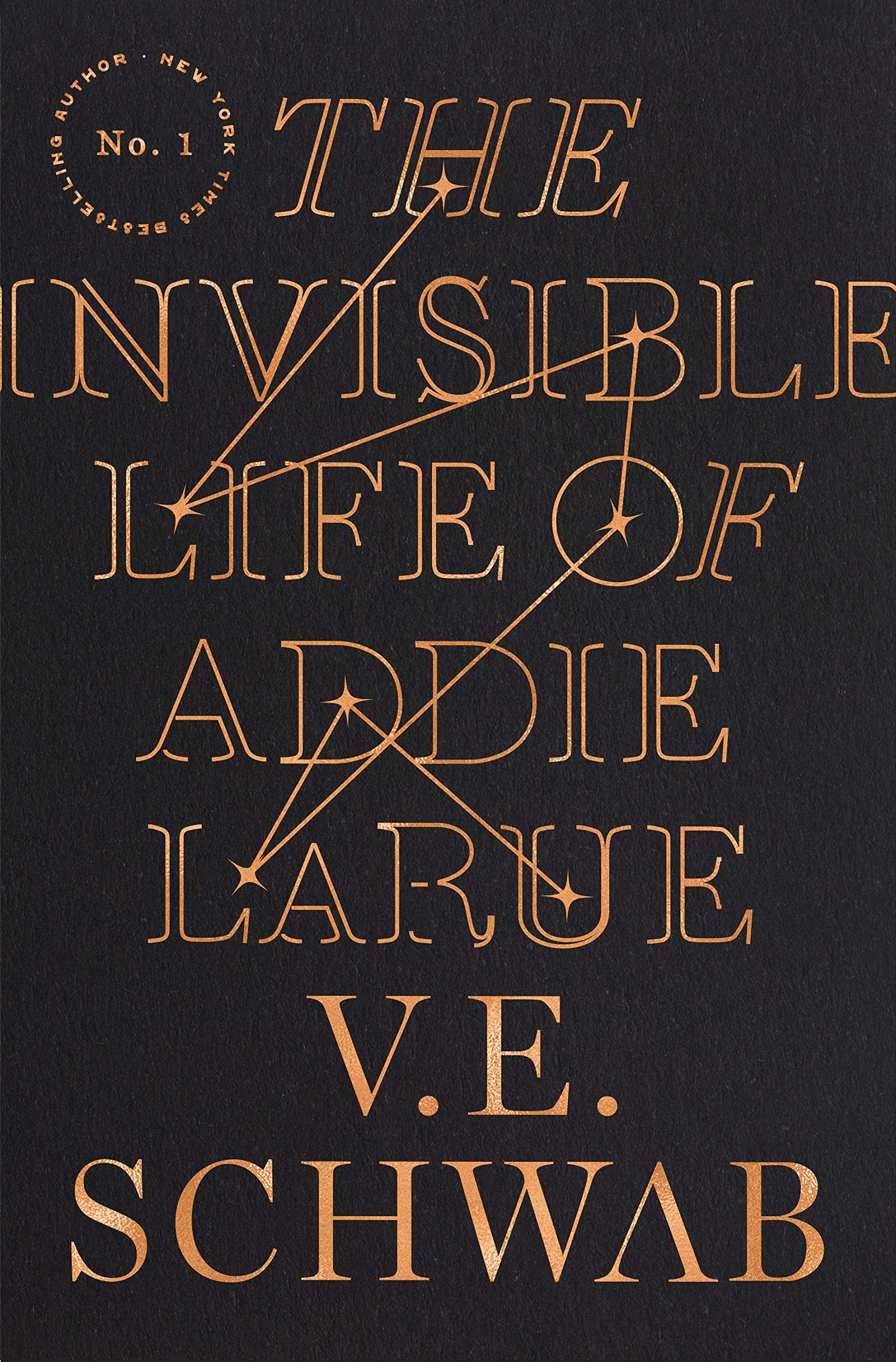
BOOK REVIEW: The Invisible Life of Addie LaRue by V.E. Schwab

The Invisible Life of Addie LaRue is a stand-alone speculative fiction novel by V.E. Schwab, the author of The Shades of Magic trilogy (A Darker Shade of Magic, A Gathering of Shadows, A Conjuring of Light) and other epic fantasy books. The Invisible Life of Addie LaRue is qualitatively different from these works; it’s more reminiscent of books written by Claire North, like The First Fifteen Lives of Harry August, which often have an intriguing supernatural premise or gimmick with a somewhat shallow depiction of the characters. In The Invisible Life of Addie LaRue the main character makes a deal with the devil to live forever but the catch is that it will be an “invisible life.”


Addie LaRue is a young woman in 1714 who asks the gods to save her from an arranged marriage and her wish is granted in that she will never age or die but the conditions are that no one will ever remember her, she can own no property, make new things or leave a mark on the world. The devil, who she comes to know as Luc (short for Lucifer, get it?), appears to her as a dark, handsome stranger on the anniversary of the granting of the wish and asks Addie if she’s ready to give him her soul yet. Addie’s first year living invisibly is incredibly tough as she figures out the rules of her situation and tries to do basic things like eat and find a place to live in a world where everyone forgets her the moment she leaves their sight. However, even though she is now a stranger to her mother and father and everyone she has ever known or will know, Addie declines Luc’s offer to give up (her soul and her life) after one year of living an invisible life.


One interesting aspect of the book for me is when we discover how Addie finds a large loophole in one aspect of the devil's deal. She can make a mark on the world, but she can only do so by serving as a muse and inspiration for works of art created by other people. It turns out that Addie happens to have seven freckles on her face in a distinctive (and memorable) pattern, and although she can’t be remembered, this motif can be, and is, included in multiple works of art (depicted in the pages of the novel) over the next 300 years as we follow Addie’s life.


The fact that we follow Addie for centuries without the basic contours of the story changing is a downside of the impact of The Invisible Life of Addie LaRue for me. The middle section of the book is somewhat repetitive (we see how Addie has lots and lots of one-night stands, how she has repeated "first-time" interactions with people over and over again). I'm sure this repetition is intention, used by the author to give the reader a taste of how repetitive Addie's life is for her as well. The primary change to the routine is that eventually Luc and Addie have a relationship (after all, he is literally the person who she interacts with the most often, and is the only person who can actually remember her after spending any significant amount of time with her). It doesn’t end well, because even though Luc says he’s in love with her after they have basically been together for twenty years, he still asks her for her soul, and Addie suspects the love affair may have just been a ruse to get her to lower her defenses to his desire.


Another weakness in the book is Addie herself. Even though the passage of time has less significance for her and the rules about her having possessions or leaving a mark on the world are difficult challenges to overcome, I was still disturbed by the lack of growth in Addie’s personality. She’s alive for long enough that she has seen astonishing technological advances and societal changes but she doesn’t seem world-weary or wise beyond her (apparently youthful) age. I suspect this may be a specific authorial choice to have Addie’s personality frozen in time as the 23-year-old woman from a small French village she was when she first gained immortality, but this is not made explicit, so the lack of development of Addie’s character over the course of the book is a puzzling and disappointing choice, to me.


The most interesting part of the novel occurs when Addie returns to a downtown Manhattan used bookstore the day after walking out without paying for a book she picked up and the manager remembers her name, something which hadn’t happened in three centuries. It turns out that Henry, the manager of the bookstore, has made his own deal with Luc, one in which he will forfeit his soul after spending one year in which everyone who sees him will see their heart’s greatest desire. Since Addie’s greatest desire is to be remembered, Henry is able to remember her. Of course, Addie immediately becomes infatuated with Henry and soon they become lovers. As things progress, they each start to become more aware of the magic deal the other had made with Luc. For example, Henry introduces his girlfriend to his friends and family and they only remember her existence for brief moments and so he has to do it over and over again. She sees the way people look at Henry and what special treatment he gets because he is literally the embodiment of all they want, at all times.


************************************SPOILER ALERT**********************************

In the end, Addie realizes that since she knows Luc so well, she can make a bargain that may be able to save Henry's soul (and life). She finally agrees to be “his” for as long as Luc is interested in having her at his side, but she draws the line at giving up her soul and she has one condition: Henry must be allowed to remember her and the time they spent together even though he will never see her again. Luc agrees to the deal and then we learn that the book we have been reading, The Invisible Life of Addie LaRue, is the true story of Addie’s life as told to Henry.

************************************SPOILER ALERT**********************************


This was a nice twist at the end, but for me it didn’t make up for other problematic aspects of the book (the slow pacing through the middle 200 pages, the fact Addie never really matures despite hundreds of years of experience and the way it treats both Luc's and Henry’s characters somewhat superficially). I think I’m in a distinct minority in my opinion of the book as “interesting, somewhat slow and flawed, but worth reading” in that it has over 650,000 ratings with an average of over 4.2 in August 2022 and a cinematic adaptation has been announced

Regardless, I encourage you to read the book yourself to see if you agree with my review.

Title: The Invisible Life of Addie LaRue.
Author: V.E. Schwab.
Format: Hardcover.
Length: 444 pages.
Publisher: Tor Books.
Date Published: October 6, 2020.
Date Read: January 29, 2022.

GOODREADS RATING: ★★½☆  (3.5/5.0).

OVERALL GRADE: A-/B+ (3.5/4.0).

PLOT: B+.
IMAGERY: A-.
IMPACT: B+.
WRITING: A-.

LinkWithin

Blog Widget by LinkWithin