Showing posts with label Southern U.S.. Show all posts

Monday, July 31, 2023

BOOK REVIEW: All The Sinners Bleed by S.A. Cosby


All The Sinners Bleed is the third Southern noir book by S.A. Cosby that I have read, after Blacktop Wasteland (2020) and Razorblade Tears (2021). I was very happy to be alerted by the Libby app that this book was available for a 1-week loan; it took me only four days to finish reading it—All The Sinners Bleed was almost impossible to put down once started.

Like the two previous books by Cosby that I have read, All The Sinners Bleed is set in the rural South. This time the protagonist is Titus Crown, who has recently surprised himself—and Charon County in rural Virginia where he was born and raised—to become the first Black man elected Sheriff.

The book begins with a bang (literally!) on the first anniversary of Titus’ election with a shooting (at Jefferson Davis HIgh School!) where a mentally troubled Black man named Lattrell Macdonald shoots and kills a well-regarded science teacher Mr. Spearman and is then himself shot by the (white) members of the sheriff’s department after brandishing a rifle while muttering incoherently about Mr. Spearman’s phone. When Titus investigates what reasons Latrell could possibly have to kill Mr. Spearman he discovers a horrifying secret which roils the entire small town of Charon.

It turns out that Mr. Spearman was a murderous pedophile, who preyed upon young Black children, assisted by Latrell to do so, while wearing masks and costumes. Even the casual description of Mr. Spearman’s acts are nauseating and Titus takes it upon himself to spare his deputies from seeing the worst stuff himself once they get a search warrant to search Spearman’s house. (The people who do watch the videotapes and view the pictures often find themselves vomiting afterwards and questioning their religious faith.) However, it soon becomes clear that there's a third man who is either white or a very light-skinned Black guy who was also involved in the heinous acts that were committed and this person, who Titus calls “The Last Wolf”  is still on the loose.

Cosby does an excellent job of depicting the internal dialogue and philosophical contradictions that Titus has as a black man serving in a public-facing law enforcement role. Many in the community want to see the incidents only in black and white: i.e., “crazy black guy killed beloved white teacher,” or “brave white cop killed armed black guy,” but Titus takes a more nuanced view because he has a job to do: catch this m****f*****. Cosby shows how the procedures and rules the sheriff's office needs to follow don’t allow him to be as forthcoming to the public in as timely a fashion as he (or they) would like. Titus is laser focused on solving the crime and capturing the remaining at-large sicko who has been raping and torturing Black kids to death. But both the black and white concerned citizens of Charon are not happy with the way Titus is doing his job in light of the revelation that Charon County has a resident serial killer on the loose.

An important characteristic of detective novels is not only how interesting the protagonist is but also how well-drawn the supporting characters are done. In the case of All The Sinners Bleed, Titus is a fully realized main character. He lives with his elderly father and has a complicated relationship with him due to his father’s (in)actions after the death of Titus’s mom decades before. These events also complicated Titus’s relationship with his brother, who dealt with his grief by using drugs. Additionally, the reasons that Titus moved back to Charon County in the first place after leaving the FBI are slowly revealed (in intermittent flashbacks) with more details that cast him in a less heroic and more realistic fashion.

Of course, since this is a genre novel, we end up with a lot more violence and dead bodies than the ones from the school shooting scene that began the book. It’s clear that the perpetrator of these atrocities is becoming more unhinged as Titus’s investigation gets closer and closer to revealing who The Last Wolf is. 

In the end, Titus (and the reader) discover who the serial killer is and stops his crime spree, but not until after a number of more horrific acts get perpetrated. Overall, I enjoyed spending time in the company of Titus, but events towards the end of the book and the fact that Cosby appears to not feel the need to build multiple mystery stories around the same character/detective, mean that it is unlikely that he’ll appear in another Cosby southern noir book. Even if that is the case, I definitely hope that we get more books from Cosby!

Title: All The Sinners Bleed.
Author: S.A. Cosby.
Format: Kindle.
Length: 352 pages.
Publisher: Scribner.
Date Published: November 1, 2022.
Date Read: June 27, 2023.

GOODREADS RATING: ★★  (5.0/5.0).

OVERALL GRADE: A (4.0/4.0).

PLOT: A-.
IMAGERY: A.
IMPACT: A+.
WRITING: A.

Saturday, May 14, 2022

BOOK REVIEW: Blacktop Wasteland by S.A. Cosby


Blacktop Wasteland is the second  book by this author that I have read; I first read and enjoyed his Razorblade Tears. Blacktop Wasteland is the more celebrated of the two, having won a slew  of awards (Los Angeles Times, Anthony, Macavity, Barry). After enjoying Razorblade Tears so much I wanted to see if Blacktop Wasteland lived up to the hype. The answer is: yes and no.

Both books are in the same genre of “action-packed crime thrillers set in the rural South.” But that’s the end of the similarities between Razorblade Tears and Blacktop Wasteland. Razorblade Tears is basically a story about two very different fathers who reluctantly are working together to find out and get revenge on whoever shot and killed their gay sons at point blank range. Blacktop Wasteland has one central main character, Beauregard “Bug” Montage that the plot hinges on, with the central narrative tension being fueled by the answer to the question of whether Bug is a “good guy who sometimes commits criminal acts” or “a criminal who sometimes does good things.” By the end of the book I don’t think the reader has a definitive answer to this question besides “it’s complicated.”

Ambiguity or the fusion of positive and negative, or dark and light elements is a recurring theme of both Razorblade Tears and Blacktop Wasteland, with it playing an even larger role in the latter. Bug is a talented getaway driver just like his decades-absent father. He is a car whisperer with the automotive equivalent of what a “green thumb” is for gardeners. He used his ill-gotten gains from his participation in a previous heist to open his own auto repair shop in his very small town in southern Virginia and business is Not Good.

Bug has three kids, two boys  with the woman he lives with in a trailer and a daughter he fathered as a teenager more than two decades ago. His cancer-ridden mother is in an expensive assisted-living facility. Bug has a number of financial obligations and not many legitimate sources of income as an ex-con. So when some former criminal associates approach him for a “slam dunk heist” he is not really in a position to resist the siren call of easy money.  

Blacktop Wasteland is a more cerebral book than one would generally expect from an entry in the crime thriller genre. This may explain the broadness of its appeal and the level of hype it has received. A central element is its depiction of the moral/philosophical dilemma of its protagonist, with the author asking the reader in Blacktop Wasteland “What would you do if you were in Bug’s circumstances, with his past and talents and debts?” Bug basically has two choices: work with some sketchy (probably racist) good old boys to drive a getaway car from a jewelry heist OR try to make a sizable dent on reducing his debts by selling his pride and joy: his father Ant Montage’s car, called the Duster, which he has maintained in perfect condition for decades. Blacktop Wasteland begins with Bug winning a street race in the Duster (and then being part of a scam which results in him not actually bringing any money home that night) and it’s clear the Duster is more than just a car to Bug, it’s the last connection he has to the father he idolizes.

So the primary narrative tension of Blacktop Wasteland is sourced in the decision Bug will make about how he will earn money. But it’s clear that the scales are not evenly weighted on the sides of good and evil. It’s not easy for a Black man who has spent time in jail to earn enough money to support himself and others using only legitimate and above board means, especially when his skills and experience are so useful to successful criminal activity. So, it’s not really a surprise when Bug makes the choice he does. What is surprising are the twists and turns that the plot takes afterwards. There are serious and permanent consequences for lots of the people Bug comes into contact with during the story.

In the end, although I was glad I read Blacktop Wasteland and am also convinced it will make an excellent movie when Hollywood inevitably adapts it for the big screen, it didn’t leave as strong an impression on me as Razorblade Tears did. I think it’s because the two books have very different messages in the end. Frankly, I’m not exactly sure what message Cosby was trying to send with Blacktop Wasteland while the message in Razorblade Tears is very clear (accept your children as they are, don’t try to mold them into something you think they should be!) and one I agree with.

Title: Blacktop Wasteland.

Author: S.A. Cosby.
Format: Kindle.
Length: 305 pages.
Publisher: Flatiron Books.
Date Published: July 14, 2020.
Date Read: April 9, 2022.

GOODREADS RATING: ★★½☆  (4.5/5.0).

OVERALL GRADE: A/A- (3.83/4.0).

PLOT: A.
IMAGERY: A.
IMPACT: A-.
WRITING: A.

Thursday, March 17, 2022

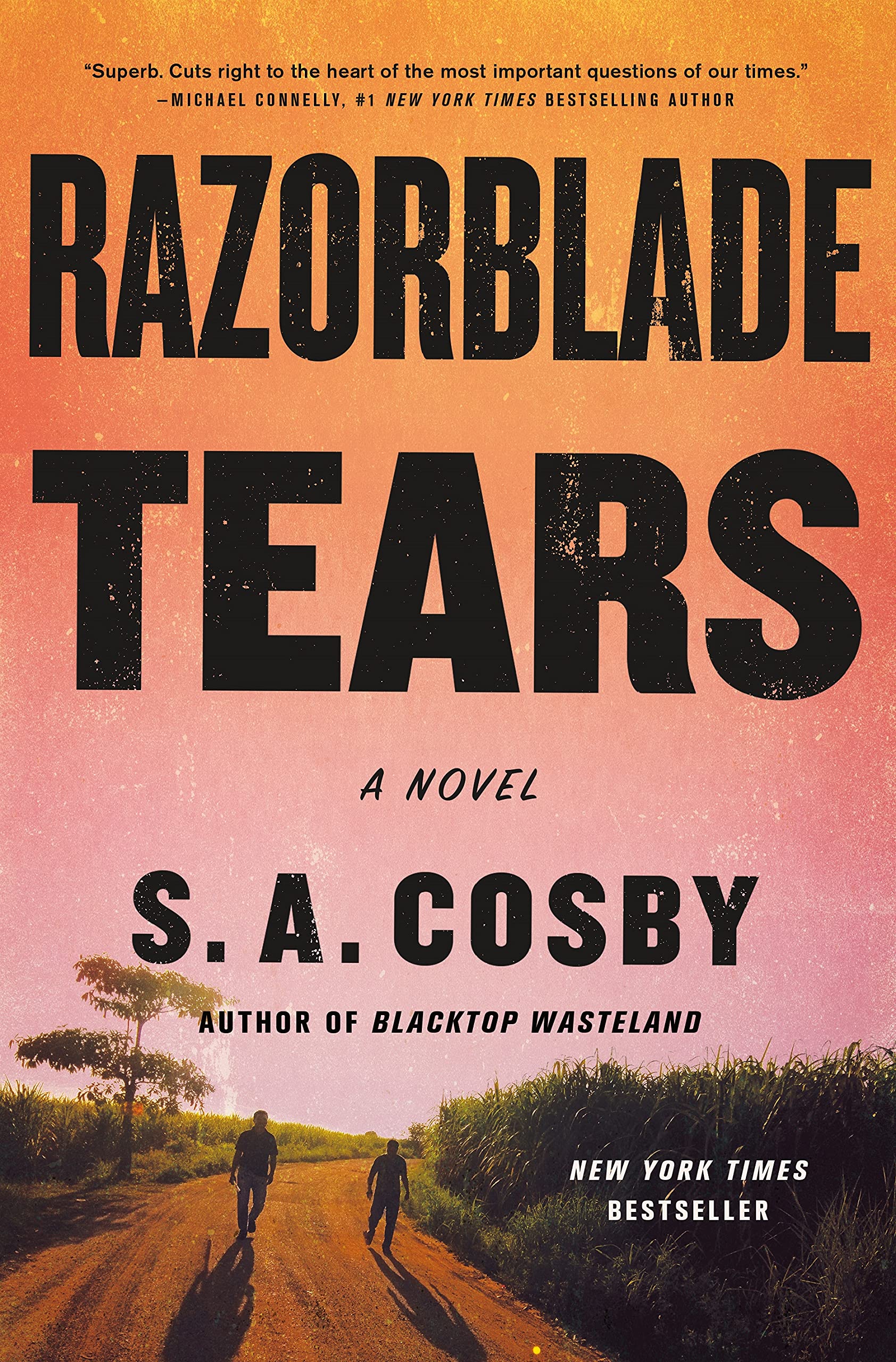
BOOK REVIEW: Razorblade Tears by S.A. Cosby


Razorblade Tears is the first book by this author that I have read; it is his first book after his wildly successful Blacktop Wasteland which won a bucketful of genre awards (Los Angeles Times, Anthony, Macavity, Barry ). The reason I started with Razorblade Tears instead is because it was on sale for $2.99 on Kindle and also because of the intriguing blurb describing the plot.

The first thing that strikes you as you read Razorblade Tears is the superior quality of the prose; Cosby is a master of metaphor and is unafraid to dazzle the reader with the brilliance of his writing. There were several times in the first few chapters that I highlighted sentences and turns of phrases. Eventually one becomes accustomed to instead of entranced by the poetry of the text and the breakneck forward momentum of the plot demands one’s full attention.

The story in Razorblade Tears is incredibly fast-paced and action-packed. After the two dads Buddy Lee and Ike team up as an avenging odd couple trying to find (out) who killed their gay sons, they start poking around and unearth a hornet’s nest of violent gang members, racist bikers, corrupt rap moguls and drug kingpins who are connected to a conspiracy to keep an explosive secret out of public view. Unfortunately for them, they are up against two guys who have suffered the incredibly painful loss of their only sons and fueled by their grief at the violent deaths and their own shame at their own homophobia that warped their relationship with them when they were alive, Buddy Lee and Ike are ready and willing to go as far as it takes (and beyond) to find and punish the people who have brought them such pain by killing their sons. The body count rises rapidly and by the end of the book vengeance has been meted out but at a price which is significant and life-altering to the survivors.

Overall, I was extremely impressed with this first encounter with the work of S.A. Cosby and I intend to read his other work. That said, I wouldn’t call Razorblade Tears a nuanced or complex book. It’s not trying to occupy the niche of the cerebral, densely-plotted mystery that unspools with increasing suspense and narrative tension. Razorblade Tears is more like a full barrel of bourbon rolling down a steep hill with a burning Confederate flag stuck in its side into a large hole that’s leaking profusely: it’s a combustible, compelling spectacle.

Razorblade Tears story moves so quickly that at first you don’t realize how simplistic the plot is. (It’s very easy to figure out who the person behind the boys murders and other crimes is.) But this flaw is outweighed by the overall message that parents should accept their LGBT children for who they are and not try to “change” or disown them because of some heteronormative vision they had of their (and their children’s) lives.


Title: Razorblade Tears.
Author: 
S.A Crosby.
Format: Kindle.
Length: 336 pages.
Publisher: Headline .
Date Published: July 6, 2021.
Date Read: March 8, 2022.

GOODREADS RATING: ★★★★ (5.0/5.0).

OVERALL GRADE: A/A- (3.83/4.0).

PLOT: B+.
IMAGERY: A-.
IMPACT: A.
WRITING: A+.

Thursday, April 01, 2021

BOOK REVIEW: Heaven, My Home (Highway 59, #2) by Attica Locke

Heaven, My Home is the second in a series of police procedural books about a Black Texas Ranger written by Attica Locke (who is also well-known for her trenchant writing on television shows such as Little Fires Everywhereand Empire). The main character in the books is Darren Matthews, and the central tension of the books come from the conflicts and circumstances that arise when one of the very few Black man in a predominantly white prestigious crime-fighting organization like the Texas Rangers has to interact with rednecks in rural sections of the state.

In Bluebird, Bluebird, Darren was involved in trying to solve a pair of murders with racial overtones (the bodies of a black man and a white woman are found dumped separately in a nearby river a few days apart) in a very small town up Highway 59 from Dallas. In the sequel, Heaven, My Home, Darren is asked to drive up Highway 59 to the Southern gothic tourist destination of Jefferson to find a missing 10-year-old kid, Levi King. Levi just happens to be the son of jailed notorious white supremacist Bill King and was last seen alive by Leroy Page, an elderly Black man who happens to own most of the property near Lake Caddo in an area called Hopetown where Native Americans, African Americans and poor Whites have been squatting for years. The child’s grandmother Rosemary King is the richest person in the nearby town of Jefferson but doesn’t seem that worried about her kin’s well-being, but Rosemary does seem fixated on getting her greedy hands on the Leroy’s deed to Hopetown.

If the story in Heaven, My Home doesn’t seem complicated enough there are still several unresolved issues from the first book. Because of this, Darren is currently being blackmailed by his own ne’er-do-well mother to keep quiet that she has a piece of evidence that if it were revealed Darren knew existed and were given to authorities might not only lead to him losing his job, but potential indictment and prosecution. Additionally, while Darren’s marriage started off in an “it’s complicated” phase in the first book, it morphs into the slow-motion train wreck stage when he starts noticing oddly charged interactions between his best friend and wife and this leads him to reach out to the widow he was powerfully (and chastely) attracted to in the first book.

The writing is delightful in both books and the mysteries are compelling, if somewhat implausibly racially charged, in both cases. One would think these features would make these books resonate with he but, surprisingly, they don’t. Primarily, I just don’t sympathize (or empathize) with Darren. He makes (and made) some bad choices in this book and the previous one. He’s clearly a (barely) functional alcoholic. Of course, there’s a long history of detectives being alcoholic, addicted messes (looking at you, John Rebus!) but here the setting of backwoods Texas repels instead of propelling me.

I hope Ms. Locke writes more books in the Highway 59 series, and I think I will probably get around to reading them, although I won’t feel an urgent need to do so.

Title: Heaven, My Home.
Author: 
Attica Locke.
Format: Kindle.
Length: 336 pages.
Publisher: Mullholland Books.
Date Published: September 17, 2019.
Date Read: February 20, 2021.

GOODREADS RATING: ★★½☆  (3.5/5.0).

OVERALL GRADE: A-/B+ (3.5/4.0).

PLOT: B+.
IMAGERY: A-.
IMPACT: A-.
WRITING: A-.

Thursday, March 18, 2021

BOOK REVIEW: Real LIfe by Brandon Taylor


Real Life by Brandon Taylor seems like it is a book that was designed in a lab to appeal to me. It’s a fictional account of a Black gay graduate student who likes to play tennis and is working on getting his Ph.D. in a STEM discipline at a predominantly white institution in a small town somewhere in the northeast. 30 years ago I was a black gay graduate student who liked to watch tennis and was working on getting his Ph.D. in a STEM discipline (applied mathematics) at a predominantly white institution (Rensselaer Polytechnic Institute) in a small town in the northeast (Troy, NY).

However, Wallace, the protagonist of Real Life, is very different from the person I was then, and since the book is set in a contemporary context, his experience is very different from my graduate days. That said, the situations that Wallace experiences as well as the descriptions of some of the characters he interacts with seem very familiar. Wallace is a graduate student in biochemistry and has a cadre of white friends, most of whom are also graduate students (in various fields). The group contains a gay couple named Cole and Vincent, another named Lukas and Nathan, and a gay international couple named Klaus and Roman, a straight couple named Emma and Thom, two “straight” guys named Yngve and Miller and then there’s Wallace. Almost all of Real Life is told through Wallace’s eyes as he observes how his friends interact with him, as the only black guy in a group of white people. Wallace is from the South, and we learn he is the first in his family to have ever gone to graduate school, and perhaps the first to go to college. His life experience is very different from the people he hangs out with when he’s not working in the lab and he is also very different from the people he works with in the lab as well. Later we learn that he was basically abandoned by his father and that his parents apparently blamed him for the fact that a family friend molested the tween-aged Wallace. The key material of the book is sourced in the tension caused by the ways Wallace’s identity and temperament distort and disrupt his experience of everyday social interactions with those around him, especially the ways these are frequently leavened with micro-aggressions and not-so-micro aggressions. And that’s when he’s with his “friends”!

Relatively early in Real Life, Miller and Wallace hook up sexually, a somewhat surprising event initiated by the putatively heterosexual Miller. Both Miller and Wallace have some warped ideas about sexuality, to my somewhat prudish sensibilities. Suffice it to say, even though their sexual activities are consensual, afterwards one or both of them are sore or bruised. (Not exactly my idea of a good time, but “different strokes for different folks.”) Near the end of the book I wasn’t completely convinced both of them would survive its conclusion. The sexual fluidity of Wallace’s coterie of friends is an interesting feature of the books, and is another example of unspoken tension that animates some of the peculiar social dynamics in the group. For example, even though Yngve is straight, it is a commonly understood fact in the group that Yngve and Lukas are often together, hanging out publicly. Lukas' boyfriend Nathan doesn't seem to be bothered by this situation, since Yngve is "straight." However one of the other gay guy, Roman, is a troublemaker. He says something explicitly racist to Wallace, and he causes tension among the other gay couples by remarking on how happy he is that he is in an open relationship with Klaus. (Or as he puts it, "Nothing is better than f***ing someone while my boyfriend watches.") This completely sets Cole off, who is a bit strait-laced and prone to jealousy about his relationship with Vincent, who seems fascinated by the idea of something other than a monogamous relationship, while Cole seems to be a gay Republican in training. Cole is probably the gay guy Wallace is closest to. There's a very fun scene where there is a very detailed description of a tennis match the two play together which appears as if it could lead to something else, and definitely reveals the evanescent sexual tension that can arise in non-sexual interactions between gay men who are friends. In some instances Wallace deliberately chooses to exacerbate not ameliorate the conflicts that arise from these tensions. To me it seems clear that Taylor is portraying Wallace as a masochist, both sexually and emotionally. There are several examples in the book where painful things happen to Wallace and even when he could try to take action or respond to reduce the pain, he doesn’t, instead he “simply takes it,” as if he deserves (or enjoys?) being victimized.

Overall, Real Life is a quick, compelling and insightful read. The writing sometimes tends to the florid, and there's not much of a plot. (The central question is, "(How long) Can Wallace survive interacting with these people?") Wallace is in a bad situation, made worse by the cluelessness and casual racism of his “friends” as well as the precarious and disempowered nature of graduate education. I was hoping for a happy ending, but this is really not that kind of book. I’m somewhat surprised at the level of acclaim Real Life has received (such as being shortlisted for the Booker Prize) but I would definitely recommend the book to people, especially well-meaning white people who think the reason for underrepresentation of racial and ethnic minorities and women in STEM academic circles is a “pipeline” problem. Taylor provides real insight that rings true for me about what it’s like being “the only one” in certain academic settings as well as the complicated nature of gay male friendships. Since this is his debut novel, I look forward to reading future books by him.

Title: Real Life.
Author: 
Brandon Taylor.
Format: Kindle.
Length: 335 pages.
Publisher: Mullholland Books.
Date Published: February 18, 2020.
Date Read: March 3, 2021.

GOODREADS RATING: ★★☆  (4.0/5.0).

OVERALL GRADE: A-/B+ (3.5/4.0).

PLOT: B+.
IMAGERY: A-.
IMPACT: B+.
WRITING: A-.

Sunday, April 12, 2020

Virginia Enacts LGBT Non-Discrimination Protections!


Virginia has become the first state in the Southern United States (former member of the Confederacy) to enact comprehensive civil rights protections for LGBT people. Last night Governor Ralph Northam signed the Virginia Values Act into law. The legislation (SB 868) goes into effect July 1, 2020 and in addition to prohibiting discrimination in employment, housing and credit on the basis of sexual orientation and gender identity, it also expanded public accommodations protections on the basis of these categories and others. According to the Williams Institute (at the UCLA School of Law) twenty-three states and the District of Columbia now have statutes specifically protecting LGBT civil rights.

The national LGBT advocacy organization, the Human Rights Campaign, described the new law:
In addition to sexual orientation and gender identity, the law also creates all-new protections for Virginians in private employment and places of public accommodation on the basis of race, color, religion, national origin, sex, pregnancy, childbirth or related medical conditions, age, marital status, disability, and status as a veteran. Virginia is the first state in the South to have non-discrimination protections for LGBTQ people, the first state in over a decade to add both sexual orientation and gender identity to existing non-discrimination law, and the first state since 1993 to add a prohibition on discrimination in public accommodations (protecting all Virginians) where none existed before.
Virginia Governor Northam said:
"We are building an inclusive Commonwealth where there is opportunity for everyone, and everyone is treated fairly. No longer will LGBTQ Virginians have to fear being fired, evicted, or denied service in public places because of who they are."
The bill was shepherded through the Virginia legislature by two openly gay legislators, Senator Adam Ebbin (D-Alexandria) and Delegate Mark Sickles (D-Fairfax). As a result of the 2019 legislative elections and the 2017 gubernatorial elections Democrats have complete control of the legislative process in Virginia for the first time in decades. Since I used to live and work in Virginia I am very excited to see this progress!

Sunday, August 20, 2017

GRAPHIC: Confederate Statues Mapped In Time and Space


This post has an interesting graphic which demonstrates that statues commemorating the Confederacy (which was devoted to the maintenance of slavery and promulgation and prolongation of white supremacy) primarily happened in two waves, one around the establishment of Jim Crow laws in the 1910s and again in response to the civil rights movement in the 1960s.

This refutes the claim that these statues are primarily about "history and heritage" and supports the argument they are signals to Black people about the permanence of white supremacy.

Hat/tip to Axios.

Thursday, May 11, 2017

BOOK REVIEW: Mississippi Blood by Greg Iles


This is the 6th book in the Penn Cage series and the 3rd book in Greg Iles' Natchez Burning trilogy. Although I loved this series overall I was somewhat disappointed by the concluding entry in the series.

The books are incredibly complex, almost gothic tales of intrigue and suspense, set in the southern city of Natchez, Mississippi in "present day" and in the 1960s. The primary character is Penn Cage, a former criminal prosecutor turned best-selling author who is the son of Dr. Tom Cage, a white doctor who has lived in Natchez all his life and is respected by the white and black citizens of the town alike.

The book (and entire Natchez Burning trilogy) is animated by the secrets Penn's dad is keeping (and has kept) in the context of the explosive (and violent) racial politics of his hometown.

In Mississippi Blood  the primary plot is about the trial of Dr. Cage for the murder of Viola Turner, the beautiful black woman who was Tom's nurse in the 1960s and who was assaulted and raped and eventually exiled from her hometown by an extremely racist group called the Double Eagles (they separated from the Ku Klux Klan because that group wasn't hardcore enough on racial issues!) Viola was dying of cancer and the two had an assisted suicide pact.

My primary issues I had with this book was that the story just became a bit too operatic and unbelievable over time, with plot developments and shocking revelations occurring in the context of an extremely dramatic trial. To be honest, this was probably a weakness of the earlier books as well, but I looked past it because I was so invested in what was happening to the characters in those earlier books. (And all 6 books in the Penn Cage  series are action-packed, emotionally resonant thrillers also.) Because Mississippi Blood  is almost certainly the final book in the Penn Cage series, several bridges have been burned (and primary characters dispatched  in the earlier entries in the trilogy) so that somehow my connection to and interest in these remaining characters seemed less intense.

Overall, Mississippi Blood is a very suspenseful, action-packed, mystery-thriller with thought-provoking and complex racial politics woven throughout and an extremely compelling read.

Title: Mississippi Blood.
Author: 
Greg Iles.
Paperback: 704 pages.
Publisher:
 William Morrow.
Date Published: March 21, 2017.
Date Read: May 10, 2017.

GOODREADS RATING:  (4.0/5.0).

OVERALL GRADE: A (3.83/4.0).


PLOT: A.
IMAGERY: A-.
IMPACT: A-.
WRITING: A.

Wednesday, April 06, 2016

GODLESS WEDNESDAY: In Mississippi, New Law Says Religion Trumps Civil Rights


What a shocker! More bad news out of Mississippi regarding civil rights and the equal treatment of all its citizens. Governor Phil Bryant, A Republican, signed House Bill 1523 into law on Tuesday. The bill, which goes into effect in July, is titled "Protecting Freedom of Conscience from Government Discrimination Act" and purports to provide people with "sincerely held religious beliefs" the right to deny services and public accommodations to certain people. But it is also to support only certain religious beliefs, such as:
The act states that the government cannot penalize an individual, organization, or business for acting according to the following "sincerely held religious beliefs or moral convictions": that "marriage is or should be recognized as the union of one man and one woman"; that "sexual relations are properly reserved to such a marriage"; and that "male (man) or female (woman) refer to an individual’s immutable biological sex as objectively determined by anatomy and genetics at time of birth."
It looks flagrantly unconstitutional as well as discriminatory to me. It will be interesting to see if the response to Mississippi's bill mirrors the negative response North Carolina and Indiana have received for enacting similiarly bigoted legislation.

Wednesday, March 23, 2016

WHOA! North Carolina Enacts Statute Explicitly Enabling LGBT Discrimination Statewide


Wow! The North Carolina legislature passed and the Republican Governor signed into law HB 2, a measure which would ostensibly overturn a recently passed Charlotte, NC ordinance which provided public accommodations protections based on gender identity.

However the law enacted not only overturns the Charlotte ordinance but also ordinances that protected LGBT people in 7 other municipalities and allows discrimination in employment and public accommodations based on sexual orientation or gender identity anywhere in the state of NorthnCarolina.

The ACLU of North Carolina made the stakes around this legislation starkly clear:
“The manner in which legislators passed the most extreme anti-LGBT bill in the nation – voting hours after it was unveiled without adequate public debate – flies in the face of fairness and democracy. Legislators have gone out of their way to stigmatize and marginalize transgender North Carolinians by pushing ugly and fundamentally untrue stereotypes that are based on fear and ignorance and not supported by the experiences of more than 200 cities with these protections. Transgender men are men; transgender women are women. They deserve to use the appropriate restroom in peace, just like everyone else."
Hat/tip to Joe.My.God

Thursday, January 07, 2016

QUEER QUOTE: Hillary Clinton Blasts Roy Moore's Attempts To Obstruct Marriage Equality in Alabama

Our first Queer Quote of 2016 comes from Hillary Clinton who blasted Alabama Chief Judge Roy Moore's bizarre attempt to prevent marriage equality in Alabama. Here's the quote:
“Marriage equality is now the law of the land—including in Alabama. Today’s unconstitutional order reminds us that, despite the Supreme Court's ruling that all Americans have the right to marry the person they love, our work is far from over.  There are still judges who are determined to stand in the way of people's rights.  There are still politicians who argue the Court got it wrong and states should ignore its ruling.  We need to ensure that marriage equality is guaranteed and enforced nationwide.   And we need to fight discrimination against LGBT Americans wherever it occurs.  There are places where you can get married on Sunday and are at risk of being fired from your job or evicted from your home on Monday because you're gay.  That's not how it should be in the United States of America.  As President, I'll fight for the equal rights of all Americans, no matter who they are or who they love.”
Hat/tip to New Civil Rights Movement 

Friday, May 01, 2015

SWEET TEA Comes To Los Angeles! A Play About Black Gay Men In Town This Weekend Only


I guess it's the time of year when artistic depictions of Black gay men are available in Los Angeles! Last week, Patrik-Ian Polk's Blackbird was released to multiple movie theaters and this weekend there's a play about Black gay men in the South called Sweet Tea showing at the Stella Adler theater in Hollywood.
Based on his award-winning book, E. Patrick Johnson stars in this new one-man exploration into the southern, black gay community. A fascinating, validating oral history inspired by the author's personal journey, SWEET TEA explores these men's perceptions, joys, experiences, angst, triumphs and vulnerabilities. With passion and insight, Johnson reinforces the spoken-word tradition while challenging stereotypes -- and finding humor, humanity and hope within.
Unfortunately I am out of town for a business trip this weekend but I encourage everyone go to see Sweet Tea!

Friday, April 24, 2015

Patrik-Ian Polk's Adaptation Of Black Gay Classic Blackbird Opening TODAY


I'm very excited to report that Patrik-Ian Polk's Blackbird is finally getting a cinematic release today more than a year after its premiere at the Pan-African Film Festival in Los Angeles last year (which I attended). It was #10 on my Best Films of 2014 list.

Blackbird will be opening in these theaters in  Los Angeles, Atlanta, Washington, D.C., San Francisco and New York City today:

  • Atlanta AMC Phipps Plaza AMC Southlake Pavilion 
  • Los Angeles AMC Town Center 8 TCL Chinese Theatre Los Angeles Cinemark 18 
  • Washington DC City Cinemas Angelika Pop UP DC ArcLight Bethesda 
  • New York City AMC Village AMC Empire 25
  • San Francisco AMC Metreon
NPR's popular Morning Edition ran a story about the film today, discussing it's association with Black billionaire Robert Johnson (the funder of Black Entertainment Television) and his new "Black Netflix" online service called Urban Movie Channel. 

I'm just excited that this very good film, with central Black gay characters based on a seminal Black gay novel (Larry Duplechan's Blackbird) is finally getting out to the masses.  I've seen it twice and I may see it again! I strongly encourage you to check it out this weekend!

Here's the trailer:

Hat/tip to Waddie G!

Friday, April 17, 2015

QUEER QUOTE: IBM Send Gov. Jindal Letter Opposing Louisiana Proposed RFRA Law


IBM has long been one of the LGBT-friendliest companies to work for, and they are putting their money where their mouth is by sending a letter to Governor Bobby Jindal and the top officials in the legislature opposing Louisiana's plan to enact an even more discriminatory RFRA then the anti-LGBT legislation Indiana and Arkansas had attempted to enact earlier this year.

Louisiana's bill is called the "Marriage and Conscience Act" and what IBM has to say about it is today's Queer Quote:
April 15, 2015 
The Honorable Bobby Jindal Governor, State of Louisiana PO Box 94004 Baton Rouge, Louisiana 70804-9004  
Dear Governor Jindal, 
I am writing to express IBM's strong opposition to H.B. 707, the Marriage and Conscience Act.  We are deeply concerned by reports that you intend to support this legislation.  
IBM has made significant investments in Louisiana including most recently a technology services delivery center in Baton Rouge, creating new jobs for Louisiana workers.  We located the center in Baton Rouge because we believe Louisiana has great talent and would continue to be a rich source of such talent.  However a bill that legally protects discrimination based on same-sex marriage status will create a hostile environment for our current and prospective employees, and is antithetical to our company’s values.  IBM will find it much harder to attract talent to Louisiana if this bill is passed and enacted into law.  
Our perspective is grounded in IBM's 104-year history and our deep legacy of diversity and inclusion - a legacy to which we remain strongly committed today.  IBM is opposed to discrimination against anyone on the grounds of race, religion, gender, sexual orientation, or other protected categories.    
We urge you to work with the Legislature to ensure this legislation is not discriminatory. 
Thank you for considering our views.  
Sincerely,  
James M. Driesse Senior State Executive  

CC: The Hon. John A. Alario, Jr President, Louisiana State Senate State Capitol Building PO Box 94183 Baton Rouge, Louisiana 70804 
The Hon. Charles E. Checkley Speaker, Louisiana House of Representatives State Capitol Building PO Box 94062 Baton Rouge, Louisiana 70804

Hat/tip to Joe Jervis

Wednesday, March 04, 2015

Texas Legislators Introduce Bill To Void Local LGBT Rights Ordinances


Here we go! Just as I predicted when I blogged about the Arkansas and West Virginia bills that are the new face of anti-LGBT animus in state legislatures, I said that many other red states would soon follow their homophobic lead. Today comes word that the biggest red state of them all, Texas, is planning on joining the rush to deny equal rights to LGBT citizens:
A Fort Bend County Republican has introduced a bill that would bar cities from adopting or enforcing non-discrimination ordinances that include protected classes not contained in state law. Texas law doesn’t include sexual orientation or gender identity and expression. 
As a result, state Rep. Rick Miller’s House Bill 1556 would undo LGBT protections passed by numerous cities, including Austin, Dallas, San Antonio, El Paso, Fort Worth, Houston and Plano. Altogether more than 7.5 million Texas are covered by such ordinances.
Will state legislators really override the local anti-discrimination ordinances that protect 7.5 million residents? We shall see....

Monday, February 09, 2015

NOW THERE ARE 37! Marriage Equality Comes To Alabama!


With the Supreme Court's 7-2 vote to deny their request for a stay on a federal judge's ruling striking down Alabama's ban on marriage equality, the Cotton State becomes the 37th in the union to allow same-sex couples to get married. Only Justices Scalia and Thomas would have approved Alabama's request for a stay.

Same-sex couples are getting married in the majority of the counties in Alabama today, despite attempts by Chief Justice Roy Moore and Governor Robert Bentley to not follow the rule of law as clearly articulated by the federal judiciary. Gee, when has that happened before?

Hat/tip to Joe Jervis

LinkWithin

Blog Widget by LinkWithin