Showing posts with label suspense thriller. Show all posts

Sunday, December 24, 2023

BOOK REVIEW: Holly by Stephen King


Holly is another entry by Stephen King into the universe in which the Bill Hodges trilogy (Mr. Mercedes, Finders Keepers, End of Watch) was set, although this time Holly Gibney is the primary character. Gibney is also featured  in The Outsider  and one of the four novellas that make up the 2020 collection If It Bleeds.  Even though I am not a fan of the horror genre or supernatural stories in general, I now consider myself a fan of King’s. In the last few years I have read and reviewed Fairy Tale (2023), Billy Summers (2022) and The Institute (2020) I appreciate what an amazing storyteller he is. Even so, I generally restrict myself to his non-supernatural fare, which I enjoy tremendously, and Holly is no exception.

The Bill Hodges trilogy were some of the first books by King that I read, primarily because they are in the mystery/detective/thriller genre. They feature Bill Hodges as a former cop who opens his own private detective agency (called Finders Keepers) and features Holly as his shy but capable assistant who becomes his partner as well as Jerome Robinson, a computer savvy Black teenager who does odd jobs for Bill.  Although Bill was the main character of the series, my favorites were always Jerome and Holly and I hoped that King would return to them in future work, which he has done with the publication of Holly.

Holly is the main character in Holly, which is set in July 2021 smack dab in the middle of the COVID-19 pandemic and the Trump era. Holly is mourning the death of her mom (due to COVID after refusing to get vaccinated) when she gets a call at the detective agency from a mother panicked about the disappearance of her adult daughter, Bonnie Dahl, who worked at the library of the local small college in town. Holly, who King himself has described as “obsessive compulsive with a huge inferiority complex,” is very careful about getting COVID and a fair amount of her internal monologue is about masking and her interactions with folks around her and their thoughts about COVID and Trump. This makes Holly a “political book” in the sense that  King (through Holly as his avatar) makes his thoughts about his views on these topics very clear. (Since I share these views I didn't find this aspect distracting or problematic.)

Some reviewers of  Holly question King’s choice to begin a detective mystery novel by revealing that the culprits are a pair of murderous, cannibalistic, septuagenarian professors, Rodney and Ellen Harris, who select their victims from the itinerant human flotsam available to them in the wake of a small town dominated by a prestigious college. But the detective story where the reader knows who did it from the beginning and the suspense is sourced in how and when (not really whether) the protagonist will figure it out (and stop the criminal before they crime again) is a tried and true trope of the genre. (Val McDermid is a Master at this form.) Here, I think this story structure works quite well, and especially when the reader gets first-person perspective from more than one character who is caught in the devilish flytrap of the Professors Harris.

An interesting feature of Holly is that it features not one but two subplots about young writers who are both experiencing their first successful encounters with the publishing industry. King often writes about writers in his books and his enthusiasm for this aspect of the story was palpable.

A surprising feature of Holly is that it features absolutely no supernatural phenomena. The Harrises have a reason for why they are periodically enticing, trapping, and culling people and it is because they believe that eating the human flesh of people significantly younger than they are will improve their health. For a significant fraction of the book King makes it appear as if they may be right, since they do appear to be experiencing  some relief, perhaps supernatural in nature, from their multiple health ailments not unfamiliar to people as old as the Harrises (mind-numbingly painful sciatica for her, and the numbing of the mind of dementia for him). But in the end King (again via his avatar Holly) points out that the bad guys’ evil, false beliefs are trumped [sic] by science: they were experiencing the placebo effect, completely dismantling any imagined rationale they could have posited to justify their murderous actions of killing and eating their neighbors. To me it is clear that King is trying to demonstrate that fact-based reality can be used to explain that people who do awful things (like deny the reality of COVID and the effectiveness of vaccines or vote for Trump or kill and eat fellow humans) are really doing it because they are awful people, despite what they tell themselves the reasons for doing these things are.

Title: Holly
Author: Stephen King.
Format: Kindle.
Length: 464 pages.
Publisher: Scribner.
Date Published: September 5, 2023.
Date Read: December 10, 2023.

GOODREADS RATING: ★★★★  (5.0/5.0).

OVERALL GRADE: A/A- (3.83/4.0).

PLOT: A-.
IMAGERY: A-.
IMPACT: A.
WRITING: A.

Thursday, December 15, 2022

BOOK REVIEW:The Island by Adrian McKinty


The Island is the latest blockbuster suspense thriller from Adrian McKinty, the author of the best-selling The Chain  and six well-regarded police procedurals with titles based off of Tom Waits lyrics set in Northern Ireland during “The Troubles” era featuring a Protestant cop named Sean Duffy. The Chain is well-known for its killer premise, addictive pacing and plot twists; The Island shares several of these attributes.
The premise of The Island is apparently sourced from an actual incident experienced by McKinty that didn’t go as wildly wrong as what happens in the book: a car accident on a private island a short ferry trip from a major city (Melbourne in this case) where a single family has controlled life (and death) for multiple generations. In McKinty’s real-life version the accident was avoided and no one was harmed, but in the version in The Island a young deaf woman rides her bike suddenly into an oncoming car carrying a vacationing American family of four (a 40-something doctor named Tom, his 20-something second wife Heather and two kids, Olivia, 14 and Owen, 12). The parents, make the fateful decision to leave the scene of the accident in the hope they can resolve whatever consequences occur from the comfort and safety of the mainland. This turns out to be a spectacular bad choice that results in multiple violent deaths.


The Island turns into a suspenseful story of survival as the wife and kids are separated from their husband and father and are literally hunted by the few dozen inhabitants of the island. In such an extreme situation, everyone involved is forced to identify their limits and go beyond them in different ways. Olivia and Owen are recovering from the death of their mom, Tom's first wife and are resentful of Heather, who is much closer to their age then she is to their parents. Heather is still getting used to the idea of being responsible for two teenaged kids at the age of 24 and getting to know her new husband who views the world substantially differently from his perch of privilege and experience. That these emotional undercurrents have to be navigated and resolved while they are trying to escape a life-and-death situation on Dutch Island are the primary narrative fuel of The Island.

McKinty does many things quite well in The IslandFirst, he successfully gets the reader to invest in the fate of the characters. He provides the reader with the internal thoughts of multiple characters and uses this mechanism to help the reader connect emotionally with them, especially Heather. Second, he writes action scenes incredibly compellingly, and there is a LOT of action (and violence) in The Island. Third, he is not afraid to have real consequences for the characters for the decisions they make. Because, there are serious (and life-changing) injuries inflicted on multiple characters, this raises the stakes for the reader in speculating about the possible fates for the character or characters we are invested in knowing what happens to in the end.
That’s not to say The Island is not without flaws. It is so obvious about its intent to be breathlessly suspenseful that at times the plot becomes wildly unrealistic and shamelessly manipulative. But once the reader gives into the breakneck pace of the plot and accepts that The Island is going to be a roller-coaster, the book is an enjoyable bit of fluff (and its quite a quick read at 384 pages).

Apparently The Island is being made into a streaming “television” series for Hulu, which I think will work well. I could see it turned into an addictive suspense drama like Fox’s 24 where every hour/episode ends with a cliffhanger.

Overall, I would recommend The Island to anyone who read and enjoyed The Chain (which according to sales figures, critical acclaim and social media buzz, is a LOT of people!).

Title: The Island
Author: 
Adrian Mckinty.
Format: Hardcover.
Length: 384 pages.
Publisher: Little, Brown.
Date Published: May 17, 2022.
Date Read: November 18, 2022.

GOODREADS RATING: ★★½☆  (3.5/5.0).

OVERALL GRADE: A- (3.67/4.0).

PLOT: A-.
IMAGERY: B+.
IMPACT: A-.
WRITING: A.

Thursday, December 08, 2022

BOOK REVIEW: Upgrade by Blake Crouch


Upgrade by Blake Crouch is the latest book from the author of other technothrillers such as  Recursion and Dark Matter.  I think I have read enough Crouch novels by now to notice a common theme: the main character is usually a straight white guy with a family who finds himself in an extraordinary situation (typically involving a technological advance that seems like or actually is science fiction) that he has to resolve through ingenuity and taking decisive (sometimes violent) action. Below I will provide evidence for my view by summarizing the three Crouch novels I have read so far.
 In Recursion, the main character is Barry Sutton, a straight white NYPD detective who got divorced after his young daughter was killed in a hit-and-run accident ten years before. Barry learns that the recent increase in FMS (False Memory Syndrome) is a result of a technological advance that allows certain people to reset reality for everyone else; the false memories people are experiencing are really memories of the previous reality which has been erased that somehow are lingering on in their consciousness. Barry has to figure out what he can do to restore reality, and decide if he can and should select a reality where his daughter doesn’t die.
In Dark Matter, the main character is a straight white guy named Jason Dessen, a former quantum mechanics scientist and physics college professor who has a wife Daniela and a baby son Charlie. One day Jason regains consciousness while stumbling out of a metal cube. He realizes that he is in an alternate universe where 15 years ago the alternate version of Jason (which he calls Jason2) decided NOT to marry Daniela and instead pursued his quantum mechanics research and ended up creating a device (the metal cube) that allows people to jump between parallel universes. Jason2 has swapped places with Jason in order to explore what his life would have been like if he had pursued Daniela instead of research. Jason has to figure out how to get his life back from a more ruthless version of himself, Jason2.
In Upgrade, the main character is Logan Ramsay, a straight white guy married to a female history professor who teaches at American University in Washington, DC and has a tween daughter who regularly beats him in their daily chess game. Logan works for the GPA (Gene Protection Agency), a federal agency tasked with enforcing the Gene Protection Act, which outlawed all gene manipulation and research in the United States. The GPA also authorizes universal, invasive  surveillance of all U.S. citizens in order to enforce the ban on gene research and resulted in the incarceration of most biotech scientists. The legislation is a(n over)reaction to “The Great Starvation,” a cataclysmic event that was triggered by the release of genetically modified locusts in China by Logan's mother Miriam Ramsay in order to try to improve rice production a decade before the events in Upgrade. Miriam Ramsay was well known as a brilliant scientist and one of the richest people in the world before her experiment resulted in the starvation deaths of hundreds of millions of people around the world. Logan’s mother killed herself soon after the magnitude of her mistake became clear and Logan went to jail for multiple years for his minor role in the event (as an assistant). During a routine raid to find a rogue geneticist Logan is infected with some biochemical agent which after a few weeks he realizes has upgraded and altered his genome, giving him all sorts of enhanced abilities like increased concentration and mental acuity, thicker bones, and speed and agility. Of course the GPA outlaws all gene modification so when the extent of his abilities becomes clear Logan is kidnapped by his own co-workers and taken to a secret site where they can observe him and monitor his changing body. He gets busted out of the secret prison by someone who has very similar upgraded abilities to him; this turns out to be his sister Kara. 
This somewhat brief summary of the beginning of Upgrade may seem like it contains spoilers but really this is just the initial setup to the main plot of the book and leaves several questions for the reader. Such as, who designed this upgrade? What will it mean for the future of society if it is effective, especially a society where gene enhancement is so prohibited and everyone’s actions are monitored so closely? Could Logan's mom be involved somehow?
One of the main features of Crouch’s writing is that the action is literally fast and furious. He’s also pretty skillful at depicting his main character in a sympathetic manner so that the reader is caught up in the circumstances that affect him and wants to see how or if he can figure out a way to survive them. This is especially the case in Upgrade, which like all the other books by Crouch I’ve read really seems like a spec script for a Hollywood blockbuster or hit streaming TV show. There’s thought-provoking technology in a world similar but significantly altered from our own, with a sympathetic protagonist facing long odds to succeed. What’s not to like? One quibble I have is that these books are starting to seem a little too glib and formulaic. As I’ve pointed out above, Crouch’s last three books have noticeable similarities. However, they have also all been huge hits and big bestsellers. The guy is good at what he does! There's also something plastic/uncompelling about his main character's relationships with other people. In Upgrade, Logan has a complicated (and slightly bizarre) relationship with his sister Kara. It's like Crouch's characters have facsimiles of relationships, not the real thing. I think this is what causes me to not connect emotionally with his books. (But they are still a delight to read.)
Overall, I’d recommend Upgrade to anyone who has read and enjoyed Dark Matter and/or Recursion.

Title: Upgrade.
Author: 
Blake Crouch.
Format: Hardcover.
Length: 352 pages.
Publisher: Ballantine Books.
Date Published: July 12, 2022.
Date Read: November 23, 2022.

GOODREADS RATING: ★★½☆  (3.5/5.0).

OVERALL GRADE: B+ (3.3/4.0).

PLOT: A-.
IMAGERY: B+.
IMPACT: B.
WRITING: B+.

Saturday, May 14, 2022

BOOK REVIEW: Blacktop Wasteland by S.A. Cosby


Blacktop Wasteland is the second  book by this author that I have read; I first read and enjoyed his Razorblade Tears. Blacktop Wasteland is the more celebrated of the two, having won a slew  of awards (Los Angeles Times, Anthony, Macavity, Barry). After enjoying Razorblade Tears so much I wanted to see if Blacktop Wasteland lived up to the hype. The answer is: yes and no.

Both books are in the same genre of “action-packed crime thrillers set in the rural South.” But that’s the end of the similarities between Razorblade Tears and Blacktop Wasteland. Razorblade Tears is basically a story about two very different fathers who reluctantly are working together to find out and get revenge on whoever shot and killed their gay sons at point blank range. Blacktop Wasteland has one central main character, Beauregard “Bug” Montage that the plot hinges on, with the central narrative tension being fueled by the answer to the question of whether Bug is a “good guy who sometimes commits criminal acts” or “a criminal who sometimes does good things.” By the end of the book I don’t think the reader has a definitive answer to this question besides “it’s complicated.”

Ambiguity or the fusion of positive and negative, or dark and light elements is a recurring theme of both Razorblade Tears and Blacktop Wasteland, with it playing an even larger role in the latter. Bug is a talented getaway driver just like his decades-absent father. He is a car whisperer with the automotive equivalent of what a “green thumb” is for gardeners. He used his ill-gotten gains from his participation in a previous heist to open his own auto repair shop in his very small town in southern Virginia and business is Not Good.

Bug has three kids, two boys  with the woman he lives with in a trailer and a daughter he fathered as a teenager more than two decades ago. His cancer-ridden mother is in an expensive assisted-living facility. Bug has a number of financial obligations and not many legitimate sources of income as an ex-con. So when some former criminal associates approach him for a “slam dunk heist” he is not really in a position to resist the siren call of easy money.  

Blacktop Wasteland is a more cerebral book than one would generally expect from an entry in the crime thriller genre. This may explain the broadness of its appeal and the level of hype it has received. A central element is its depiction of the moral/philosophical dilemma of its protagonist, with the author asking the reader in Blacktop Wasteland “What would you do if you were in Bug’s circumstances, with his past and talents and debts?” Bug basically has two choices: work with some sketchy (probably racist) good old boys to drive a getaway car from a jewelry heist OR try to make a sizable dent on reducing his debts by selling his pride and joy: his father Ant Montage’s car, called the Duster, which he has maintained in perfect condition for decades. Blacktop Wasteland begins with Bug winning a street race in the Duster (and then being part of a scam which results in him not actually bringing any money home that night) and it’s clear the Duster is more than just a car to Bug, it’s the last connection he has to the father he idolizes.

So the primary narrative tension of Blacktop Wasteland is sourced in the decision Bug will make about how he will earn money. But it’s clear that the scales are not evenly weighted on the sides of good and evil. It’s not easy for a Black man who has spent time in jail to earn enough money to support himself and others using only legitimate and above board means, especially when his skills and experience are so useful to successful criminal activity. So, it’s not really a surprise when Bug makes the choice he does. What is surprising are the twists and turns that the plot takes afterwards. There are serious and permanent consequences for lots of the people Bug comes into contact with during the story.

In the end, although I was glad I read Blacktop Wasteland and am also convinced it will make an excellent movie when Hollywood inevitably adapts it for the big screen, it didn’t leave as strong an impression on me as Razorblade Tears did. I think it’s because the two books have very different messages in the end. Frankly, I’m not exactly sure what message Cosby was trying to send with Blacktop Wasteland while the message in Razorblade Tears is very clear (accept your children as they are, don’t try to mold them into something you think they should be!) and one I agree with.

Title: Blacktop Wasteland.

Author: S.A. Cosby.
Format: Kindle.
Length: 305 pages.
Publisher: Flatiron Books.
Date Published: July 14, 2020.
Date Read: April 9, 2022.

GOODREADS RATING: ★★½☆  (4.5/5.0).

OVERALL GRADE: A/A- (3.83/4.0).

PLOT: A.
IMAGERY: A.
IMPACT: A-.
WRITING: A.

Thursday, March 17, 2022

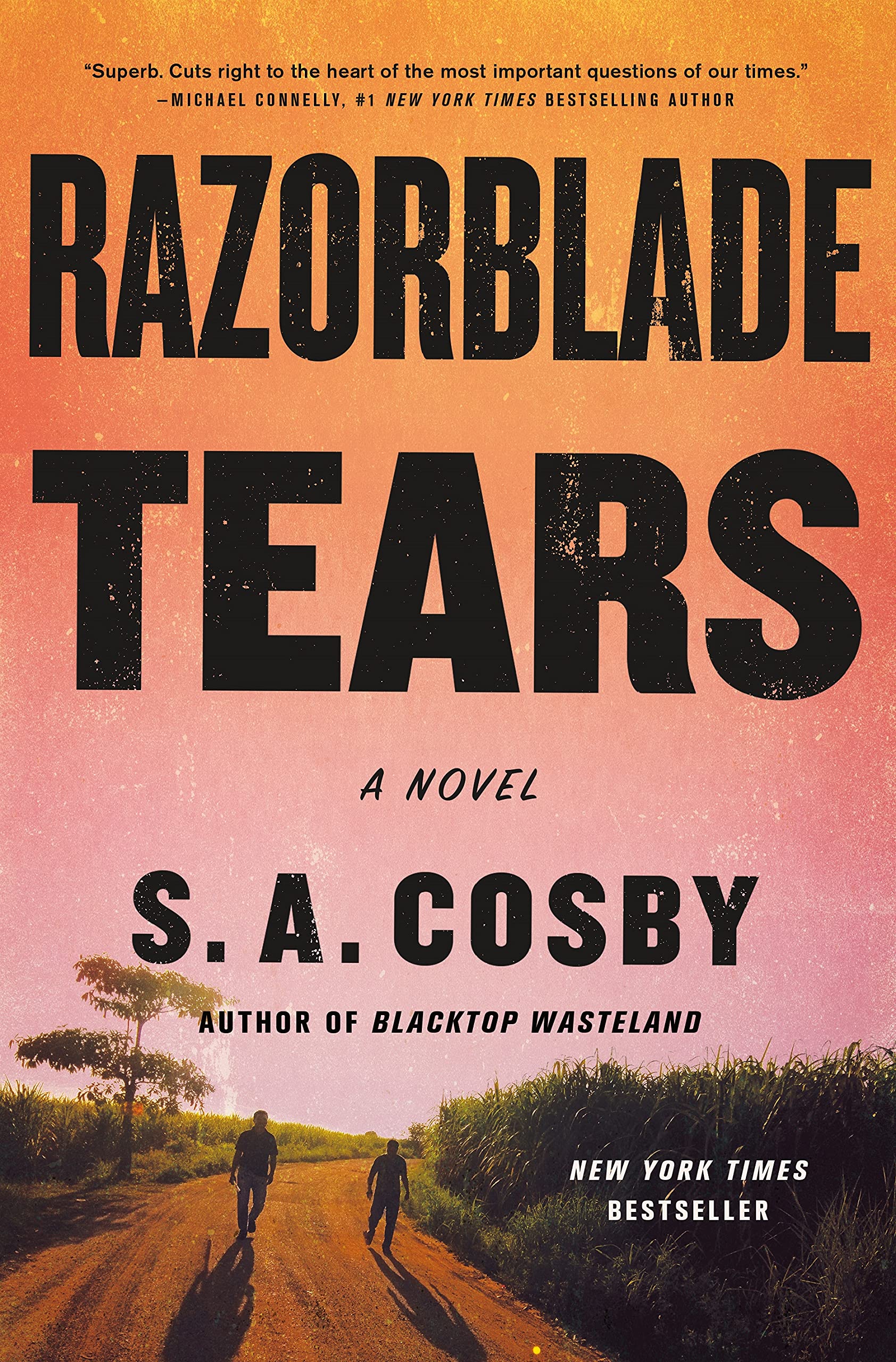
BOOK REVIEW: Razorblade Tears by S.A. Cosby


Razorblade Tears is the first book by this author that I have read; it is his first book after his wildly successful Blacktop Wasteland which won a bucketful of genre awards (Los Angeles Times, Anthony, Macavity, Barry ). The reason I started with Razorblade Tears instead is because it was on sale for $2.99 on Kindle and also because of the intriguing blurb describing the plot.

The first thing that strikes you as you read Razorblade Tears is the superior quality of the prose; Cosby is a master of metaphor and is unafraid to dazzle the reader with the brilliance of his writing. There were several times in the first few chapters that I highlighted sentences and turns of phrases. Eventually one becomes accustomed to instead of entranced by the poetry of the text and the breakneck forward momentum of the plot demands one’s full attention.

The story in Razorblade Tears is incredibly fast-paced and action-packed. After the two dads Buddy Lee and Ike team up as an avenging odd couple trying to find (out) who killed their gay sons, they start poking around and unearth a hornet’s nest of violent gang members, racist bikers, corrupt rap moguls and drug kingpins who are connected to a conspiracy to keep an explosive secret out of public view. Unfortunately for them, they are up against two guys who have suffered the incredibly painful loss of their only sons and fueled by their grief at the violent deaths and their own shame at their own homophobia that warped their relationship with them when they were alive, Buddy Lee and Ike are ready and willing to go as far as it takes (and beyond) to find and punish the people who have brought them such pain by killing their sons. The body count rises rapidly and by the end of the book vengeance has been meted out but at a price which is significant and life-altering to the survivors.

Overall, I was extremely impressed with this first encounter with the work of S.A. Cosby and I intend to read his other work. That said, I wouldn’t call Razorblade Tears a nuanced or complex book. It’s not trying to occupy the niche of the cerebral, densely-plotted mystery that unspools with increasing suspense and narrative tension. Razorblade Tears is more like a full barrel of bourbon rolling down a steep hill with a burning Confederate flag stuck in its side into a large hole that’s leaking profusely: it’s a combustible, compelling spectacle.

Razorblade Tears story moves so quickly that at first you don’t realize how simplistic the plot is. (It’s very easy to figure out who the person behind the boys murders and other crimes is.) But this flaw is outweighed by the overall message that parents should accept their LGBT children for who they are and not try to “change” or disown them because of some heteronormative vision they had of their (and their children’s) lives.


Title: Razorblade Tears.
Author: 
S.A Crosby.
Format: Kindle.
Length: 336 pages.
Publisher: Headline .
Date Published: July 6, 2021.
Date Read: March 8, 2022.

GOODREADS RATING: ★★★★ (5.0/5.0).

OVERALL GRADE: A/A- (3.83/4.0).

PLOT: B+.
IMAGERY: A-.
IMPACT: A.
WRITING: A+.

Thursday, March 10, 2022

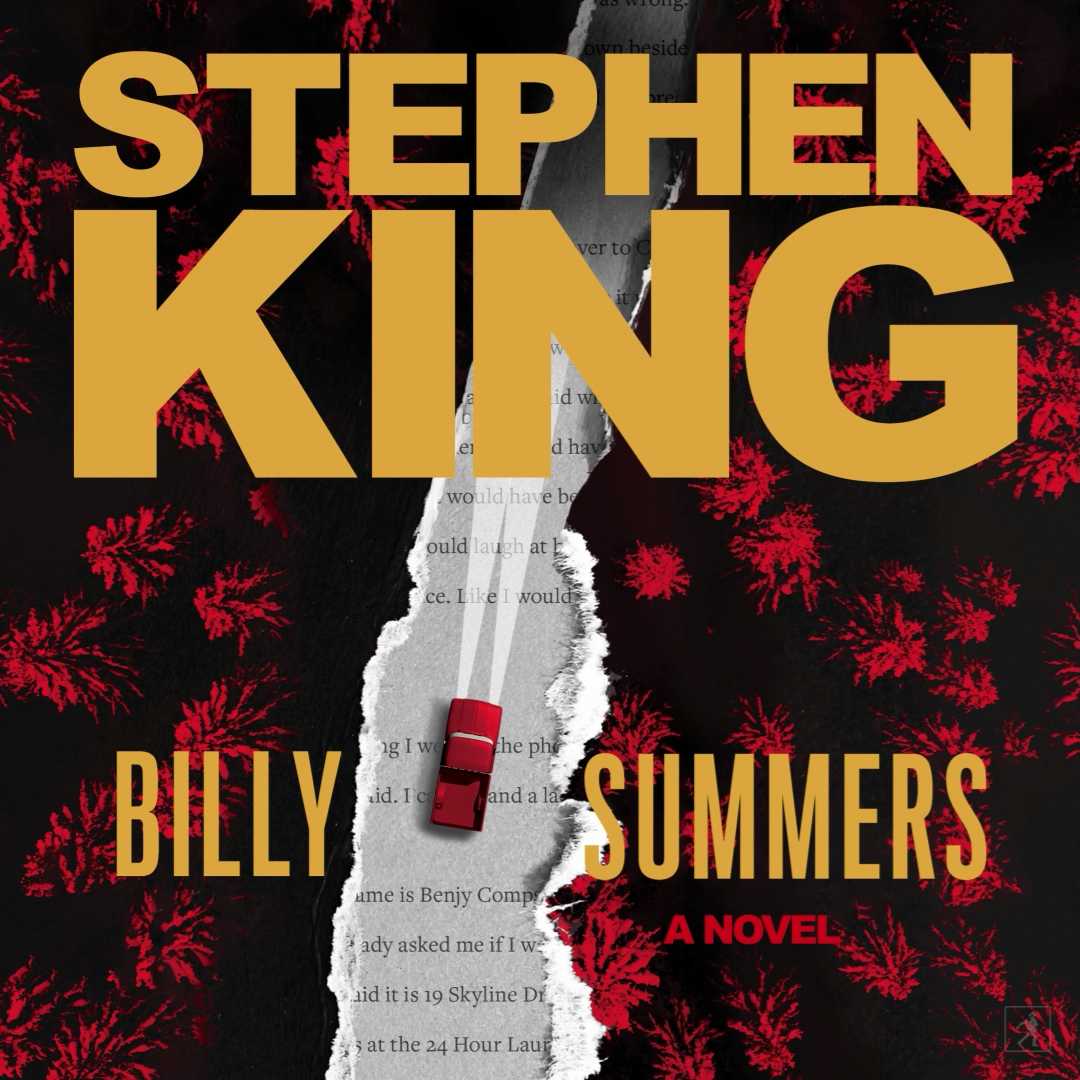
BOOK REVIEW: Billy Summers by Stephen King


Billy Summers is the seventh book of Stephen King’s that I have read. Although he is most well-known for his horror fiction (especially classics such as It, Pet Sematary, Carrie, The Shining, Salem's Lot, Misery and The Stand) I have only read his work in the genres of science fiction (11/22/63) and suspense-thriller (The Institute, The Outsider, Mr. Mercedes, Finders Keepers, End of Watch). King’s latest suspense thriller is Billy Summers, and like almost all of his work, has garnered thousands of ratings and reviews on Goodreads with an enviably high average score (4.27 on a 5-point scale). I begin this review with this information to encourage the reader to think beyond the labels and boundaries of genre; King is simply a consummate storyteller and he writes incredibly readable books. (That being said, I have no intention of reading any of his horror novels any time soon and I still get annoyed when he incorporates supernatural elements into otherwise “straight” mystery/suspense books.)


Billy Summers is a story centered around the title character, who we quickly find out is an assassin for hire; a Gulf War veteran who has been able to monetize his skill and training as a military sniper to help eliminate “bad guys” for money. In Billy Summers, King is setting up and playing with numerous familiar tropes (the criminal/bad guy with the heart of gold, the “one last heist” scenario, and the “if it’s too good to be true, then it probably is.” In fact, the set up IS too good to be true: Billy is being offered a huge sum of money, big enough that this could be his last hit, to kill a guy who he is told has previously killed someone. As I said, the story is centered around Billy and it is told primarily through his eyes, so the reader experiences everything from his perspective. This narrative technique basically insures that even though we know that Billy kills people, we are pretty sure (or we want to believe) that Billy’s not REALLY a bad guy, i.e. he has a heart of gold. As we learn more about the hit Billy is supposed to pull off it appears sketchier and sketchier. The guy who is hiring Billy directly is someone who has done so before and is clearly in the mafia; he’s just a front for the actual person who wants the mark dead, and THAT person remains unknown. There’s another dude involved in creating and maintaining Billy’s cover (as an author who is renting an office in a high-rise with bird’s eye view of the kill spot) who Billy takes an instant dislike to and appears to have the charm (and possibly, ethics) of a used-car salesman.


As the story goes along we follow Billy as he befriends his neighbors in the house that has been rented for him for the summer as well s the other tenants in the office building where he "works" everyday. He seems like a really good guy: is he really going to go through with the killing? I don’t want to include spoilers so I won’t answer that question except to say that everything does not go as planned that day and Billy ends up on the run, being hunted by the mob. 


Right after the day of the hit is planned for the book takes a surprising turn by introducing a new character whose relationship with Billy complicates his plans  for what to do after the events of the day the hit was planned. It’s an interesting stylistic choice by King because Billy Summers becomes a very different book from that point on.


One of the more interesting aspects of Billy Summer is that Billy uses his cover story as an author working on a book on a deadline to actually write a book. He writes the story of his life, beginning around 8-years-old when Billy was forced to kill his mother's boyfriend after that guy had just killed Billy's 5-year-old sister, continuing through his decade or so at a group foster home, his enlistment in the Marines before his 18th birthday and details of his service in Iraq which led to multiple commendations and medals. King depicts the text of Billy's book in a different font and so another trope gets added to Billy Summers (the story within the story). At some points that story of Billy's past becomes more interesting/compelling than the main story of Billy's present and future.


In the end, I didn't like Billy Summers as much as I liked some of King’s other books that I have read such as The Institute, The Bill Hodges trilogy and 11/22/63, but there’s no question  that his signature use of suspense and thrills are as effective as ever. I do appreciate that he was able to sustain this level of engagement with the reader without deploying any supernatural events at all. However, I think the difference between Billy Summers and those others books (which also mostly have limited supernatural elements) is that it’s hard to completely identify with a main character who really does kill people for money, regardless of what a horrific childhood he had. That’s not to say the book is bad or fails to entertain, it’s better than a lot of books and it definitely is entertaining to read. It’s just that Billy Summers doesn’t completely match the ridiculously high standard of “Sheesh, that was a good book!” that one typically has after finishing a Stephen King novel.

Title: Billy Summers.
Author: 
Stephen King.
Format: Hardcover.
Length: 515 pages.
Publisher: Scribner.
Date Published: August 3, 2021.
Date Read: February 8, 2022.

GOODREADS RATING: ★★★★  (4.0/5.0).

OVERALL GRADE: A- (3.75/4.0).

PLOT: A-.
IMAGERY: A-.
IMPACT: A-.
WRITING: A.

Thursday, October 28, 2021

BOOK REVIEW: Cross and Burn (Tony Hill / Carl Jordan, #8) by Val McDermid


Cross and Burn is the eighth installment in the British police procedural crime thriller series written by Val McDermid featuring psychological profiler Dr. Tony Hill and Detective Chief Inspector Carol Jordan set in the Manchester suburbs of Bradfield in the north of England. This series is one of the most exciting and compelling entries in the multiple genres that it occupies (which include suspense thriller, British police procedural, and murder mystery). It is also one of the rare series that has both a male and female lead in a primarily non-romantic relationship.


I hadn’t read one of McDermid’s books in a while so I had forgotten about one of the most effective aspects of her books, which is the inclusion of first-person perspectives of future crime victims. By doing this, she connects the reader to the characters and increases the impact of their deaths at the hands of the homicidal psychopaths that tend to populate her books. It’s also surprising because many authors generally use first-person mode to indicate important characters who may be placed in extreme peril and ultimately survive, but McDermid seems to be unafraid of killing off these characters. It's not like they always die or always survive, so the uncertainty ratchets up the suspense in the reader.


As I have said before, one of the added pleasures of reading a long-running series in order that have a repeated primary protagonist (like Jane Casey’s Maeve Kerrigan, Stephen Booth’s Cooper & Fry, Peter Robinson’s Alan Banks or Peter James’ Roy Grace, for example) is the deepening relationship the reader has with the characters due to increased familiarity via repetition. In the Hill & Jordan series, the two have gone through a lot together, especially in the previous book’s The Retribution which resulted in the horrendous death of Carole Jordan’s only brother and his female partner. This happened as a direct consequence of her and Tony’s work of hunting and capturing a serial killer (who escaped and went on a killing spree). It causes Carol to (irrationally) blame Tony for his inability to realize that once the serial killer had escaped that his revenge might have included her family, quit her job as a police officer, and cut off all contact with Tony and her former colleagues in the Bradfield Metropolitan police department.


In addition to including first-person perspectives of victims McDermid often includes first-person perspectives of the perpetrator as well. This is something other suspense thriller authors do as well, but generally not as cleverly as she does. In Cross and Burn, the reader watches with horror while a deranged male chauvinist targets women who happen to resemble Carol Jordan, capturing them, making them play out his twisted vision of a “perfect subservient wife” and then eventually killing them when they fail to meet his insane “standards.” Through back channels Tony is brought in to help with the case by DI Paula McIntyre when she’s approached for help by the teenage son of a missing woman who works in the same hospital as her wife. For some reason Paula’s new boss decides that circumstantial evidence tying Tony to one of the disappearances of a woman later found dead means that he is likely the serial killer the Bradfield police are looking for. The only good outcome of this bizarre development is that it gets Carol out of her mourning funk enough to try and help Tony fight the charges.


Another one of the notable features of McDermid’s books are the (sometimes gory) scenes of violence and torture. She doesn’t shy away from the depiction of the horrors that violent crimes, both physical and psychological, can produce. Despite this, her books are always entertaining, well-plotted and memorable. In fact, overall Cross and Burn is an example of a master working at the height of her craft, cementing her status as one of the best in the business by creating another spine-chilling entry in her long running series.

Title: Cross and Burn (Tony Hill & Carol Jordan, #8).
Author: 
Val McDermid.
Format: Kindle.
Length: 438 pages.
Publisher: Mariner Books.
Date Published:  October 22, 2013.
Date Read: October 8, 2021.

GOODREADS RATING: ★★★★½☆  (4.5/5.0).

OVERALL GRADE: A-/B+ (3.5/4.0).

PLOT: B+.
IMAGERY: B+.
IMPACT: A-.
WRITING: A-.

Thursday, September 16, 2021

BOOK REVIEW: Someone Else's Skin (DI Marnie Rome, #1) by Sarah Hilary

Someone Else’s Skin is the first book in Sarah Hilary’s Detective Inspector Marnie Rome series. The first book is a pretty standard British police procedural mystery but has some notable and unique aspects. (I just realized that most British police procedurals I read are murder mysteries but there is no dead body in Someone Else’s Skin—only other several serious crimes: attempted murder, kidnapping, sexual battery, wounding and violent sexual domestic abuse.) The primary way in which the Marnie Rome books are different from most police procedurals is Marnie herself. When she was in her early twenties and working as a police officer, Marnie’s mother and father were murdered violently by an adopted son who they had fostered soon after Marnie left home at age 18. The fact that her job is to solve major crimes when she herself is a victim of one is a key difference between the DI Marnie Rome series and others in the genre.


Another strength of this first Marnie Rome book are the secondary characters. For example, her sergeant is Noah Jake, an openly gay, biracial (Jamaican-British) police detective with a handsome, blonde-haired, blue-eyed boyfriend. Her boss is Tim Welland, who was the supervising officer for Marnie’s parents’ crime scene. Marnie’s potential love interest is Ed Belloc, a good-looking guy who works in Domestic Violence Victim Support Services. Unusually, the perpetrator in Someone Else’s Skin is also a highlight of the book (typically I usually find myself less interested in the criminals in the police procedurals I read). 


The plot of Someone Else’s Skin is suspenseful. Both Marnie and Noah get placed in extremely dangerous situations and since it’s the first book, it seemed possible that one or both of them might not make it through to the end of the story without harm.


Overall, I found Someone Else’s Skin quite a strong entry in the British police crime procedural genre: I like that the main character is a female detective and enjoyed the characterization of DS Noah Jake. I look forward to reading the other books in the series. Soon!

Title: Someone Else's Skin.
Author: 
Sarah Hilary.
Format: Kindle.
Length: 423 pages.
Publisher: Headline Books.
Date Published: August 28, 2014.
Date Read: January 4, 2020.

GOODREADS RATING: ★★★★☆  (4.0/5.0).

OVERALL GRADE: A- (3.67/4.0).

PLOT: A-.
IMAGERY: A-.
IMPACT: A-.
WRITING: A-.

LinkWithin

Blog Widget by LinkWithin