Showing posts with label James S.A. Corey. Show all posts

Wednesday, November 30, 2022

BOOK REVIEW: The Shattered Skies (The Cruel Stars, #2) by John Birmingham


The Shattered Skies by John Birmingham is the second book in the space opera science fiction trilogy called the Cruel Stars. Birmingham has summarized the Cruel Stars trilogy as “Space Nazis invade and try to ruin everything, everywhere, all over the galaxy.” I quite enjoyed reading the first book in the series The Cruel Stars earlier this year and as soon as I finished it I wanted to read the next one in the series and was quite happy to see that it was available. Sadly, the third book in the series is not scheduled to come out until next year. Middle books in trilogies have a reputation for disappointing the reader but in this case The Shattered Skies bucks the trend and continues the story begun in The Cruel Stars in a way that is as exciting, entertaining and engrossing as the first book.
In addition to the five main characters from The Cruel Stars, Lucinda Chase, Frazer McLennan, Sephina L’trel, Princess Alessia and Booker, The Shattered Skies introduces two new POV characters in Captain Anders Revell, an aide-de-camp of a high-ranking Sturm military leader who is investigating the surprising defeat that befell the Sturm in the first book, and Sub-commandant Domi Surprarto, a underling suddenly promoted to captain of the Javan Navy ship Makassar after the Sturm malware turns the top brass into mindless zombies.
The Shattered Skies has the same frenetic action, snarky humor, political intrigue and social commentary of  The Cruel Stars. Additionally, the author uses the addition of the new characters to provide a more nuanced view about the two warring sides in the Sturm-Volume war. In the first book, we are basically introduced to the Sturm as galaxy-invading ideological zealots who want to kill everyone who is not a “pure human” if they have had any technological or genetic modifications. And so our assumption is that the people opposing the Sturm are the good guys. However, by giving us Revell’s POV we see that he is quite passionate about his belief that he’s fighting for the “good” side and we see that the Sturm are providing aid and comfort to people (like Lucinda’s father) who have been abused and exploited in a debtors prison planet that they liberated. The fact that the "good guys" support a system where debtors prisons are a real thing begins to raise niggling doubts about the righteousness of their cause. Also, by getting Suprarto’s POV we see that some of the “Allies” on the good guys’ team (like the Javan Army and the Yulin-Irawaddy Collective) have problematic characteristics (they’re extremely hierarchical, rife with corruption and selfish and self-centered). This makes for a more interesting read because as the stakes of the military conflicts go up, the reader starts to more seriously question who they want to win this battle. Which vision for civilization do we really want to prevail? The Sturm's neo-Luddite view of unaltered "natural" humanity? Or the competing corporate capitalist view where single families can own entire planets and control the lives of every sentient being on their "property"? How should the choice be decided? That the Cruel Stars books even raises these questions puts it above most other books in the military sci-fi/space opera genre.
Overall, The Shattered Skies is an excellent space opera, with interesting characters, well-depicted action sequences, neat technology and an exciting plot. Hopefully, the story will all be resolved in the third and final book of the trilogy, expected in summer 2023 (currently I have seen two proposed titles on the internet, The Forever Dead and The Empty Heavens). Whatever it’s called, this book will be on my must-read list!

Title: The Shattered Skies (The Cruel Stars, #2).
Author: 
John Birmingham.
Format: Kindle.
Length: 432 pages.
Publisher: Del Rey Books.
Date Published: January 11, 2022.
Date Read: October 24, 2022.

GOODREADS RATING: ★★★★½☆  (4.5/5.0).

OVERALL GRADE: A- (3.67/4.0).

PLOT: B+.
IMAGERY: A-.
IMPACT: A-.
WRITING: A.

Wednesday, November 23, 2022

BOOK REVIEW: The Cruel Star (The Cruel Stars, #1) by John Birmingham


The Cruel Stars by John Birmingham is the first book in a space opera science fiction trilogy with the same name. Birmingham has summarized the Cruel Stars trilogy as “Space Nazis invade and try to ruin everything, everywhere, all over the galaxy.” This is the first book by this author I have read; I did so because a machine learning algorithm recommended The Cruel Stars to me because I have either read, bought or borrowed related/similar books (like The Expanse books by James S.A. Corey and The Final Architecture trilogy by Adrian Tchaikovsky) that led the computer program to extrapolate that I would also enjoy this one. And you know what, the code was right, people, because I completely loved reading The Cruel Stars!
The structure of the book will be quite familiar to regular readers of fantasy and science fiction. The story is told via chapters from the perspective of different characters, similar to the structure of George R.R. Martin’s The Song of Ice and Fire and James S.A. Corey’s The Expanse. The five main characters of the The Cruel Stars are Lucinda Chase, a newly minted war hero who gets a field promotion to captain of her ship when the enemy’s sneak attack decapitates the senior leadership of the entire Armadalen military; Frazer McLennan, a foul-mouthed military genius from Scotland turned archaeologist who killed millions of Earth citizens in order to save billions by almost entirely wiping out an invading  army over 700 years ago and by miraculous advances in medicine is still alive (but decrepit); Sephina L’trel, a foul-mouthed lesbian space pirate who leads a small team of violent mercenaries burning to get revenge on the people who killed their loved ones; Princess Alessia Szu Suri sur Montanblanc ul Haq, the 12-year-old scion of an incredibly rich and powerful family who owns and rules the entire planet of Montrachet as well as a galaxy-spanning financial empire; and Corporal Booker3-212162-930-Infantry, a human being who has downloaded his mind into software as a member of a belief system called The Source. 
Each of these characters gets their own POV chapters as the story progresses, demonstrating their importance to the plot. However my favorite character in The Cruel Stars is not one of these previously mentioned POV characters, it’s Herodotus, who is an “Armada-level Intellect,” which means he is a sentient artificial intelligence with technological powers that are near god-like (such as the ability to teleport or “fold space” at will and near-infinite data processing capacity and speed) along with an incredibly snarky attitude. (Come for the god-like computer, stay for the snark!)
In The Cruel Stars we discover that the Sturm, also known as The Human Republic, the group that McLennan defeated hundreds of years ago (and has not been heard of since) has returned to continue their genocidal war against all humans who have modified their bodies with either technological or genetic enhancements. In the beginning of the book we discover that The Sturm has launched a devastating first strike in the form of a successful malware attack that turns any humans with technological implants who were accessing the galactic equivalent of the Internet at the time into brain-devouring zombies. 
The return of The Sturm has life-altering consequences for all of our main characters. Lucinda becomes the captain of her ship, the Defiant, because all the higher ranked officers are struck down by the Sturm malware. Alessia becomes the sole living representative of her family, as the few remaining relatives who were not affected by the initial attack were killed in a grisly execution broadcast galaxy wide. McLennan is captured by the Sturm while conducting an archaeological dig at a site the Human Republic considers sacred but is rescued by Herodotus after only some mild torture has occurred. Sephina has a lucrative heist interrupted and then watches the love of her life slaughtered by Sturm weapons hours after the initial attack. The only person who is positively impacted by the return of the Sturm is Booker, who is in prison sentenced to be permanently deleted at the vey moment the malware attack strikes his penal colony. The warden makes a deal to allow Booker to escape and promises to put in a good word with future authorities if Booker uses his military expertise to fight back and save lives on the prison habitat. Booker agrees to the deal, keeps his end of the bargain and escapes into space implanted in the operating system of a huge security robot.
Overall, The Cruel Stars is a fantastically entertaining space opera with lots of action, humor and violence. The characters are compelling and world-building intriguing. It’s reminiscent of the very best work of Peter F. Hamilton; fans of Hamilton should also read (and I am confident will enjoy!) The Cruel Stars.

Title: The Cruel Stars.
Author: 
John Birmingham.
Format: Kindle.
Length: 416 pages.
Publisher: Del Rey.
Date Published: August 20, 2019.
Date Read: October 17, 2022.

GOODREADS RATING: ★★★★½☆  (4.5/5.0).

OVERALL GRADE: A- (3.67/4.0).

PLOT: A-.
IMAGERY: A-.
IMPACT: A-.
WRITING: A-.

Friday, February 25, 2022

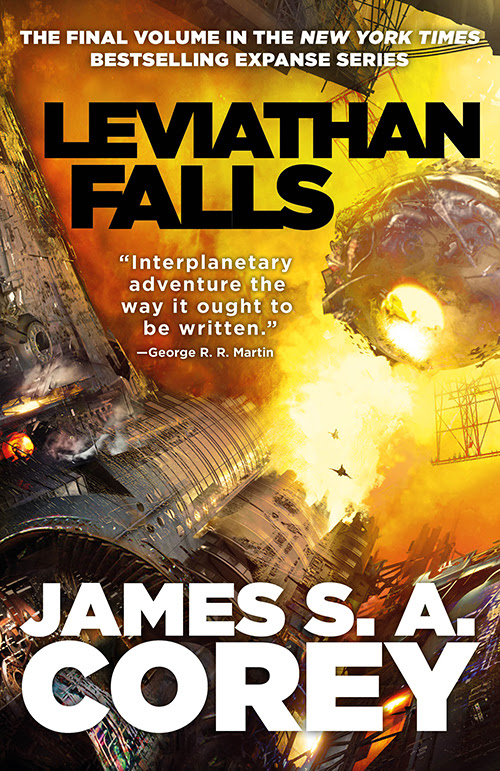
BOOK REVIEW: Leviathan Falls (The Expanse, #9) by James S.A. Corey


Leviathan Falls is the ninth and final book in the bestselling space opera series called “The Expanse” written by James S.A. Corey (which is a pseudonym for the writing duo of Ty Franck and Daniel Abraham). The Expanse has been adapted for television and has become a hit show with the same name on Amazon Prime that recently concluded with its sixth and final season in January 2022. It’s an amazing feat that the authors were able to write and publish all nine books in the series in roughly 10 years: Leviathan Wakes (2011), Caliban’s War (2012), Abaddon’s Gate (2013), Cibola Burn (2014), Nemesis Games (2015), Babylon’s Ashes (2016), Persepolis Rising (2017), Tiamat’s Wrath (2019) and Leviathan Falls (2021).

Most of the titles of the books in the Expanse have always had a somewhat Delphic quality to them, since they don’t seem to directly relate to or describe the events that occur in them. But the authors were pretty direct when they titled the last book Leviathan Falls in a clear echo of the first book’s title Leviathan Wakes. Another interesting aspect of the book series is that the nine books can be thought of as a trio of trilogies. This last impression is bolstered by the fact that the final three books take place nearly 30 years after the events of the first six books so that Persepolis RisingTiamat's Wrath , and Leviathan Falls work together as a separate trilogy to conclude the story that began in Leviathan Wakes .

The great thing about Leviathan Falls is that even though it’s the last book in a 9-part space opera series it still tells a self-contained story. Just like every other book in the series, at its core this is a story about a chosen family of four characters: Amos, Naomi, Alex and James. Of course the crew of Rocinante has been through a lot since we were first introduced to them in Leviathan Wakes but they are still the hooks on which the principal story in The Expanse hangs thousands of pages later.

In Leviathan Falls the family the reader has come to know so well over the first eight books is expanded to include other characters, such as adopted family members like Elvi Okoye and Teresa Duarte and actual family members like Alex’s son Kit, Kit’s wife and their newborn child. There are even some new characters introduced in Leviathan Falls that have significant impacts on the outcome of the series’ overall plot. Chief among those would have to be Aliana Tanaka. Tanaka is a Colonel in the Laconian Intelligence Directorate who is tasked with tracking down the head of the Laconian government, Admiral Winston Duarte (Teresa’s dad).   Duarte had a mysterious interaction with an alien entity in Tiamat’s Wrath that left him physically and mentally capacitated but in the beginning of Leviathan Falls he seems to have recovered and used some kind of mysterious alien technology to leave Laconia.  Since Laconia is basically an authoritarian empire with Duarte as it’s head, that he was incapacitated and that now he’s missing are two incredibly important (and sensitive) pieces of information that the de facto head of the Laconian government, General Anton Trejo, is trying very hard to suppress. He’s the one who gives Tanaka her carte blanche to track Duarte down by whatever means necessary.

In Persepolis Rising, Laconian forces burst out of their ring gates with protomolecule-fueled spaceships that were far more technologically advanced than anything in the Galaxy and quickly took over control of the solar system, which even 30 years after the events of Babylon’s Ashes still contains a plurality of the entire human population in our galaxy. Eventually Laconia takes over all of the Ring gates, and in doing so, maintains control over all 1300 potential systems where humans have been settling since the gates were discovered by James Holden in Abbadon’s Gate. Due to their alien-enhanced ships, Laconia has superior military firepower to any other human government and Duarte has basically declared himself Emperor of humanity. The Resistance to Laconia has been run principally by Naomi Nagata, Bobbie Draper and Alex Kamal for decades.

As the story in The Expanse has advanced, the plot of the struggle for supremacy between different factions of humanity during the race to colonize and control the solar system has slowly been subsumed by the greater mystery of what happened to the alien intelligence who created the ring gates and the protomolecule and the other alien intelligence who eliminated the ring-builder aliens.

The ring-builder aliens are long gone but their vanquishers remain, and it has become clearer and clearer they are very powerful and very pissed off at the latest intelligent aliens (i.e. humans) to use the ring gates. They have the ability to alter the physics of space-time temporarily in localized regions, and this sometimes results in all human consciousness being affected for brief periods of time. Literally every human being stops thinking for say 15-20 minutes on multiple planets simultaneously. If they could eliminate all human consciousness by making the effect last permanently, it seems like they would. And the blackout periods are becoming more frequent.

Thus in Leviathan Falls the stakes of the plot have been raised to the highest possible level: it is about the survival of humanity itself (or at least humans as self-aware individuals). But even as this story unspools, the author(s) keep(s) the focus on our four main characters, with each of their arcs being resolved by the end in ways that seem incredibly well-aligned with how each has been depicted through the entire series. And so the story ends. Or so the reader thinks, but then there’s an epilogue, which like icing on the cake or a cherry on a sundae, is really the perfect ending to an enjoyable experience. There are reports that Ty Franck and Daniel Abraham knew the last sentence of the last book multiple years before it was published and I believe (and want to believe) that this is true. It definitely left me with a smile on my face, and I believe it will leave everyone else who reads the entire series with one as well.

Title: Leviathan Falls (The Expanse, #9).
Author: 
James S.A. Corey.
Format: Hardcover.
Length: 528 pages.
Publisher: Orbit Books.
Date Published: November 20, 2021.
Date Read: December 25, 2021.

GOODREADS RATING: ★★★★  (5.0/5.0).


OVERALL GRADE: A (4.0 /4.0).

PLOT: A.
IMAGERY: A-.
IMPACT: A+.
WRITING: A.

Friday, December 13, 2019

The Expanse Season 4 Is Available NOW on Prime Video!


Now that Game of Thrones is off the air, my favorite television show is The Expanse, based on the amazing 9-book space opera series written by James S.A. Corey is my favorite show. After the first 3 seasons aired on SyFy, that network failed to pick up the show but it was revived at Amazon Studios, which has produced Season 4 (based on Cibola Burn) and is currently in production on Season 5 (based on Nemesis Games). Season 4 (all 10 episodes!!) is now available for streaming on Amazon Video. Once my semester is truly over I expect to binge all 10 before the end of the year!

Saturday, July 27, 2019

The Expanse Season 4 Premiere Date Is December 13; Season 5 Is a Go!


There is absolutely awesome news about The Expanse, the television adaptation of my favorite space opera novels of the same name written by James S.A. Corey. The first three seasons (covering the first 3 books) aired on SyFy which then cancelled the show. But it was picked up by Amazon Prime after an energetic campaign by fans (like yours truly), The release date for Season 4, which is based on Cibola Burn (not my favorite of the books) is December 13, 2019. But also announced (today!) is that the show has been renewed for season 5 on Amazon Prime, which presumably will be based on Nemesis Games, which is probably the best book of the 9-book series. It features an "oh @!$@&*#!!" moment akin to the Red Wedding in Game of Thrones which I absolutely can not wait to see.

Meanwhile here's an official synopsis for The Expanse Season 4 from Amazon Prime Video:
Season 4 of The Expanse, its first as a global Amazon Original, begins a new chapter for the series with the crew of the Rocinante on a mission from the U.N. to explore new worlds beyond the Ring Gate. Humanity has been given access to thousands of Earth-like planets which has created a land rush and furthered tensions between the opposing nations of Earth, Mars and the Belt. Ilus is the first of these planets, one rich with natural resources but also marked by the ruins of a long dead alien civilization. While Earthers, Martians and Belters maneuver to colonize Ilus and its natural resources, these early explorers don’t understand this new world and are unaware of the larger dangers that await them.

Thursday, June 06, 2019

BOOK REVIEW: Tiamat's Wrath (The Expanse, #8) by James S.A. Corey


Tiamat's Wrath is the eighth and penultimate book in The Expanse series by James S.A. Corey.
I have eagerly bought and quickly devoured each of the previous books in this fast-paced, high-quality space opera after I stumbled into the first one, Leviathan Wakes, giving it a chance because of  the recommendation from George R.R. MartinThis series (and the author) are at the very top of the short list of my favorite reads and authors. (Others on this list would be anything by Peter F. Hamilton, Tana French, and Richard K. Morgan.)

Tiamat's Wrath takes place a few years after the events depicted in Persepolis Rising. The main characters of the series (James Holden, Alex Kamal, Naomi Nagata, and Amos Burton) are scattered across multiple star systems while more recent additions to the crew/family like Clarissa and Bobbie have also experienced big changes since they were added to the original inner circle. 

Tiamat's Wrath begins with the news of the death of Chrisjen Avasarala, one of the most popular characters in the series (played irrepressibly by Shohreh Aghdashloo in the television adaptation of the books) and probably my favorite character in The Expanse overall. That devastating news basically sets the tone for Tiamat's Wrath, because since it is the penultimate book it is becoming more likely that not all characters will survive each installment, and clearly not everyone is going to make it to the conclusion of the story. In fact, Tiamat's Wrath has the biggest body count of significant characters who die in any of the previous books in the series. In addition to Avasarala, there are other significant deaths in Tiamat's Wrath as well, which I won't mention here but are shocking and saddening when they occur.

The situation in Tiamat's Wrath  is definitely not good for our heroes and for most of humanity in the solar system and the nearly 1300 other star systems that can be accessed by the alien gates discovered at the end of Book 3, Abaddon's Gate. By dint of superior technological and military firepower (fueled by the mysterious alien entity called "the protomolecule" discovered in Book 2, Caliban's War), High Consul Winston Duarte of Laconia is now the de facto Emperor of the known Galaxy and Bobbie, Alex, and Naomi are trying to organize what little resistance there is to Laconian hegemonic rule of humankind. Holden is a prisoner on Laconia, an "honored guest" (read: prisoner/hostage) of Duarte and has been for years since the events at the end of Persepolis Rising. Amos is missing and assumed dead after not being heard of for years after volunteering for a special ops mission on Laconia several years before. Naomi has put herself into a self-imposed isolation as she works as the chief strategist for the Laconian resistance. Alex is piloting the Resistance's biggest ship under Bobbie's command.

The POV characters we get in Tiamat's Wrath are Elvi Okoge (an exobiologist who we first met in Book 4, Cibola Burn, who is now an important scientist in the Laconian Science Directorate), Alex, Bobbie, Naomi, Holden and a surprising new one: Teresa Duarte, the 14-year-old daughter of the most powerful man in the known Universe, Winston Duarte.

While the main storyline is how our main characters fight (and die!) to resist (and successfully!) end Laconian domination of the Sol system and others, another even more important story is how the aliens who destroyed the other aliens who developed the ring gates are apparently trying to figure out a way to eliminate the consciousness of every human in every system where humans live. It is clear those aliens know how to affect the consciousness, because during the course of Tiamat's Wrath there are multiple times that the entire human race (on all planets) simultaneously loses consciousness for a brief (but not insignificant) time. Only Elvi seems to realize how serious the threat to all human life is; all the other main characters are focused on the Laconian threat.

One of the most intriguing aspects of the plot in Tiamat's Wrath is the inside look at the putative Laconian Empire, as seen from the perspective of the 14-year-old Teresa. The way that everyone defers to Winston Duarte, and  by extension his daughter is fascinating (and frightening). The warping of the social fabric of an entire society is clearly depicted and manifests in unusual ways. For example, crushes and friendships between teenagers are nonsensical when one member of the group has the ultimate power to have anyone expelled, vanished or worse. We also get the perspective of Naomi Nagata as she becomes the head of the underground resistance and finds a way to undermine the seemingly omnipotent Laconian empire, even as the attacks by the evil aliens become more disruptive.

For me, an incredibly attractive aspect of Tiamat's Wrath and The Expanse series as a whole is the diversity of the characters. This is (obviously)  easier to see in the television adaptation but the authors make it explicit in the book as well. Non-white characters (such as Naomi, Elvi, the Duartes, Cortázar and Bobbie, to name a few) have incredibly significant parts to play in the story. The inclusion of non-heterosexuality happens casually but intentionally among various secondary characters which for an LGBT reader like myself is quite affirming. The effort to be consciously inclusive is a clear feature of the book (and show).

SPOILER ALERT!!


By the end of Tiamat's Wrath  our four main characters are actually back together (on the Rocinante no less!) which was incredibly satisfying (if a little improbable). It brought back nostalgic memories of where the entire story began, way back in Book 1. It’s nice that Book 8 basically has a “happy ending” but this does make me suspicious that Book 9 may not....

Regardless, things are teed up perfectly for an exciting conclusion to the entire 9-book series in the final book. I can't wait!

OVERALL RATING: FIVE STARS

Title: Tiamat's Wrath (The Expanse, #8)
Author: 
James S.A. Corey.
Paperback: 534 pages.
Publisher:
 Orbit.
Date Published: March 29, 2013.
Date Read: May 24, 2019.

GOODREADS RATING: 
★★★★  (4.0/5.0).

OVERALL GRADE: A (4.0/4.0).

PLOT: A-.
IMAGERY: A-.
IMPACT: B+.
WRITING: A.

Thursday, January 03, 2019

BOOK REVIEW: The Witch Elm by Tana French


Wow! Tana French proves yet again why and how she is the Queen of Literary Mystery Fiction. After writing six (ok, maybe five) exquisite entries in what is now known as the Dublin Murder Squad series, French decided to release a standalone mystery The Witch Elm (or The Wych Elm) which is not even indirectly connected to her much-celebrated prior works. When I discovered in late September that Tana French had a new book coming out soon, I pre-ordered the hardcover from Amazon instantaneously. There are a handful of authors for whom I do that for (Peter F. Hamilton, James S.A. Corey, Richard K. Morgan come immediately to mind) and there are none others in the mystery fiction area (although new books by Ian Rankin, Louise Penny, Adrian McKinty and, more recently, Val McDermid are all on my must-read-as-soon-as-I-can list).

The Witch Elm  is very different from French’s other books, which are generally police procedurals set in the context of murder mysteries and generally have police detectives on the Dublin Murder Squad as the main character for whom we get first-person perspectives.

Instead, The Witch Elm has Toby Hennessy as the main character, and for an extraordinarily long period of time (well over 100 pages, possibly close to 200) there is no sign of a dead body and no sign of anyone from the Dublin Murder Squad. There goes Tana again, breaking those genre rules and upending her readers expectations!

Toby is a very odd choice for a main character of a book that ends up being an intricately plotted murder mystery, since he’s a 20-something, blonde, attractive, upper class white guy who begins the book basically bragging about how lucky he is. His charmed life is shattered by a scene that happens very early in the book, where sudden violence befalls Toby, leaving him injured and potentially permanently incapacitated (due to a vicious blow to the head).

French is deploying and deconstructing the literary device of the unreliable narrator as a central trope of the book. Toby potentially has permanent brain damage which affects his perception of events around him as well as his memory. We the reader literally can not believe what Toby perceives to hear and see. But it also becomes clear that Toby has always been oblivious to what goes on around him due to his inability to perceive the effects of marginalization on people who do not share his class and gender.

As the plot develops (and the dead body finally arrives) we are engulfed by a complicated and multifaceted network of familial relationships that involve jealousies, slights and resentments which are sourced from events in the characters’ pasts. Toby is the only child of a pair of well-to-do parents (mom is a professor and dad is a barrister) and has grown up with two other similarly situated cousins, Susanna and Leon, who are about the same age and attended the same secondary schools as Toby. They have literally known each other their entire lives and in some sense are closer than some siblings. Their parents all vacationed together and  would regularly leave the 3 kids for weeks at a time during holidays at the home of their parents unmarried brother Hugo, at a grand old house called The Ivy House. Even now, when Toby, Susanna and Leon are nearly 30 and their grand-uncle Hugo is nearly 70 the extended family (Susanna is married and has 2 kids of her own, Toby has a longtime girlfriend named Melissa) attend weekly Sunday dinner at The Ivy House, which  almost serves as another character in the book. French delights in using her command of the language to describe its coziness and provides the reader with a real sense of place. It’s during one of these Hennessy family gatherings that a human skull is discovered in the wych elm on the grounds of the Ivy House, leading to multidirectional finger pointing and eventually actual suspicion between various pairings in the trio of cousins about how much and what each of them knows or remembers about the past and the supposed suicide of a teenaged classmate 10 years before. The notion of suspecting and being an object of suspicion of the people whom you have literally grown up with animates the emotional resonance of the book.

French uses the evanescence and plasticity of memory as another trope with which to redirect the suspicions of Toby, our unreliable narrator and the reader towards various possible suspects. She also (somewhat rashly) seizes the opportunity to conduct another anthropological survey of the social lives and mores of Dublin teenagers. This was at the heart of what I think of as her worst book, The Secret Place, which revolves around the discovery of the body of a teenage boy on the grounds of a posh private girls school. Happily, I think she’s more successful and insightful at the portrayal of modern-day teenage life in The Witch Elm. I am curious as to why French wanted to return to depicting that particular milieu when there are so many others to choose from.

Typically, for me, the joy of reading a Tana French novel has been sourced in her mellifluous, oftentimes  surprisingly piquant prose as she describes conversations between characters who are usually experiencing the worst times of their lives, either during a police investigation into the death of a loved one or recalling situations that dredge up the emotions and feelings that led someone they knew to commit (and/or conceal) a murder. Happily, that Tana French is well represented in The Witch Elm. What is missing this time is the voyeuristic perspective she usually provides the reader by allowing us to see the discovery, detection and resolution of crime(s) through the eyes of a member of the Dublin Murder Squad. Surprisingly, this is a minor loss.

Another feature of a French novel is her penchant for breaking the rules of the detective mystery form she is writing in. From the unresolved issues in her brilliant debut novel In the Woods and the stunning audacity of The Likeness to her clever refusal to center multiple books on the same detective(s) in her ongoing mystery series, to the disastrous dabble with the supernatural in The Secret Place, French has blazed her own trail in the British police procedural genre. In The Witch Elm she goes even further, by centering the book around Toby, a self-centered, entitled “git” who is oblivious to his own privilege (and prejudices). French is (I think) trying to reveal and skewer the perspective of the Tobys of the world, while she simultaneously uses his lack of awareness to misdirect the reader to the central mystery at the heart of the novel. 

In the final chapter of the book, after the major reveal of “whodunnit,” she breaks the rules of the genre again (multiple times!) so successfully that I was forced to give her my top rating and applaud her daring. This is the case, even though early in my reading of the book I had harbored disappointed misgivings about The Witch Elm’s eventual place in French’s oeuvre (“uh-oh, I think this may be another misfire like The Secret Place!” to “Oh my goodness what just happened? I have to re-read that entire section!”). By the end I felt she had surpassed the cool, precise excellence of The Trespasser, which up to that point was in a statistical tie in my heart with Broken Harbor for my designation as her best book. The Witch Elm, in my opinion, is another example of French operating at the top of her game, expanding and demonstrating what a literary genre novel can and should be. Another triumph.

Title: The Witch Elm.
Author: 
Tana French.
Paperback: 509 pages.
Publisher:
 Viking.
Date Published: October 9, 2018.
Date Read: December 18, 2018.

GOODREADS RATING: ★  (5.0/5.0).

OVERALL GRADE: A+/A (4.16/4.0).

PLOT: A.
IMAGERY: A+.
IMPACT: A+.
WRITING: A.

Sunday, November 25, 2018

My Favorite Books Read In 2017 (Mystery, Science Fiction, Fantasy, Thriller)


In 2017 I read 60 books; as usual almost all of these were novels, primarily in the genres of mystery/thriller and fantasy/science fiction. Interestingly, the books that I read in 2017 were  dominated by the mystery/thriller category (33) with the rest pretty evenly split between the genres of science fiction (15) and fantasy (9) with a few books falling into both categories or neither. 2017 was more like 2014 when mystery/thriller predominated my reading list while in 2015 more than half the books I read that year were science fiction. In 2016, surprisingly no particular genre dominated. This is surprising (to me) because generally if I were to list my favorite genres in decreasing order it would be 1) science fiction 2) thriller 3) fantasy 4) mystery. One issue is that thriller can really be any genre (even though most of the thrillers I read are also mysteries).

I was introduced to several new authors in 2017 (Stuart MacBride,  John Sandford, Blake Crouch, Dennis Taylor, Justin Cronin, Rachel Caine, Val McDermid and Susie Steiner; I definitely look forward to reading more of books from many of these authors in the future. In 2017 I followed up my 2016 read of my first Stephen King novel (11/22/63) with the Bill Hodges trilogy (Mr. Mercedes, Finders Keepers, End of Watch).

Happily in 2017 I also read lots of book by authors whose work has previously been some of my favorite reads (Ian Rankin, Jo Nesbø, Louise Penny, Brian Staveley, Michael Connelly, Patrick Tomlinson, Peter Robinson, Brent Weeks, Adrian McKinty, N.K. Jemisin and Greg Iles). In 2017 I read not one but two books from what is currently my favorite series, i.e. The Expanse by James S.A. Corey. The sixth book, Babylon's Ashes, was released in December 2016 but I didn't read it until my Hawaii vacation in January 2017 and when the seventh book Persepolis Rising was released in December 2017 I gobbled it up soon afterwards. Another favorite author, Peter V. Brett, published the fifth and final book in the Demon Cycle, The Core, nearly 9 years after the first book, The Warded Man, came out in 2009.

I'm always looking for more good books and authors to add to my "To Be Read (TBR)" pile! Feel free to make suggestions of books or authors you think I would like in the comments after seeing what books have resonated with me previously.

Below are my favorite reads for 2017 in the genres of Science Fiction, Fantasy, Mystery and Thriller.

Favorite Science Fiction Novel Read In 2017: Persepolis Rising by James S.A. Corey
As I have said before, The Expanse series is my favorite current series. This is not much of a surprise, since space opera is my favorite genre, and The Expanse is an action-packed space opera series about the human colonization of the solar system that is impacted by the discovery of alien technology. For example, in 2014 (Cibola Burn) and 2015 (Nemesis Games) a book from the Expanse series was my favorite for that year. In 2016, there were no Expanse books released and thus in 2017 Book 6 and Book 7 of the series was released: Babylon Ashes and Persepolis Rising. I was sort of disappointed with Babylon's Ashes but was very impressed with Persepolis Rising. It is quite incredible that the two authors who write together as James S.A. Corey have managed to basically stick to the schedule of an average of one book per year for seven books, even as they have been heavily involved in the adaption of their books for television as The Expanse series, the first three seasons of which have been broadcast on SyFy, but which has moved to Amazon Prime for season 4 after the cable channel declined to renew the show. In 2018 we are again not having an Expanse book, with the 8th book in the series Tiamat's Wrath having been delayed until 2019.

Runner-Up in Favorite Science Fiction Novel Read In 2017: Death's End by Liu Cixin.
Death's End is the third book in the space opera trilogy written by Cixin Liu who won the Hugo award for Best Novel for the first book in the series called The Three-Body Problem. The story is about an invasion of Earth by aliens known as Trisolarians (because their home world is surrounded by three stars). All three books are excellent and very different in their own way. The first two books (The Three-Body Problem and The Dark Forest) also appeared on my end-of-year favorite reads list for 2015 so it shouldn't be surprising that the third book appears on one as well. In Death's End the stakes for humanity grow even higher (and this is after the threat of alien invasion is resolved in quite an unexpected way!) and the time scale of the book grows longer and longer. There's not much more I can say about Death's End without revealing plot details but I can mention that it has a main character that is a female scientist and strongly encourage you to read the book. It is well-written, complicated science fiction at its very best. If it wasn't for N.K. Jemisin's The Obelisk Gate I am fairly confident that Death's End would have likely won the 2016 Hugo Award for Best Novel instead.

Honorable Mention (Science Fiction):  Children of the Divide (Children of a Dead Earth, #3) by Patrick S. Tomlinson.
One of my favorite books from a few years ago was The Ark by Patrick S. Tomlinson, the first book in the Children of a Dead Earth trilogy. As I have said earlier, I like specific genres of fiction (mystery/thriller and science fiction/fantasy) and one of the things that drew me to The Ark is that it is a rare example of a book which combines mystery and science fiction in a clever and engaging way. Children of the Divide is the third book in this series and it does an excellent job of  continuing (and possibly completing) the story that began in The Ark while still maintaining its commitment to blurring genre boundaries of science fiction and mystery. Children of the Divide is about a former detective who is now part of a small human colony on a planet trying to engage with the indigenous alien population and uncover corrupt and criminal conspiracy among the colonial leaders.

Favorite Fantasy Novel Read Novel In 2017: The Core (The Demon Cycle, #5) by Peter V. Brett
Peter Brett's Demon Cycle has been one of my favorite reads in the category of fantasy since the first entry The Warded Man appeared in 2009. Brett is definitely on the short list of my favorite fantasy authors: Brian Staveley, Brent Weeks, Michael J. Sullivan, and Daniel Abraham. The Demon Cycle is set in a world where there are different kinds of monsters (called "demons") who appear every night once the sun goes down. Demons apparently rise up from the "core" of the earth and have claws, teeth and talons and kill humans. Civilization does not have electricity  and so society is based around daytime activity because there is a strong belief that there is no way to fight against the demons. It is known that certain symbols (called "wards") can protect property from demon incursion but deep knowledge or understanding of wards and the ability to create new wards has been lost in the annals of time. When the series starts the main characters are Arlen Bales, Leesha Paper and Rojer Inn who live in an area we would recognize as similar to 18th century North America (without the slavery). One of the highlights of the series is that it proceeds (The Desert Spear) we are introduced to another pocket of humanity that lives in dry, arid area. This society we would recognize as based on 18th century Middle Eastern or Muslim living. Here the main characters are Ahmann Jardir, Inevera and Abban Haman. In The Core, Arlen, Jardir and Arlen's wife Renna take the battle against the demons to The Core in order to settle the question of which creature, corelings or humans will dominate the planet. This plot summary is a bit simplistic, because the war against the demons has many fronts and involves many other "lesser" characters. (One of the other strengths of the Demon Cycle books is the nuanced characterization of the primary and secondary characters in the series.) Brett wraps up the 5-book series expertly and satisfyingly in The Core. I am very interested in seeing what Brett will follow up the Demon Cycle with; he's a great writer.

Runner-Up Favorite Fantasy Novel Read in 2017: Skullsworn by Brian Staveley
The Chronicles of the Unhewn Throne is an epic fantasy trilogy (The Emperor's BladesThe Providence of Fire,,The Last Mortal Bond) featuring a trio of heirs (Adare, Kaden and Valyn) to the Unhewn Throne of the Annurian Empire by Brian Staveley; it was one of my favorite reads in 2015 and 2016. They are great books, built around amazing characters and featuring taut plotting, treacherous betrayals, huge battle scenes and god-like creatures. Although Adare, Kaden and Valyn are the main characters in the book, there are several side characters who make indelible impressions. One of these is Pyrre, a priestess of the God of Death. In Skullsworn, Staveley writes an entire (somewhat short) book entirely focused around Pyrre and gives us insight into how such the smart, accomplished woman we met in the trilogy became a fully-fledged and devoted member of what is essentially a death cult. Pyrre is so fabulous in the original trilogy that it is not surprising that her origin story makes for an exciting read. It is pretty difficult to write a prequel for a character we know survives this story, especially one who literally kills without compunction in service of her religious beliefs but Staveley is so talented he does it very successfully. There are many other characters in the Unhewn Throne trilogy who would also make excellent subjects of their own books (Gwenna, The Flea, to name just a few) so I hope Staveley returns to this setting soon.

Honorable Mention (Fantasy): Age of Swords (The Legends of the First Empire, #2) by Michael J. Sullivan
One of my happy discoveries in recent year has been the work of Michael J. Sullivan. His Riyria Revelation trilogy (Theft of Swords, Rise of Empire, Heir of Novron) was on my list of favorite reads for 2016. Sullivan approaches the book industry a bit differently than most authors, since he started by self-publishing his books (quite successfully) and even though his books are now published by major booksellers one is also able to buy them directly from him. He has a new epic fantasy series based thousands of years before the events of the Riyria Revelations called the Legends of the First Empire. Amazingly, he has completed first drafts of the entire 6-book series, so the books are guaranteed to be released on a pretty regular schedule. Age of Swords is the second book in the series and builds upon the setting and characters introduced in the first book, Age of Myth. Unlike the Riryia trilogies, which feature two male characters and are effectively laced with humor, this new series has a female protagonist and is primarily based on an existential conflict between the powerful Fhrey (near immortal, masters of magic and powerfully violent) and humans, who are portrayed in the Bronze age, but inventive and resource. The humans thought the Fhrey were gods until one of them was killed in Age of Myth, but there is still a sense that if the Fhrey decided to invade lands occupied by humans they could exterminate them without much trouble.

Favorite Mystery Novel Read In 2017: Flesh House (DS Logan McRae, #4) by Stuart MacBride
Comedy is so difficult to do that when I find someone who does it well I am always impressed. That Stuart MacBride is able to do this in the context of police procedural mystery thrillers is amazing. I only started reading MacBride's books about Detective Sergeant Logan McRae's adventures as part of the Aberdeen Constabulary in 2017 but already they are very near the top of my all-time list in the mystery category. It was somewhat difficult to decide which of the seven McRae books I read last year should be at the top of this list, but I think it makes sense to pick Flesh House since it is simultaneously the most thrilling and the most darkly comic of these books that I have read so far. As a DS, Logan is basically in middle management, with uniformed police and Detective Constables (DCs) beneath him, and Detective Inspectors (DIs) and Detective Chief Inspectors (DCIs) above him. Unfortunately, in both directions he is surrounded by incompetence and indolence, which MacBride exploits for its maximum comedic effect. The key character here is his immediate boss, DI Roberta Steel (who is such a great character that MacBride has written an entire stand-alone book featuring her in And Now We Are Dead). In Flesh House, Logan (as usual) is juggling multiple criminal investigations, although they are overshadowed by what appears to be the re-emergence after 3 decades  of a cannibalistic serial killer called the Flesher. Len Wiseman was the person who was arrested, tried and convicted as the Flesher but he has been free for years because his conviction was overturned on appeal. Recently a container car full of human meat that was en route to a local butcher has been found and the Granite City is gripped with panic about their local food supply and the police are in such a frenzy to put Wiseman behind bars again that they are willing to bend the rules to get the result that they want. Logan eventually solves the case but only after he puts himself in mortal danger (again) and undergoes excruciating situations which have lasting consequences on his political and personal future.

Runner-Up Favorite Mystery Novel Read in 2016: Police at the Station and They Don't Look Friendly (Sean Duffy, #6) by Adrian McKinty
One of the key discoveries I made in 2016 was the Inspector Sean Duffy  books by Adrian McKinty. These are a series of police procedurals set in the suburbs of Belfast, Northern Ireland at the height of the "Troubles" in the mid-1980s. I'm already a sucker for police procedurals, having consumed several books of this type written by Duncan MacBride (DS Logan McRae), Ian Rankin (DI John Rebus in Edinburgh), Elizabeth George (Inspector Lynley series in England), Peter Robinson (DCI Alan Banks in Yorkshire), Michael Connelly (Harry Bosch in Los Angeles), Jo Nesbø (Harry Hole in Oslo, Norway), Jussi Adler-Olsen (Department Q series in Copenhagen, Denmark), Tana French (Dublin Murder Squad) and Henning Mankell (Kurt Wallander in Ystad, Sweden). McKinty's Sean Duffy is a nice Catholic boy who is a Royal Ulster Constabulary officer in Carrickfergus, a predominantly Protestant section of Northern Ireland (which also just happens to be the name of the real town that McKinty grew up in.). The Duffy books are bit more than your everyday police-procedural murder-mystery; they have significant elements of spy thriller components, all embedded in oft-amusing cultural commentary on the 1980s and 1990s. The latest (and possibly last) book in the series is the unforgettably titled Police at the Station and They Don't Look Friendly begins with a bang in Chapter 1 with Duffy abducted and basically left for dead as the result of a contract killing and gets even more suspenseful from there. The book then jumps to a time line BEFORE the abduction to tell the story about how Sean got into this predicament and the reader is left with the very real possibility that Detective Duffy may not survive this tale. (I don't want to give away anything but McKinty has revealed that there will be 3 more Duffy books coming out starting with The Detective Up Late in 2019).

Honorable Mention (Mystery):  Well-Schooled in Murder (Inspector Lynley, #3) by Elizabeth George.
I finally started reading the British police procedurals written by American Elizabeth George in 2017. George is widely known for her Inspector Lynley series (which at one point was a popular BBC television series that also aired on PBS). The Lynley series is now 20 episodes strong and features upper-class DI Tommy Lynley (the 8th Earl of Asherton) and working-class DS Barbara Havers solving crimes with the supporting characters being Lynley's girlfriend  Lady Helen Clyde and his best friend Simon St. James. I read the first four novels in the series in 2017 but I think that the strongest of these is the third book, Well-Schooled in Murder. The plot is about a murder that has occurred at a boarding school which is something of a locked room mystery. I definitely intend to read more of these books in the future, even though the romantic tension between Tommy and Helen is a bit off-putting, the class tension between Havers and Lynley is intriguing.

Favorite Thriller Novel Read In 2017: Mr. Mercedes (Bill Hodges, #1) by Stephen King.
Stephen King is a colossus in the publishing world, primarily known for his numerous best-sellers, his prodigious, decades-long written output and the number of film adaptations which have become classic movies (Carrie, It, Misery, Dolores Claiborne, et cetera). Since I am not a fan of horror I had mostly ignored his work  but I did read 11/22/63 (since as an alternative history about the President Kennedy assassination that involves time travel it is effectively science fiction) and very much enjoyed it. So, when I discovered that King had written a mystery thriller series (Mr. Mercedes, Finders Keepers, End of Watch) I decided to check it out and was pleasantly surprised by how good it was. I read all three books in a row; they are very suspenseful, funny and interesting. I don't think King is a great writer, but I do think that he is a fantastic storyteller. I selected Mr. Mercedes as my favorite thriller read in 2017 because the last third of the book is almost impossible to put down. The book begins with the horrible hit-and-run which results in the death of 8 people and the wounding of several more. King tells the story from the perspective of the person who commits the crime, Brady Hartsfield, as well as  the police officer who unsuccessfully investigated the crime and who is now near retirement, Bill Hodges. Hodges teams up with two unlikely sidekicks, a gangly  teenaged African-American named Jerome Robinson and an obsessive-compulsive recluse named Holly Gibney. Together Holly, Jerome and Bill make an engaging team that are a highlight of the entire series. Although they have a limited role in the sequel Finders Keepers they return in the final entry in the trilogy, End of Watch. The series has been adapted for television but is airing on something called the Audience Network which I don't have access to.

Runner-Up Favorite Thriller Read in 2017: Criminal (Will Trent, #6)  by Karin Slaughter
I discovered Karin Slaughter in 2015 when I read the the first book Blindsighted in her Grant County series. The book made an immediate impression on me, grabbing an Honorable Mention for Favorite Thriller Read in 2015. I basically devoured the rest of the six books in the Grant County series in 2016 and have been rapidly making my way through her 9-book Will Trent series ever since. Slaughter is a crime thriller writer who also combines romantic tension between her main characters. The Grant County series was built around a trio of characters: Sara Linton, Jeffrey Tolliver and Lena Adams. (Tolliver and Linton were married and Adams is the only female detective in the same police station where Tolliver was chief of police.) The Will Trent series is based around another female-male-female triangle, Sara Linton, Will Trent and Angie Polaski. (Trent and Polaski were orphans who lived in group homes together, both became Atlanta police officers and eventually married while Sara moves to Atlanta from Grant County and becomes romantically involved with Will.)  In both series Slaughter provides point-of-view perspectives from each of the main characters and shows how the very same events and actions by the principals can be interpreted very differently, usually due to the past experiences and traumas each character carries with them. Slaughter does an excellent job of characterizing female characters and her books are full of extremely strong and independent woman while simultaneously depicting society's (and violent men's) horrific domination and  oppression of women. I chose Criminal as the runner-up thriller of the year from the six Will Trent books I read in 2017 because it revolves around unearthing secrets about Will's parentage and we learn more about why his boss, Amanda Wagner, is so closely tied to him.

Honorable Mention (Thriller): Mississippi Blood (Penn Cage, #6) by Greg Iles.
The Penn Cage books by Greg Iles have been some of my favorite thriller reads in the last few years. Overall, I think the first trilogy (The Quiet Game, Turning Angel, The Devil's Punchbowl) is even more gripping than the second (Natchez Burning, The Bone Tree, Mississippi Blood) although the stakes and acclaim for the second one are greater in every aspect. Reading the series in order raises the stakes for the reader in how invested we are in the ultimate disposition of the characters. Not all of our favorites survive the end of the series, and it is heartbreaking. There's a real sense of suspense and danger that tragedy could strike anyone, even the eponymous Penn Cage. For me, the imbrication of race, crime, Southern history and journalism in the series is a potent mix and convinced me to keep Mississippi Blood on my list of favorite reads in 2017.

LinkWithin

Blog Widget by LinkWithin