Showing posts with label Grenada. Show all posts

Monday, January 17, 2022

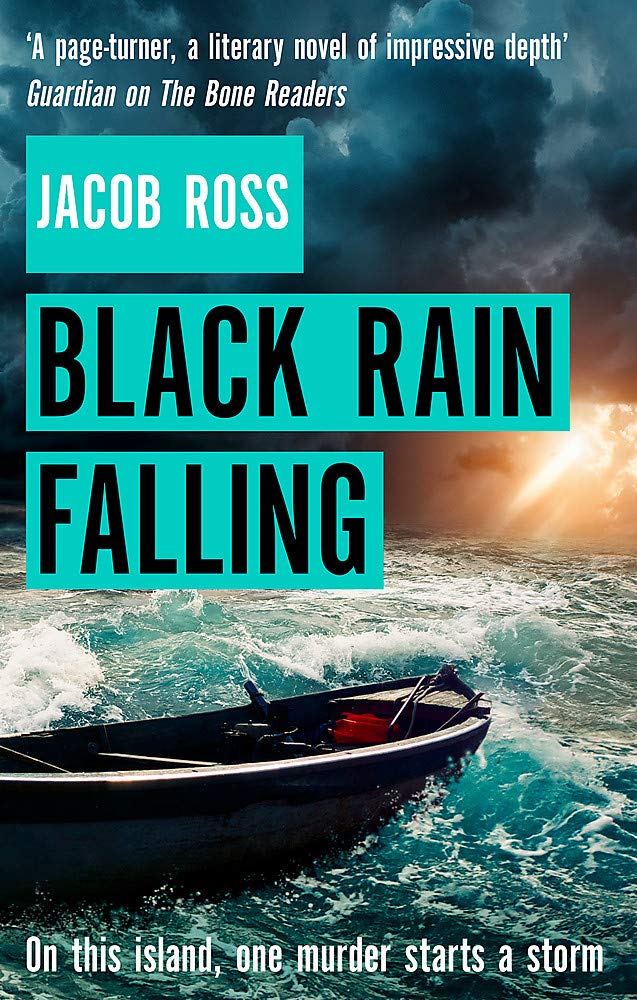
BOOK REVIEW: Black Rain Falling (DC Digger, #2) by Jacob Ross

Black Rain Falling is the sequel to The Bone Readers, the first two in what is apparently designed to be four novels collectively called the Camaho Quartet. These books were written by Jacob Ross, a Grenadian-born, award-winning author and poet who lives in Britain. They are police procedural novels, crime thrillers set on an island called Camaho (which is clearly a thinly disguised version of Grenada) featuring two psychologically wounded and ethically complicated detective protagonists in Detective Constables Michael "Digger" Digson and Kathleen Stanislaus and a host of colorful supporting characters and criminals.

The Bone Readers was memorable for its immersive depiction of island life while unspooling a captivating, suspenseful story and introducing the reader to DC Digger and DC Stanislaus (who is invariably referred to as "Miss Stanislaus" in the text). In Black Rain Falling, the stakes are higher for our main characters as Miss Stanislaus fatally shoots in self defense a known criminal (who was also responsible for her traumatic sexual assault when she was a teenager) and Digger’s frenemy/boss/rival Malan Greaves uses this incident to make his move to advance his career while crippling Digger’s and Stanislaus’ by dissolving the special criminal justice investigative unit that all three of them worked at by having them all transferred to a new police station where he gets a promotion and Digger's enemies get easier access to him.

However, the central mystery in Black Rain Falling is about how the international drug trade is bringing increased crime that is beginning to impact life on Camaho and neighboring islands. For example, there is a shockingly violent killing, an abundance of “hush money” and an incredibly powerful speedboat that can be used to ferry drugs between multiple islands. Digger and Stanislaus are trying to puzzle out the connections between these pieces before the corrupt powers that be strip them of their ability to do anything about it. 

By the end of the book both Digger and Stanislaus, who have complicated and ambivalent relationships with their fathers will need to rely on familial connections in order to persevere and ultimately succeed.

As with the first book, the reader can come for the compelling characters and thrilling plot but what really sets these mysteries apart from others in the genre is 1) Digger and Stanislaus’ chemistry and teamwork; 2) the verisimilitude of the depiction of the island setting of Camaho (Grenada) and 3) Ross' lyrical writing; the author is an award-winning poet and it shows in the quality of the prose.

Overall, Black Rain Falling is another excellent police procedural written by Jacob Ross, set in the Caribbean with two compelling characters in DC Digger and Miss Stanislaus whom I hope to spend a lot more time with in future installments of the Camaho Quarter.

Title: Black Rain Falling.
Author: 
Jacob Ross.
Format: Kindle.
Length: 432 pages.
Publisher: Mullholland Books.
Date Published: March 5, 2020.
Date Read: December 30, 2021.

GOODREADS RATING: ★★★★★  (5.0/5.0).

OVERALL GRADE: A- (3.67/4.0).

PLOT: A-.
IMAGERY: A.
IMPACT: A-.
WRITING: A.

Thursday, February 18, 2021

BOOK REVIEW: The Bone Readers (DC Digger, #1) by Jacob Ross

The Bone Readers by Jacob Ross is an excellent book in the police-procedural, murder-mystery genre with a great hook: it’s set on a small (fictional) island adjacent to Trinidad and Barbados called Camaho.

The author was born and raised in Grenada (which is an actual island adjacent to Trinidad and Barbados), and so was I! Ross uses his familiarity and comfort with the culture, geography, and language of the West Indies to infuse this story with the verisimilitude of Island life. You can almost taste the mangoes, smell the spicy curry and feel the bumps when driving on the badly paved roads!

The main character in The Bone Readers is Michael “Digger” Digson. In the great tradition of the crime fiction protagonists, Digger has a troubled past and a complex personality. Early on in the book we discover that he’s an “outside child” (illegitimate son) of an important man on the island, the Commissioner of Police. This is a curious coincidence because it is only through some unusual circumstances that Digger became a police officer himself. Basically, he was bullied into doing it by DC Chilman, an apparently alcoholic detective very near retirement with an eye for rudderless youths with the potential and talent to become excellent police officers. Digger lives by himself, in the house left to him by his grandmother, who has raised him since the awful day a little over a decade ago when Digger was a little boy that his mom kissed him and said “Don’t worry, Sweetman, I home a lil later” and never came home again. In fact, her body was never even found but it’s pretty clear she was killed as part of a public protest in 1999 that was violently settled by the police at the time. Part of the reason why Digger agreed to become a cop was so that he could research his mother’s death and disappearance and discover the details of the role his father may have played in her death. 

If you think Digger has a complex personality, Ross is just getting started. Many of the other players in the novel, such as DC Chilman, Miss Stanislaus and Malan Greaves are also fascinating characters. They all have complicated relationships with each other and oftentimes with Digger. As I have said in reviewing other books, a key factor in the assessment of the quality of a genre book is the multifaceted nature of how the secondary characters are depicted. Since most police procedurals are very similar what makes the reader continue to enjoy them and read volume after volume in a long-running genre series are the changes and developments that happen to characters that readers can identify with and/or care about. From this perspective, The Bone Readers is very high-quality first entry in what I hope becomes an extended series of books.

DC Chilman, we discover, has an outside child himself and a surprisingly durable relationship with the Minister of Justice (the most important law enforcement official in the island country.) Malan Greaves is Digger’s boss; he takes over supervision of the Camaho police station after Chilman retires. Malan has his own foibles. He’s married but he’s constantly flirting (and more) with women and is all too eager to engage in violence himself to “keep the peace.” This behavior is forced to change with the arrival of Miss Stanislaus on the force, who wants nothing to do with Malan but notes everything he does. Miss Stanislaus is brilliant, with Sherlockian powers of observation and deduction. But she also has a troubled past, and although her professional and personal disdain for Malan is quite clear, her attitude towards Digger is quite different. They make an intriguing couple, and an effective team.

The pace of the story is somewhat languorous, like the pace of island life, but this doesn’t make The Bone Readers any less compelling. The central mysteries are all “cold cases’ of varying degree. There’s the case of who killed Digger’s mom, which he is obsessed with, for obvious reasons. There’s also the case of a missing young man named Nathan that Chilman is obsessed with and makes Digger (and Malan) promise to focus on after their mentor retires. In their investigation of Nathan’s disappearance, Miss Stanislaus and Digger find out about someone else who has disappeared, a teenaged girl named Alice, and Miss Stanislaus notices that something is very peculiar about the church that Nathan and Alice attended. The Old Hope Spiritual Baptist Church is run by a charismatic (and corpulent) preacher named Deacon Bello who happens to be a spiritual advisor to several very important men on the island, including, it turns out, the Minister of Justice. Miss Stanislaus joins the church and starts living at their compound with several other women and young children, any of whom appear to be curiously similar. However things get hectic when Deacon Bello ends up dead at the hands of Miss Stanislaus using an official police weapon she had never been officially issued.

Overall, reading The Bone Readers, especially for someone who was born (and partially raised) in the Caribbean, is a rare treat and joyful experience. The book shimmies and shimmers with the sounds and sights of the islands. The dialogue has the rhythms and cadences of island patois, and the descriptions reflect the unique look and feel of "home." There are so many familiar (and unfamiliar) little details that produce feelings of nostalgia and pride (“Yes! This is how we/they do!”) which is a very unusual experience for me to have while reading crime fiction, but a welcome one. I think even for people without a familial connection to the islands, the novelty of the setting and the richness of the story will be attractive and compelling. I hope to spend A LOT more time with Miss Stanislaus and DC Digger solving mysteries on Camaho, so I hope Mr. Ross writes more books, and soon!

Title: The Bone Readers.
Author: 
Jacob Ross.
Kindle: 273 pages.
Publisher:
 Peepal Tree Press.
Date Published: November 8, 2016.
Date Read: February 3, 2021

GOODREADS RATING: ★★★★★  (5.0/5.0).

OVERALL GRADE: A/A+ (4.17/4.0).

PLOT: A.
IMAGERY: A+.
IMPACT: A+.
WRITING: A.

Thursday, August 13, 2015

BOOK REVIEW: Hurricane Fever by Tobias Buckell


Tobias Buckell is a Caribbean-American writer who is most well known for his excellent Xenowealth series (kick-ass space operas featuring dreadlocked super-strong, dark-skinned heroes fighting freaky aliens science fiction spanning four books so far). In addition to his Xenowealth books, in 2012 Buckell wrote a fun little "eco-thriller" about a radically different geopolitical power structure reshuffled by the effects of global climate change that features a character which is basically a Black lesbian version of James Bond called Arctic Rising (see my generally positive B+ review). The book generally got excellent reviews and was nominated for the Prometheus Award in 2013.

Last year I found out that Buckell has now written another book set in the same world of Arctic Rising called Hurricane Fever, which this time features one of the more eccentric (but interesting) characters from the first book called Prudence Jones, or Roo for short. Roo is a dreadlocked, former Caribbean Intelligence agent (one of the interesting conceits of the Arctic Rising universe is that the Caribbean Islands have banded together to form a political unit that actually has some sway in the world) who after the events of the first book in the series is now the sole guardian for his orphaned nephew.

I was able to receive an ARC (author review copy) of Hurricane Fever in exchange for an unbiased review.

I actually like Hurricane Fever quite a lot (even more than Arctic Rising). It is a fast-paced, action-packed thriller with an interesting premise set in a foreseeable near-future; however I think that Buckell sort of squanders Roo's potential as a leading man by not making him as likeable or emotionally approachable as a character. I do appreciate Buckell's commitment to include diverse characters and the fact that his main character is a Black man presents the readers with situations and concerns which are not usually raised in your ordinary technothriller.

The basic plot of Hurricane Fever is reminiscent of something from James Bond (Ian Fleming), Jason Bourne (Robert Ludlum), Mission Impossible or even Die Hard. Despite swearing that he “left all that spy shit behind” Roo unsurprisingly gets sucked back in when one of his former agent friends (named Zee) is found dead and a message is automatically communicated to Roo with information about a plot that could lead to a worldwide catastrophe. Roo ends up in the Caribbean sea in the area between Barbados and Venezuela with a woman who calls herself Zee's sister just as a climate-change enhanced hurricane is approaching and a super-villain is trying to complete his dastardly scheme.

Overall, Hurricane Fever is a fun and compelling read, set in an interesting near future world which has been affected by climate change.

Title: Hurricane Fever (Arctic Rising, #2)
Author: Tobias Buckell
.
Paperback: 272 pages.
Publisher:
 Tor Books.
Date Published: July 1, 2014.
Date Read: September 8, 2014.


OVERALL GRADE: A- (3.67/4.0).

PLOT: A-.
IMAGERY: A-.
IMPACT: B+.
WRITING: A.

Friday, August 01, 2014

BOOK REVIEW: The Apocalypse Ocean (Xenowealth Series, Book 4) by Tobias S. Buckell


Tobias S. Buckell's Xenowealth series is an entertaining melange of space opera and Caribbean diaspora culture. I only discovered the series after his eco-thriller Arctic Rising (featuring a Black lesbian James Bond-like character!) became a bestseller in 2012.

The first three books in the Xenowealth series, Crystal Rain, Ragamuffin and Sly Mongoose were published by mainstream publishers but then Buckell successfully used Kickstarter to fund the production of the fourth book in the series, The Apocalypse Ocean. Bizarrely, even though I reviewed the first three books right after it came out somehow I missed the publication of the fourth book.

In fact the only reason I even know that The Apocalypse Ocean exists is because my friend Karen Lord who is a published science fiction author (I love writing that!) was visiting Southern California and she told me that Buckell has a sequel to  Arctic Rising out called Hurricane Fever (which is dedicated to Karen and set mainly in Barbados) and oh by the way did you know Xenowealth Book 4 came out 18 months ago?

I was able to quickly buy a Kindle copy of The Apocalypse Ocean and enjoyed it very much. The Xenowealth universe is very interesting and Buckell writes with flair. Here is the blurb from Buckell's website giving an overview of The Apocalypse Ocean:
Welcome back to the Xenowealth. 
Humanity continues to gain control of the Forty Eight Worlds as they deorbit wormholes and join the many worlds and civilizations together. But as they do so, they must deal with the horrors of past injustices as humanity forms new societies out of the wreckage of the old. 
And some of those horrors aren’t content to rest. Kay, who has rescued herself from a hellish life dominated by uncaring alien creatures, seeks bloody twisted revenge for what was done to her. 
And a new force is not happy about the manner in which the Forty Eight worlds are reshaping themselves. In fact, it’s about to put a stop to it all.
The plot of The Apocalypse Ocean is an expanded version of "Plaça del Fuego," a short story published at Clarkesworld Magazine in 2009. Both are set on the planet of Octavia, a minor planet in the Forty Eight Worlds that are connected by a wormhole network created aeons ago but are now being used by humans aliens alike. In the first three books, humanity was fighting to break free from centuries of enslavement and domination by an alien race called the Benevolent Satrapy. The humans have split into two primary factions, one group calling themselves the Xenowealth and the League of Human Affairs.

As you can tell from the name of the series (Xenowealth) Buckell's books spend more time depicting one particular group. The Xenowealth group features characters like Pepper and his daughter Nashara, who are both near-superhuman, dreadlocked wearing cyborgs known as "ragamuffins" who appear to be nearly impossible to kill. Pepper and Nashara are great characters who have appeared in most of the Xenowealth books.

In Book 4, Buckell introduces several new interesting characters: Tiago, a street kid who is a pickpocket in the city of Palentar on the island of Plaça del Fuego; Kay, a teenage girl who has been genetically engineered to emotionally control and manipulate humans and is Tiago's boss; the Doaq, a mysterious, terrifying monster who appears to have a wormhole for a mouth; and Thinkerer, a robot from the League world of Trumball who has questionable loyalties and hidden abilities.

The best part of The Apocalypse Ocean is the breakneck pace of the action that Buckell is able to maintain, as he continues to ratchet up the stakes involved and reveal more and more of the underlying structure of the larger Universe the story is set in.

I'm very glad that The Apocalypse Ocean was written and I applaud Buckell for his tenacity and audacity in getting it out there. I hope it (and Hurricane Fever) are successful enough that the wait for the fifth and final installment in the series, rumored to be named Desolation's Gap, will cone out sooner rather than later. I know that I will plunk down my hard-earned cash to pick that up!

Title: The Apocalypse Ocean.
Author: 
Tobias S. Buckell.
Paperback: 250 pages.
Publisher:
 Amazon Digital Services.
Date Published: December 13, 2012.
Date Read: July 15, 2014

OVERALL GRADE: A/A- (3.83/4.0).

PLOT: A.
IMAGERY: A.
IMPACT: B+.
WRITING: A.

Saturday, December 21, 2013

QUEER QUOTE: Barbados PM Responds Positively To LGBT Rights Inquiry


After the horrible news of the passage of virulently anti-gay legislation in Uganda that could lead to sentences of life imprisonment for homosexuality, it is nice to report some good news from another part of the world where people of color predominate.

In Barbados, which is one of the 77 countries which still has a sodomy law, Prime Minister Freundel J. Stewart has responded respectfully and positively to an inquiry from one of the few organized LGBT advocacy groups in the Eastern Caribbean country.

The following excerpt from his letter is today's Queer Quote:
I wish to acknowledge receipt of your letter dated November 5, 2013. In your letter,  you requested that Barbados, in the person of the Prime Minister, seek at this year's Commonwealth Heads of Government Meeting in Sri Lanka to have included in the agenda of the Meeting in 2015, an item on the rights of gays, lesbians, bisexuals and transgendered persons. 
Although matters of State did not allow me to attend the 2013 meeting, I wish to assure you that Barbados remains committed to the principles enshrined in the Universal Declaration of Human Rights and will continue, therefore, to lend its voice to calls both regional and international fora for the elimination of all forms of discrimination including discrimination against persons of differing sexual orientation.
This response is reminiscent of the letter the Prime Minister of Trinidad and Tobago wrote last year expressing her "personal" support for LGBT rights.

Anyway, it is indicative of a modicum of progress on LGBT rights in the region. Perhaps in addition to calling for an end to discrimination in regional and international fora PM Stewart might want to insure that his country has enacted legal prohibitions against LGBT discrimination.

Jus' sayin'.

Thursday, December 12, 2013

77 Countries Around The World Have Laws Banning Homosexuality


The disappointing news that India had recriminalized sodomy through a  court ruling yesterday has drawn attention to the fact that there are now 77 countries around the world that have laws banning homosexuality around the world. India's unfortunate action alone impacted over 1/6th of the world's population!

Business Insider has the full list of countries where LGB people are de facto (and de jure) criminals:
  1. Afghanistan
  2. Algeria
  3. Angola
  4. Antigua and Barbuda
  5. Bangladesh
  6. Barbados
  7. Belize
  8. Bhutan
  9. Botswana
  10. Brunei
  11. Burundi
  12. Cameroon
  13. Comoros
  14. Dominica
  15. Egypt
  16. Eritrea
  17. Ethiopia
  18. Gambia
  19. Ghana
  20. Grenada
  21. Guinea
  22. Guyana
  23. India
  24. Iran
  25. Jamaica
  26. Kenya
  27. Kiribati
  28. Kuwait
  29. Lebanon
  30. Liberia
  31. Libya
  32. Malawi
  33. Malaysia
  34. Maldives
  35. Mauritania
  36. Mauritius
  37. Morocco
  38. Mozambique
  39. Myanmar
  40. Namibia
  41. Nauru
  42. Nigeria
  43. Oman
  44. Pakistan
  45. Palau
  46. Papua New Guinea
  47. Qatar
  48. Samoa
  49. São Tomé and Principe
  50. Saudi Arabia
  51. Senegal
  52. Seychelles
  53. Sierra Leone
  54. Singapore
  55. Solomon Islands
  56. Somalia
  57. South Sudan
  58. Sri Lanka
  59. St Kitts & Nevis
  60. St Lucia
  61. St Vincent & the Grenadines
  62. Sudan
  63. Swaziland
  64. Syria
  65. Tanzania
  66. Togo
  67. Tonga
  68. Trinidad and Tobago
  69. Tunisia
  70. Turkmenistan
  71. Tuvalu
  72. Uganda
  73. United Arab Emirates
  74. Uzbekistan
  75. Yemen
  76. Zambia
  77. Zimbabwe


Hat/tip to Joe.My.God

Tuesday, November 12, 2013

80% Of British Commonwealth Countries Have Sodomy Laws

While progress on LGBT equality is accelerating at at an amazing pace in the United States we should not grow complacent about how homosexuality is treated around the world. For example, a new report indicates that 41 of 53 members of the Commonwealth declare homosexuality to be illegal.
Homosexuality is illegal in 41 out of the 53 Commonwealth countries, a report released on Monday reveals. Despite this, the forthcoming Commonwealth heads of government meeting (Chogm) in Sri Lanka has elected not to discuss the issue of anti-gay discrimination. Commissioned by the Kaleidoscope Human Rights Foundation and compiled by LGBT activists throughout the Commonwealth, the report calls for Commonwealth countries to repeal anti-gay legislation, with an immediate moratorium on enforcement. 
“If you look at the world as a whole, around about 40% of nations have state-sponsored homophobia,” said Kaleidoscope’s spokesman, Douglas Pretsell. “Half of those – about 54% – are in the Commonwealth. If you look at the rest of the world not inside the Commonwealth, it’s only 24.5% – so the Commonwealth has a big problem. “These are laws that make it illegal to be gay.”
The other half and I visted two of these Commonwealth countries earlier this year (Barbados and Grenada) and I can confirm to you that homosexuality may be illegal but there is most definitely homosexuality there!
Hat/tip to Joe.My.God

Wednesday, May 15, 2013

MadProfessah Is On Vacation (Grenada and Barbados)

more...

It's that time of year again! Last year I went off to Europe in May. The year before that I went to Cape Town, South Africa. Starting Wednesday May 15th until Thursday May 30th, I am officially on vacation. I am going to be visiting the Caribbean (Grenada, where I was born, and Barbados, where I went to secondary school). My husband is going as well, and it will be his first time in the Caribbean.

It should be a great trip!

I will have access to wireless internet and will of course bring devices with me but blogging will definitely be lighter than usual, maybe one post per day. My biggest peeve is that I will have to wait until I get back to see (S3E08) "Second Sons" episode of Game of Thrones.

Thursday, December 20, 2012

BOOK REVIEW: Tobias Buckell's Xenowealth series


Tobias Buckell is the author of the global warming eco-thriller Arctic Rising (read my review) published in 2012. He is more well-known for his debut series of novels, Crystal Rain, Ragamuffin and Sly Mongoose which are collectively known as the Xenowealth series.

Buckell is an unusual sci-fi author in that he was born in the Caribbean (Grenada, the same island where I was born) and even more rare is his decision to include aspects of his West Indian heritage in to his science fiction writing. So, the books of the Xenowealth series have people of color as the central characters. To be specific, his characters are Caribbean members of the black diaspora.  One could describe the series as an alien space opera populated by islanders.

Crystal Rain
The first book in the series, Crystal Rain, introduces the world of Nanagada and the Xenowealth Universe. There are 48 inhabited planets that are connected by various wormholes that are controlled by a governing alien entity called the Benevolent Satrapy. Crystal Rain revolves around the main character John deBrun, his 13-year-old son Jerome and John's friend (crewmate?) Pepper. John is a mysterious figure: he appeared 27 years ago out of the sea, missing one hand but impressive strength and survival skills he has become an integral and valued part of his community which no loger has access to advanced technology (although there are rumors that it existed and worked in the long, almost-forgotten past), and John appears not to have aged a day. Pepper is even more mysterious, since we are introduced to him as literally dropping out of the sky in a metal container and even though he starts by speaking gibberish, once he adjusts his throat somehow he starts speaking the local Nanagadan dialect perfectly.

Ahh, the Nanagadan dialect! Its a large feature of  In order to emphasize or centralize the idea that the characters involved here are of Caribbean origin, Buckell makes the decision to write much of the spoken dialogue to be in Caribbean patois. This can make the dialogue VERY hard to read and understand, although after awhile the reader gets somewhat used to it. My problem with the choice was not that Buckell included West Indian dialect, but his truly bizarre choices in how he punctuated the dialogue which made the text less like the actual spoken Caribbean patois I am familiar with. So in the end Buckell's well-intention decision just ended up being a distraction.

However, even with this flaw, and some plot holes one could fly a steam-powered airship through, Crystal Rain is still an enjoyable read. The main plot involves an invasion of the Nanagadan Capitol City by the neighboring Aztec-based civilization known as the Azteca who worship aliens called the Teotl who insist on live human sacrifice. The Nanagadans have their own aliens as well, who they revere but do not worship, called the Loa, who are in an existential predator-prey relationship with the Teotl. All the aliens (and we suspect, John and Pepper) have been stuck on this planet since the planet's access to the nearest wormhole was destroyed hundreds   of years ago and only John may have the keys to restoring that access somewhere locked in his amnesia-riddled head.

Ragamuffin
The second book in the Xenowealth series is Ragamuffin, but it is very different from Crystal Rain. For example, the first book takes places in its entirety on one planet (Nanagada) while this putative sequel, although set in the same Universe as Crystal Rain, takes place on multiple planets (and the space between them, on space ships) and features a new character named Nashara. One can enjoyably read the books of the series out of order because they work as stand-alone books as well as entries in a series, which is often a good sign of quality.

More information is provided about the bigger picture in Buckell's well-populated universe of aliens, dread-locked freedom fighters of Caribbean-descent (known as "ragamuffins"), technologically enhanced humans, space habitats and advanced virtual reality. Nashara is a great character, with as much kick-ass potential as the now-legendary Pepper (whom she is apparently remotely related to). We get a useful map of the entire wormhole system which illustrates the structure and extent of the Benevolent Satrapy. We find out exactly where New Anegada (better known as Nanagada in Crystal Rain) is in the grand scheme of things and the oppressed fate of most humans in the Universe as either living in habitats in space, or in reservations on alien-inhabited planets.

Technically, Ragamuffin is a much stronger book than Buckell's debut, and this was recognized by his peers when Ragamuffin was nominated for a Nebula award for Best Novel. For one thing, the use of dialect is minimized  and although it is not a long book, it is jam-packed with action and plot developments. The book is structured into three parts, and it is not until the middle section that Nashara is brought together with John, Pepper and other popular characters from the first book. The third and final section of the book is very exciting as our new characters and old characters work together to a surprising conclusion that most fans of space opera will enjoy.


Sly Mongoose
This is the third (and final?) book in what is known as the Xenowealth series. (I am sort of surprised the series is known by that name since the word "Xenowealth" literally is used once in the 1,000-plus pages of the three books of the series, and that happens in the very last chapter of the very last book!)

The only character that appeared in the first two books, Crystal Rain and Ragamuffin, that appears in this book is Pepper (who is really a great character--there's a very good television series that could be based around him). Pepper is near super-human, he has a technologically enhanced body and implants which allow him to be faster, stronger and deadlier than almost anyone around him. He also has a world-view which generally puts his needs and wants before anyone else's, regardless of typical social conventions.

But in the opening scene of Sly Mongoose, even Pepper more than meet his match when the ship he is on is overrun by space zombies! He has to eject from the ship and use a jury-rigged heat shield to crashland on a floating habitat in the atmosphere of Chilo, an uninhabitable planet. Even for the nearly indestructible Pepper falling a couple of miles through a poisonous atmosphere without a parachute into a solid object nearly kills him, and results in the loss of an arm and a leg.
We know that with time (or in an auto-doc), Pepper can recover from almost any kind of injury, given time. However, the plot rushes along at a headlong pace giving Pepper almost no time to catch his breath and heal.

Buckell introduces an entirely new cast of complex characters and unusual society in Sly Mongoose, starting with the main protagonist named Timas, a teenage boy with bulimia who is the sole breadwinner for his family as long as he stays thin enough to fit into the pressure suits which allow him to go down to the deadly surface of planet Chilo. Another interesting aspect of the book is the application of the computer technology from the previous books called "the lamina" to create a society where instantaneous virtual democracy is the rule: everyone gets to vote on every decision and the majority rules.

The plot of Sly Mongoose follows Timas and Pepper as the planet starts to be overwhelmed by the Zombie Army which spreads through the floating cities of Chilo like a virulent infection. Buckell is able to weave in the horrific events occurring on one planet with the ongoing fight for power between various factions of humanity (the mongoose men from Nanagada and the xenophobic forces of the League of Human Affairs) that are grappling for a dominance now that the overlords of the Benevolent Satrapy have been eliminated. The book ends in such a way that the story can be continued, with most (but not all) questions resolved. The third book in the Xenwealth series shows how much Buckell has grown and improved as an author since writing his first book and leads an interest and hope that he will continue adding to the stories in this rich universe he has created in the future.

Title: Crystal Rain.
Author: Tobias S. Buckell.
Length: 384 pages.
Publisher: Tor Science Fiction.
Published: May 29, 2007.

OVERALL GRADE: B+ (3.33/4.0).

PLOT: A-.
IMAGERY: B+.
IMPACT: B+. 
WRITING: B.


Title:  Ragamuffin.
Author: Tobias S. Buckell.
Length: 352 pages.
Publisher: Tor Science Fiction.
Published: June 3, 2008.

OVERALL GRADE: A- (3.66/4.0).

PLOT: A-.
IMAGERY: A-.
IMPACT: A. 
WRITING: B+.

Title
:  Sly Mongoose.
Author: Tobias S. Buckell.
Length: 384 pages.
Publisher: Tor Science Fiction.
Published: March 27, 2012.

OVERALL GRADE: B+/A- (3.5/4.0).

PLOT: B+.
IMAGERY: A-.
IMPACT: A-. 
WRITING: B+.
Tuesday, August 07, 2012

Olympiad XXX: 19yo Wins Grenada's 1st Ever Gold


19-year-old athletic sensation Kirani James of my home country of Grenada won the gold medal in the Men's 400m dash at the London Olympics last night. It was Grenada's first medal of any kind despite competing in every Summer Olympics since 1984. James, although only 19, is the reigning World Champion in the 400m and became the first non-American man to complete the one-lap race in under 44 seconds, finishing in 43.94s.

Winning the silver was 18-year-old Luguelin Santos of the Dominican Republic and the bronze medalist was Lalonde Gordon of Trinidad and Tobago completing a Caribbean sweep of the event. Also in the final race was the unusual site of twin brothers Kevin and Jonathan Borlée of Belgium, who finished 5th and 6th just 0.02s apart from each other.

But the night belonged to James who in the last few years has begun to put Grenada on the map for his prowess in the 400 meters in a similar way to how Jamaica is now known for world-class sprinters (and deep seated homophobia!)

Caribbean runners (or runners for other countries who are of Caribbean descent) have been dominating the sprints at this year's Olympics with Jamaicans winning both the men's and women's 100m.

Thursday, July 26, 2012

BOOK REVIEW: Arctic Rising by Tobias Buckell


I first heard of Tobias Buckell's Arctic Rising from a rave review on NPR earlier this spring. One of the most interesting features of the book (to me) is that its author was born in the same small country that I am from, the Caribbean island nation of Grenada. But even that curious fact would not be enough to get me to read the book if its subject was not interesting.

In this case, the subject is an interesting combination of near-future science fiction and "eco-thriller." The setting is an un-named time in the near future where global warming climate change has had a profound impact on the geopolitical power structure of the world. Much of the Arctic Sea is open water and this has produced brand new shipping lanes, which have allowed Greenland and Canada to become powerful countries in this new era. Additionally, countries like Nigeria, Brazil, India and China have become superpowers in this new world where island nations have disappeared and the Caribbean's tourist economy has collapsed due to the extremely violent nature of hurricanes.

In this setting, Buckell places a thrilling story of intrigue involving his main character Anika Duncan, who is an airship pilot for the United Nations Polar Guard in the Arctic circle whose life unravels when she comes across a ship with a mysteriously radioactive cargo whose crew takes extreme measures to prevent her from finding out what it is. From that point on the story proceeds at breakneck pace, with people repeatedly trying to kill and/or capture Anika. Acquaintances, colleagues and friends who try to help Anika often face dire consequences.

Arctic Rising is exciting, sort of like a James Bond thriller except that the main protagonists are a multiracial, lesbian and her male Caribbean-born, dredlock-wearing independent spy named Prudence Jones.

One immediate draw back of the novel is that the action is provided in very short, bite-sized chapters, presumably the proper length that an action scene in the filmed adaptation would cover. Also, the writing and characterization is almost laughably weak, similar to what you would expect in a John Grisham, Brad Melzer or Dan Brown novel. Obviously, millions and millions of people buy and enjoy those kind of novels, and they have been adapted into television and films because they capture the audience's attention.

I appreciate Buckell's ambition of trying to occupy that "non-stop action thriller" space with a book that at least is set in a world impacted by climate change and who has deliberately injected issues of race, gender and sexual orientation through his characters. But an important artistic achievement, Arctic Rising is not.

However, it is a lot of fun and at least a diversion which can keep one occupied and content while it lasts. Which is not long.

Title: Arctic Rising.
Author: Tobias S. Buckell.
Length: 304 pages.
Publisher: Tor Books.
Published: February 28, 2012.

OVERALL GRADE: B+ (3.33/4.0).

PLOT: B.
IMAGERY: A-.
IMPACT: A-. 
WRITING: B.

Wednesday, September 21, 2011

Teenager Wins 400m Gold Medal for Grenada

Kirani James, left, beat World Champion LaShawn Merritt at the tape in the 400m
Photo credit: Andy Lyons/Getty Images
Somehow I missed this amazing story from two weeks ago. An 18-year-old boy named Kirani James from my home island countryof Grenada (which has a population of just over 100,000 people, smaller than most cities in the United States) won the 400m gold at the recent World Track and Field Championships by beating an Olympic champion in the event!

But that was not the only amazing story of this 400 meter race. Another Grenadian runner, Rondell Bartholomew, placed sixth and there were twin brothers from Belgium that finished 3rd and 5th!

The Guardian has a great article on the race:

It takes something special to steal the headlines from an Olympic champion who has just returned from a 21-month ban because he accidentally ingested steroids while taking penis-enlargement pills. And Kirani James did just that. He beat LaShawn Merritt, who returned to the track after his suspension in July, in one of the great 400m races in the history of the world championships. James turns 19 on Saturday and his life is never going to be the same again.
If James's name had not been noted before he ran in Daegu, that is hardly surprising. The world 400m champion has run only four professional races in his career, three of them in the past three days. People who like easy labels are already calling him the new Usain Bolt but that does not quite fit. He is neither as flamboyant nor as fast. The first of those differences is not going to change but the second surely will.
The race had the kind of finish that is going to be rerun in the highlights reels for years to come. Merritt came into the home straight with a lead but James ran him down with 50 metres to go. The two were shoulder to shoulder as they came up to the line but James got himself half a stride in front and won by three hundredths of a second, despite Merritt's despairing dip of the head. His winning time of 44.60sec was a personal best, though it is unlikely to be so for long. The Belgian Kevin Borlée took bronze, completing a colourful cast of medal winners. His identical twin, Jonathan, was fifth.
James comes from Grenada and is their first world championship medallist. When he was 16 he was running the 400m in 45.24, a time that would easily have been good enough to earn a place in the final here. 
Now, that is great writing, and a great story. Congratulations, Kirani! (About those Belgian Borlée twins, expect to see them again on this blog in the near future, as either Eye Candy or Celebrity Friday).

Thursday, May 26, 2011

GRENADA: Man, 41, Charged Under Sodomy Law


Since I was born on the island of Grenada in the Eastern Caribbean I'm always attentive when the island-nation appears in the news. According to the AP, a 41-year-old man has been arrested and charged with sodomy for having consensual sex with a 17-year-old man.

The age of sexual consent in Grenada is 16 but while the sex in question was consensual, local law prohibits sodomy under the charge of "unnatural connection."
Grenada is one of several Caribbean nations that has laws banning sex between men. The penalty in most islands, including Grenada, is up to 10 years in prison, although Barbados and Guyana have life imprisonment, according to a 2010 United Nations report.
Many islands remain socially conservative, with Jamaica considered one of the most hostile islands toward homosexuals. A gay right activist was killed there last year, and three gay men were attacked and beaten in St. Lucia in March. Gay cruises to the region also continue to draw protesters.
In Grenada, gays are discriminated against and find it hard to find employment and housing, said Nigel Mathlin, president of GrenCHAP, a local nonprofit organization that represents marginalized groups.
"The government, they are very much aware of the changes that need to be made, of bringing our laws into line with international human rights principles," Mathlin said.
I'll be following this case relatively closely. I really don't see how the Caribbean nations of Barbados, Trinidad, Grenada and Jamaica can expect to have a vibrant tourism industry while still maintaining anti-gay sodomy laws and an unwelcoming, discriminatory atmosphere.

It's good to see that there is some organized resistance and challenge to explicit homophobia on the island of Grenada in the form of GrenCHAP and Nigel Mathlin.

Tuesday, February 08, 2011

Immigration Equality Releases LGBT Asylum Stats


Immigration Equality, the national LGBT immigration advocacy organization (on whose board MadProfessah sits) announced today that they had won over 101 asylum cases in 2010:
Immigration Equality, a national organization that helps obtain asylum for individuals persecuted in their home country based on their sexual orientation, gender identity or HIV-status, announced today that its legal and pro bono teams won a record 101 cases in 2010.  An overwhelming number of those wins – 38 - were for clients from the Caribbean, with 28 of those for individuals from Jamaica.  Other cases included 24 asylum seekers from Central and South America; 16 from Eastern Europe (including seven Russian clients); nine from the African continent and five from the Middle East. 
Immigration Equality maintains the largest pro bono network of attorneys – in addition to its in-house legal staff – dedicated solely to securing asylum for lesbian, gay, bisexual and transgender asylum seekers.  Firms providing pro bono representation for Immigration Equality clients include Dewey & LeBoeuf; Jones Day; Kirkland and Ellis; Latham Watkins; Ropes and Gray; Skadden; Weill  Gotshal; and White & Case. In addition to the 2010 wins announced today, the organization has 97 additional cases, filed in 2010, which are awaiting a ruling, as well as several cases filed prior to 2010. 
“For too many lesbian, gay, bisexual and transgender people, the world remains a dangerous place,” said Rachel B. Tiven, the group’s executive director.  “In many cases, the clients who turn to Immigration Equality for help are literally running for their lives.  They have been mistreated and beaten by authorities in their home country, disowned by their families and ostracized by society.  By offering them safe haven, the United States is not only saving their lives, but benefitting from the talent, skills and service these asylees bring to our country.  We are proud, and honored, to help them begin life anew here in their adopted homeland.”

[...]

Immigration Equality 2010 Asylum Wins by Country *
Jamaica                        28
Russia                          7
Grenada                       4
Peru                             4
Uzbekistan                  4
Venezuela                    3
Mexico                         3
Ghana                          3
El Salvador                  3        
* Countries from which Immigration Equality had 2 or fewer wins are not listed.
Total 2010 wins include six individuals who won withholding of removal or secured relief under the Convention Against Torture Treaty (CAT).

Notice that 2 of the top 3 countries are in the West Indies. In fact, Grenada is the country where I was born.

LinkWithin

Blog Widget by LinkWithin