Showing posts with label books 2021. Show all posts

Friday, February 25, 2022

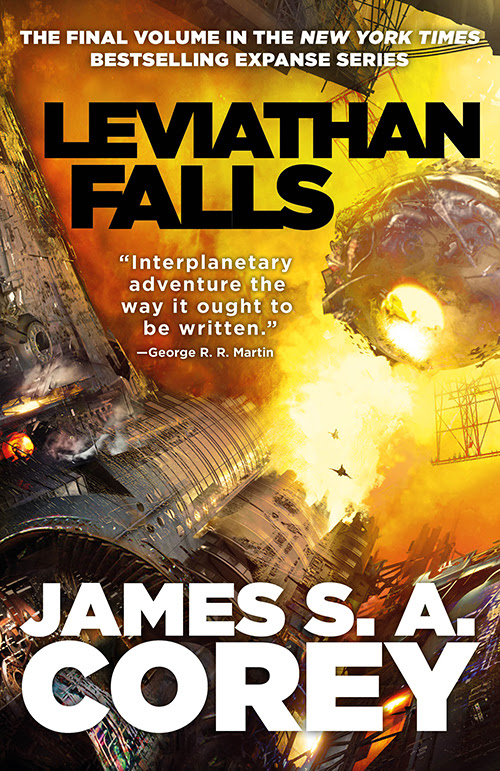
BOOK REVIEW: Leviathan Falls (The Expanse, #9) by James S.A. Corey


Leviathan Falls is the ninth and final book in the bestselling space opera series called “The Expanse” written by James S.A. Corey (which is a pseudonym for the writing duo of Ty Franck and Daniel Abraham). The Expanse has been adapted for television and has become a hit show with the same name on Amazon Prime that recently concluded with its sixth and final season in January 2022. It’s an amazing feat that the authors were able to write and publish all nine books in the series in roughly 10 years: Leviathan Wakes (2011), Caliban’s War (2012), Abaddon’s Gate (2013), Cibola Burn (2014), Nemesis Games (2015), Babylon’s Ashes (2016), Persepolis Rising (2017), Tiamat’s Wrath (2019) and Leviathan Falls (2021).

Most of the titles of the books in the Expanse have always had a somewhat Delphic quality to them, since they don’t seem to directly relate to or describe the events that occur in them. But the authors were pretty direct when they titled the last book Leviathan Falls in a clear echo of the first book’s title Leviathan Wakes. Another interesting aspect of the book series is that the nine books can be thought of as a trio of trilogies. This last impression is bolstered by the fact that the final three books take place nearly 30 years after the events of the first six books so that Persepolis RisingTiamat's Wrath , and Leviathan Falls work together as a separate trilogy to conclude the story that began in Leviathan Wakes .

The great thing about Leviathan Falls is that even though it’s the last book in a 9-part space opera series it still tells a self-contained story. Just like every other book in the series, at its core this is a story about a chosen family of four characters: Amos, Naomi, Alex and James. Of course the crew of Rocinante has been through a lot since we were first introduced to them in Leviathan Wakes but they are still the hooks on which the principal story in The Expanse hangs thousands of pages later.

In Leviathan Falls the family the reader has come to know so well over the first eight books is expanded to include other characters, such as adopted family members like Elvi Okoye and Teresa Duarte and actual family members like Alex’s son Kit, Kit’s wife and their newborn child. There are even some new characters introduced in Leviathan Falls that have significant impacts on the outcome of the series’ overall plot. Chief among those would have to be Aliana Tanaka. Tanaka is a Colonel in the Laconian Intelligence Directorate who is tasked with tracking down the head of the Laconian government, Admiral Winston Duarte (Teresa’s dad).   Duarte had a mysterious interaction with an alien entity in Tiamat’s Wrath that left him physically and mentally capacitated but in the beginning of Leviathan Falls he seems to have recovered and used some kind of mysterious alien technology to leave Laconia.  Since Laconia is basically an authoritarian empire with Duarte as it’s head, that he was incapacitated and that now he’s missing are two incredibly important (and sensitive) pieces of information that the de facto head of the Laconian government, General Anton Trejo, is trying very hard to suppress. He’s the one who gives Tanaka her carte blanche to track Duarte down by whatever means necessary.

In Persepolis Rising, Laconian forces burst out of their ring gates with protomolecule-fueled spaceships that were far more technologically advanced than anything in the Galaxy and quickly took over control of the solar system, which even 30 years after the events of Babylon’s Ashes still contains a plurality of the entire human population in our galaxy. Eventually Laconia takes over all of the Ring gates, and in doing so, maintains control over all 1300 potential systems where humans have been settling since the gates were discovered by James Holden in Abbadon’s Gate. Due to their alien-enhanced ships, Laconia has superior military firepower to any other human government and Duarte has basically declared himself Emperor of humanity. The Resistance to Laconia has been run principally by Naomi Nagata, Bobbie Draper and Alex Kamal for decades.

As the story in The Expanse has advanced, the plot of the struggle for supremacy between different factions of humanity during the race to colonize and control the solar system has slowly been subsumed by the greater mystery of what happened to the alien intelligence who created the ring gates and the protomolecule and the other alien intelligence who eliminated the ring-builder aliens.

The ring-builder aliens are long gone but their vanquishers remain, and it has become clearer and clearer they are very powerful and very pissed off at the latest intelligent aliens (i.e. humans) to use the ring gates. They have the ability to alter the physics of space-time temporarily in localized regions, and this sometimes results in all human consciousness being affected for brief periods of time. Literally every human being stops thinking for say 15-20 minutes on multiple planets simultaneously. If they could eliminate all human consciousness by making the effect last permanently, it seems like they would. And the blackout periods are becoming more frequent.

Thus in Leviathan Falls the stakes of the plot have been raised to the highest possible level: it is about the survival of humanity itself (or at least humans as self-aware individuals). But even as this story unspools, the author(s) keep(s) the focus on our four main characters, with each of their arcs being resolved by the end in ways that seem incredibly well-aligned with how each has been depicted through the entire series. And so the story ends. Or so the reader thinks, but then there’s an epilogue, which like icing on the cake or a cherry on a sundae, is really the perfect ending to an enjoyable experience. There are reports that Ty Franck and Daniel Abraham knew the last sentence of the last book multiple years before it was published and I believe (and want to believe) that this is true. It definitely left me with a smile on my face, and I believe it will leave everyone else who reads the entire series with one as well.

Title: Leviathan Falls (The Expanse, #9).
Author: 
James S.A. Corey.
Format: Hardcover.
Length: 528 pages.
Publisher: Orbit Books.
Date Published: November 20, 2021.
Date Read: December 25, 2021.

GOODREADS RATING: ★★★★  (5.0/5.0).


OVERALL GRADE: A (4.0 /4.0).

PLOT: A.
IMAGERY: A-.
IMPACT: A+.
WRITING: A.

Monday, January 17, 2022

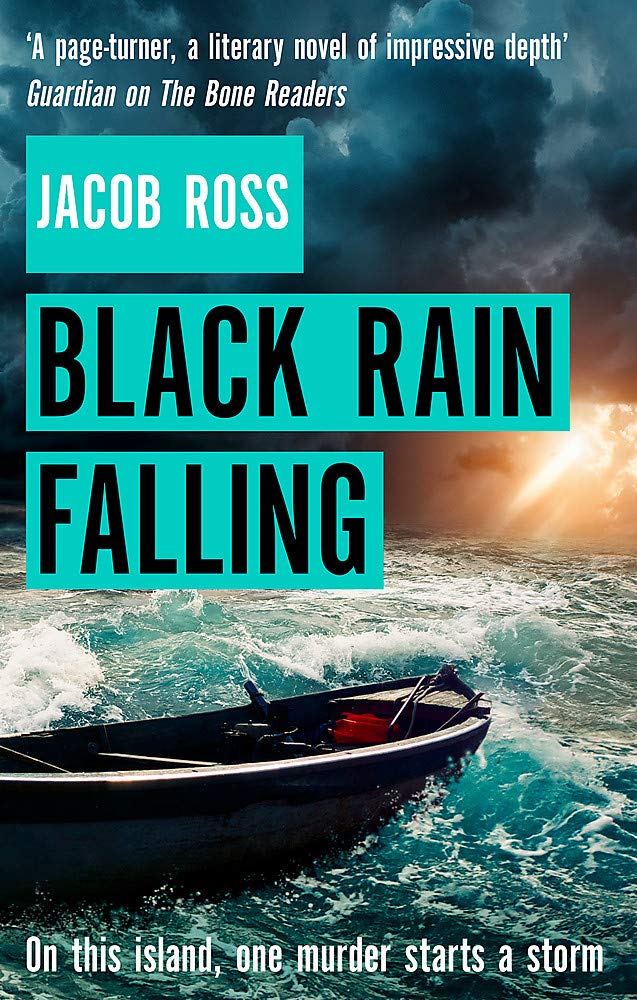
BOOK REVIEW: Black Rain Falling (DC Digger, #2) by Jacob Ross

Black Rain Falling is the sequel to The Bone Readers, the first two in what is apparently designed to be four novels collectively called the Camaho Quartet. These books were written by Jacob Ross, a Grenadian-born, award-winning author and poet who lives in Britain. They are police procedural novels, crime thrillers set on an island called Camaho (which is clearly a thinly disguised version of Grenada) featuring two psychologically wounded and ethically complicated detective protagonists in Detective Constables Michael "Digger" Digson and Kathleen Stanislaus and a host of colorful supporting characters and criminals.

The Bone Readers was memorable for its immersive depiction of island life while unspooling a captivating, suspenseful story and introducing the reader to DC Digger and DC Stanislaus (who is invariably referred to as "Miss Stanislaus" in the text). In Black Rain Falling, the stakes are higher for our main characters as Miss Stanislaus fatally shoots in self defense a known criminal (who was also responsible for her traumatic sexual assault when she was a teenager) and Digger’s frenemy/boss/rival Malan Greaves uses this incident to make his move to advance his career while crippling Digger’s and Stanislaus’ by dissolving the special criminal justice investigative unit that all three of them worked at by having them all transferred to a new police station where he gets a promotion and Digger's enemies get easier access to him.

However, the central mystery in Black Rain Falling is about how the international drug trade is bringing increased crime that is beginning to impact life on Camaho and neighboring islands. For example, there is a shockingly violent killing, an abundance of “hush money” and an incredibly powerful speedboat that can be used to ferry drugs between multiple islands. Digger and Stanislaus are trying to puzzle out the connections between these pieces before the corrupt powers that be strip them of their ability to do anything about it. 

By the end of the book both Digger and Stanislaus, who have complicated and ambivalent relationships with their fathers will need to rely on familial connections in order to persevere and ultimately succeed.

As with the first book, the reader can come for the compelling characters and thrilling plot but what really sets these mysteries apart from others in the genre is 1) Digger and Stanislaus’ chemistry and teamwork; 2) the verisimilitude of the depiction of the island setting of Camaho (Grenada) and 3) Ross' lyrical writing; the author is an award-winning poet and it shows in the quality of the prose.

Overall, Black Rain Falling is another excellent police procedural written by Jacob Ross, set in the Caribbean with two compelling characters in DC Digger and Miss Stanislaus whom I hope to spend a lot more time with in future installments of the Camaho Quarter.

Title: Black Rain Falling.
Author: 
Jacob Ross.
Format: Kindle.
Length: 432 pages.
Publisher: Mullholland Books.
Date Published: March 5, 2020.
Date Read: December 30, 2021.

GOODREADS RATING: ★★★★  (5.0/5.0).

OVERALL GRADE: A- (3.67/4.0).

PLOT: A-.
IMAGERY: A.
IMPACT: A-.
WRITING: A.

Friday, January 07, 2022

BOOK REVIEW: Filthy Animals by Brandon Taylor

Filthy Animals is a collection of short stories by Brandon Taylor, the author of the critically acclaimed debut novel Real LifeReal Life is about a Black, gay graduate student in a STEM discipline navigating his personal and professional life in a predominantly white, midwestern University town. Taylor drew upon his own experience as a graduate student in biochemistry at University of Wisconsin at Madison to provide a disturbingly real depiction of what it looks like to be “the only one” in multiple different settings that revolve around academia. As someone who has been in similar situations for nearly 35 years (gulp!) to say I resonated with multiple aspects of the novel is to put it much too mildly.

Filthy Animals is both a very similar and a very different book than Real Life. Firstly, it is a collection of loosely connected short stories instead of a novel. Also, both works are centered around the experiences of outsiders in familiar (at least to me, as a professor and dean) academic settings. However, in Filthy Animals the characters in each story change. The short collection (278 pages) consists of 11 stories; five of which (“Potluck,” “Flesh,” “Proctoring.” “Apartment,” and “Meat”) feature three recurring characters I would gladly read an entire book about. They are Charles, a white, muscular, apparently bisexual, twenty-something dancer; Lionel, a Black, gay, mathematics graduate student who struggles with mental health and self-harm ideations; and Sophie, a ethnically ambiguous, highly talented dancer who is in an open relationship with Charles. The stories where Sophie, Charles and Lionel appear are the most compelling in the collection as their foibles get revealed while they interact with each other in surprising ways.

The one-off stories have their own appeal as well. Taylor is almost always presenting characters who demonstrate the different ways one can be isolated or marginalized in society. In several of the stories the protagonist is damaged, injured or sick in some way. (They are often, but not always, gay.) For example, the titular story “Filthy Animals” is a rather disturbing tale about a somewhat feral group of teenage boys who apparently have nothing better to do than accost each other, using sex, violence and sexual violence as a means to relate to one another.

Overall, I think I was less engaged with Filthy Animals than with Real Life so I hope that Taylor returns to novel writing soon. This is not to say that one of the books is objectively “better” than the other. That said, I am glad to see someone with experiences and identities so similar to mine producing such well-received writing. I look forward to reading more of it.

Title: Filthy Animals.
Author: 
Brandon Taylor.
Format: Hardcover.
Length: 288 pages.
Publisher: Riverhead Books.
Date Published: June 22, 2021.
Date Read: December 27, 2021.

GOODREADS RATING: ★★★★☆  (4.0/5.0).

OVERALL GRADE: A- (3.67/4.0).

PLOT: B+.
IMAGERY: A-.
IMPACT: A.
WRITING: A-.

Thursday, December 23, 2021

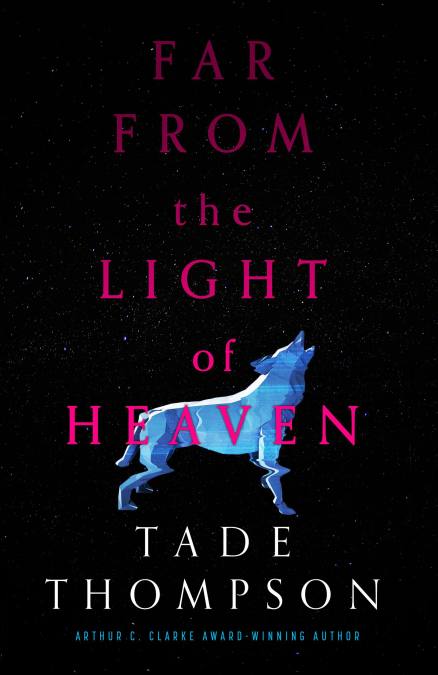
BOOK REVIEW: Far from the Light of Heaven by Tade Thompson


Far From The Light of Heaven is my first Tade Thompson book. Thompson is a Nigerian-British author best known for the Wormwood Trilogy featuring the books Rosewater, The Rosewater Insurrection, and The Rosewater Redemption. He won the Arthur C. Clarke award for Rosewater in 2019. This series is set in Nigeria in 2066 and is often referred to as part of the Afrofuturism movement.  I have only read a few Afrofuturism books (Lagoon by Nnedi Okrafor comes to mind) but so far I haven’t been that impressed (although I am a big fan of N.K. Jemisin's award-winning Broken Earth trilogy). The description of Rosewater as genre mashup of “Africanfuturism, cyberpunk, biopunk, Afropunk, zombie-shocker, [and] love story” is not appealing to me so I haven’t read it yet, although I do typically like genre mash-ups (like the apocalyptic police procedural The Last Policeman by Ben Winters). However, Far From The Light of Heaven piqued my interest when I saw the official summary for the book:


The colony ship Ragtime docks in the Lagos system, having traveled light-years to bring one thousand sleeping souls to a new home among the stars. But when first mate Michelle Campion rouses, she discovers some of the sleepers will never wake.


Answering Campion’s distress call, investigator Rasheed Fin is tasked with finding out who is responsible for these deaths. Soon a sinister mystery unfolds aboard the gigantic vessel, one that will have repercussions for the entire system—from the scheming politicians of Lagos station, to the colony planet Bloodroot, to other far-flung systems, and indeed to Earth itself.


From this we can tell that there are two primary protagonists in the story, Rasheed and Michelle (Shell). We are introduced to Shell first, meeting her on Earth even before she boards the Ragtime as first mate. Surprisingly, even though we meet Rasheed last, I identified with him more than her.


Their motivations for why they act the way they do in response to the extraordinary series of events that befall them on Ragtime are very different from each other. Shell is responsible for the welfare of the one thousand passengers in suspended animation and is shattered that 31 of them have been dismembered on her watch (even though it happened while she was sleeping for 10 years like all the other humans on the spaceship). But (somewhat bizarrely, I think) she insists on maintaining her exercise and sleep schedule while the ship (especially the A.I. which is the actual captain of Ragtime) becomes more and more erratic. In the end, I didn’t really connect with Shell or empathize with her. Rasheed on the other hand we are introduced to with the context that he has a problematic incident in his past that involves an on-duty killing of an alien. He's the assigned investigator to the incident on the ship and he’s single mindedly focused on discovering who committed the murders (even when paying more attention to surviving his time on Ragtime becomes more and more urgent). I was more interested in what happens to him (and his partner Salvo, a humanoid android or Artificial). 


There are other important characters in the book but I don’t want to mention them because to do so would reveal spoilers. However, I will say one strength of the book is the diversity of its characters. As a mystery-science fiction genre mashup, Far From The Light of Heaven works much better as science fiction than as mystery. We do find out who committed the crime(s) but there’s really no way we could have figured it out from the information provided to the reader.


Overall, I am glad that I read Far From The Light of Heaven although I don’t think it’s outstanding or very memorable. That’s fine, not everything has to be a barn burner or award-winning. An entertaining genre novel with a diverse cast and a vision of the far future that is centered around the existence of black people (or people of African descent) is a net good in of itself, in my view.

Title: Far From The Light of Heaven.
Author: 
Tade Thompson.
Format: Kindle.
Length: 385 pages.
Publisher: Orbit.
Date Published: October 26, 2021.
Date Read: December 19, 2021.

GOODREADS RATING: ★★½☆  (3.5/5.0).

OVERALL GRADE: B+ (3.33/4.0).

PLOT: B+
IMAGERY: B.
IMPACT: B+.
WRITING: A-.

Thursday, December 16, 2021

BOOK REVIEW: The Back Road (DCI Tom Douglas, #2) by Rachel Abbott


The Back Road is the second book by Rachel Abbott that I have read, after Only The Innocent. These are the first two books in the long-running series of police procedural, psychological thrillers starring DCI Tom Douglas. The series is up to 10 books so far and generally each entry has an average rating above 4.0 on Goodreads with 10,000+ ratings, which is quite rare (and impressive) territory for a series of genre books.

In The Back Road Tom Douglas has left his position at the Met in London and is living in a small suburb called Little Melham when word comes of a young girl who was knocked over by a car and left for dead in the middle of the night. The entire village is shocked when more information comes out that Abbie  had been abducted via online messaging prior to the automobile incident on the back road, which is a short cut that basically only locals know about. Is the culprit someone they know?

The book is primarily told from the perspective of Ellie Saunders, a married mother of two young children who had been driving on the back road to see her lover the night in question and who happens to be Tom Douglas' neighbor. Her husband is a school teacher who knew Abbie and her sister, who was visiting at the time knows something is going on with her sister's marriage but it distracted by her increasing attraction to Tom. Ellie works as a nurse and is involved in Abbie's care and tries to comfort Abbie's concerned (adoptive)  parents.

I don't know if two data points makes a trend but in the two books I have read featuring DCI Tom Douglas female characters have been at the center of the mystery, often prime suspects or at the very least persons of interest with either motive, opportunity or means to commit the crime(s) in question. Also, the mental and emotional states of the women in the books have been complex and mostly hidden from Tom but presented in first person to the reader. In Only The Innocent, more time was spent on the investigation procedures because Tom was on the job then while in The Back Road we see the  investigation proceeding from the eyes of Ellie, the suspect. (Something similar had happened in the first book as well.)

For this reason, I would definitely call both DCI Tom Douglas books I have read so far to be psychological thrillers, because a significant aspect of the text is about learning about the psychology of the main characters and how the crime affects their emotions and thoughts. We also get access to Tom's thoughts and feelings about the crimes, the investigation and the suspects s well as developments in his personal life. This is pretty typical with police procedural, investigator-driven mysteries but what I think is new/different here is the focus on the internal psychological conflict(s) of others besides the primary protagonists. And, I'm not sure that I'm a fan of this particular twist on the genre. It takes attention away from the narrative tension of the mystery itself (who did it, how will "we" figure out who did it and what will the consequences be) which usually dominates works in the mystery genre. That, and the fact that there's not very much diversity in the supporting characters in the books is definitely making me reassess my commitment to continuing this series. If I'm going to read murder-mysteries with non-genre elements I'd prefer to spend my time with stories that have female protagonists (like Jane Casey's Maeve Kerrigan, Elly Griffiths' Ruth Galloway, Robert Bryndza's Erika Foster and Robert Dugoni's Tracy Crosswhite) or diverse casts (like Peter James DCI Roy Grace and Sarah Hilary's Marnie Rome). That being said, I do also enjoy books with just a plain old white guy as the protagonist (like C.J. Box's Joe Pickett and William Kent Krueger's Cork O'Connor).

Overall, The Back Road is an entertaining mystery novel with substantial suspense and psychological content. For those looking for a more traditional police procedural crime thriller I would suggest look elsewhere but clearly there are many people who appreciate Rachel Abbott's approach to the genre and I can see why.


Title: The Back Road.
Author: 
Rachel Abbott.
Format: Kindle.
Length: 472 pages.
Publisher: Black Dot Publishing .
Date Published: March 8, 2013.
Date Read: November 19, 2021.

GOODREADS RATING: ★★★★☆  (4.0/5.0).

OVERALL GRADE: B+/A- (3.5/4.0).

PLOT: A-.
IMAGERY: B+.
IMPACT: B+.
WRITING: A-.

Thursday, November 25, 2021

BOOK REVIEW: Winter's Orbit by Everina Maxwell


Winter’s Orbit is an unusual read for me. It’s a debut novel with a story that straddles two genres: fantasy and gay male (m/m) romance. The story apparently started life with the title “The Course of Honour” on a website better known for fan fiction (Archive Of Our Own) in the original works section. Eventually Tor Books agreed to publish Everina Maxwell’s story reworked as a space opera with a queer romance (instead of the original which is apparently primarily a queer romance with some SFnal elements). I’m generally not a huge fan of romance, but I am gay, and gay male romance is something I very rarely choose (mostly because I think it will be cheesy). That said, I was completely devastated by the m/m romantic themes in Madeline Miller’s A Song for Achilles when I read it earlier this year. Plus it’s also rare for a book in one genre to overlap with another, so a m/m romantic space opera is very rare, like finding a Black, gay mathematician (oh, wait…).

Winter’s Orbit has received significant acclaim for its insightful writing and emotional resonance. The central plot revolves around the tried-and-true romance trope of the “fake-dating scenario.” This is when the two protagonists have to demonstrate for external stakeholders that they are a romantic couple when in reality they are complete strangers to each other. Of course, the two strangers get to know each other better as they spend copious amounts of time together in order to bolster the verisimilitude of their fake relationship and (inevitably) romantic sparks fly in reality. It’s another iteration of “Love Conquers All.”

In Winter’s Orbit the main characters are Kiem and Jainan. Kiem is a grandson of the Emperor and has the title of Prince. Jainan was married to Kiem’s cousin Taam, another Prince. The Jainan-Taam marriage also served the diplomatic purpose of uniting the two worlds of Iskaat and Thea, respectively. However, when Prince Taam is killed (which may or may not have been an accident) the Emperor asks (read: commands) Kiem to marry Jainan in order to maintain the appearance of good positive relations between Iskaat and Thea. This is important because the decennial review of the treaty that Iskaat has with a galactic superpower called The Resolution that provides interstellar communication, trade and travel is upcoming and political stability and domestic tranquility are factors the Resolution will consider during the treaty review process.

The emotional resonance of Winter's Orbit is primarily provided by the clash of personalities of the two main characters. Kiem is a fun-loving, n'e'r-do-well who was one of the more scandal-prone members of the extended royal family. Jainan is a very studious (he has an Engineering doctorate) foreigner to Iskat from Thea who takes duty and fidelity very seriously. They are both hunky but don't think the other will find them attractive. (Kiem because he thinks Jainan is too smart and serious, and Jainan because he knows from the celebrity  rags that Kiem has had LOTS of prior short-term relationships with others guys). Seeing the two reconcile with their arranged marriage and working through the misconceptions they have with each other and learning from (and getting over) their pasts is one of the central plots of the book.

Structurally, the author provides access to the inner thoughts of both primary characters (Kiem and Jainan), which primarily allows the reader to see what the two think about each other. That’s how we the reader knows that each of them is misinterpreting the words and (in)actions of the other. Because both Jainan and Kiem are essentially public figures, their marriage is first and foremost a diplomatic act, and is made available for public consumption. But of course this makes any private moments more fraught between the two.

In addition to the romantic plot, another key feature of the book is the political intrigue storyline. Both Kiem and Jainan represent their individual nations in their diplomatic and marital union, and they are pressured by representatives from their countrymen to demonstrate their loyalty in different ways. These political concerns play a role in what and how decisions are made, especially by the Emperor and the partisans from Thea and Iskaat.

One aspect of Winter’s Orbit that I really appreciated was the complete absence of homophobia. There’s never any stigma or questions about the fact that the royal marriage is between two men. This is extremely refreshing; it’s lovely to read a book where one’s existence and/or worldview as a gay man is not up for debate.

Overall, although I liked Winter’s Orbit and I enjoyed the same-sex romance storyline, as a space opera I was underwhelmed. In my opinion, the science fiction element of the book was under-developed. The good news is that even though the story in Winter’s Orbit is very self-contained, there are enough loose ends that a sequel would be reasonable. I would be interested in reading a sequel, which in some sense means that even though my overall reaction to Winter’s Orbit is muted, the book was a success since in the end I am open to reading more.

Title: Winter's Orbit.
Author: 
Everina Maxwell.
Format: Kindle.
Length: 384 pages.
Publisher: Tor Books.
Date Published:  February  2, 2021.
Date Read: October 20, 2021.

GOODREADS RATING: ★★★★½☆  (4.5/5.0).

OVERALL GRADE: A- (3.67/4.0).

PLOT: B+.
IMAGERY: A-.
IMPACT: A-.
WRITING: A.

Thursday, November 18, 2021

BOOK REVIEW: China Mountain Zhang by Maureen McHugh


I have been hearing about China Mountain Zhang on Goodreads for so long that I finally decided to break down and read it. China Mountain Zhang is famous for being the debut novel of Maureen McHugh that was nominated for many of the most prestigious awards in speculative fiction: the 1992 Hugo Award, the 1993 Nebula award, the Locus Award for Best First Novel (1993), the James Tiptree, Jr. Award(1993), and the Lambda Literary Award (1993) and winning several of them (Tiptree, Locus and Lambda).

China Mountain Zhang is also well-known for its unusual structure: it is a mosaic novel, i.e. a collection of intertwined stories, all set in a 22nd century United States (and world) dominated by China, and featuring a character named Zhang Zhong Shan, which contains two of the most famous names in the Chinese language, akin to being called George Washington Jones. It so happens that Zhang, the title character, is a guy with multiple secrets. He’s a closeted gay man in a culture rife with state-sanctioned deadly homophobia. Even though he appears to be ABC (American-Born Chinese), in actuality he has a Latino father, his mother named him Rafael and (illegally) provided him with spliced genes that give him his Asian appearance that aligns with his public identity as Zhang.

The reader learns about the world of the twenty-second century through cleverly curated details provided in the stories. For example, we know that the United States is no longer a capitalist democracy because Zhang has to go to a special government office to obtain a new job when he loses (or leaves) the first job we see him have in an early chapter. (This indicates that even in New York City there appears to be a planned economy.) Socially and culturally, China appears to be the zenith of society in the book, and going to China is what most people we meet in the stories aspire to do.

Eventually Zhang goes to spend a difficult 18 months near the North Pole in order to get credit that he can use to finance an education in China that will provide him with engineering and architectural credentials that will allow him much more job flexibility and earning potential in the future. (There are multiple references to communism and Mao Zedong but individual ownership of property does not seem to be outlawed in the United States, although collectives appear to be popular and socially favored.) In my opinion, Zhang is the most important (and frequently appearing) character in the book and his stories are the best passages; it makes sense that he’s the title character.

Overall, although I’m glad that I have finally read China Mountain Zhang, I was not really that impressed with it. Having an openly gay character in 1992 (was and) is definitely ahead of its time, but being unable to realize that societal homophobia (even in a world dominated by Chinese culture) might have abated was not a possible future the author envisioned. So my overall takeaway from the book is that it produces a vision of a downbeat, if not dystopian, future. Of course, not all books need to be upbeat but my hope is that in most books I read the story will be engrossing or engaging to the reader in multiple ways, either in wanting to know how the story ends (here since the book is a mosaic there is no “plot” per se, so this is not a factor) or depicting characters or the setting in a way that cause a visceral connection with the reader (neither really worked for me here although I was curious about how exactly China came to dominate the United States but that story is not fully given). So in the end I view China Mountain Zhang as a creative but not compelling read; it’s suitable for sci-fi completists but probably not for casual aficionados of the genre.

Title: China Mountain Zhang.
Author: 
Maureen McHugh.
Format: Kindle.
Length: 321 pages.
Publisher: Orb Books.
Date Published:  April 15, 1997 (March 1992).
Date Read: October 17, 2021.

GOODREADS RATING: ★★★★☆  (4.5/5.0).

OVERALL GRADE: B+ (3.33/4.0).

PLOT: B.
IMAGERY: B+.
IMPACT: A-
WRITING: B+

Thursday, October 28, 2021

BOOK REVIEW: Cross and Burn (Tony Hill / Carl Jordan, #8) by Val McDermid


Cross and Burn is the eighth installment in the British police procedural crime thriller series written by Val McDermid featuring psychological profiler Dr. Tony Hill and Detective Chief Inspector Carol Jordan set in the Manchester suburbs of Bradfield in the north of England. This series is one of the most exciting and compelling entries in the multiple genres that it occupies (which include suspense thriller, British police procedural, and murder mystery). It is also one of the rare series that has both a male and female lead in a primarily non-romantic relationship.


I hadn’t read one of McDermid’s books in a while so I had forgotten about one of the most effective aspects of her books, which is the inclusion of first-person perspectives of future crime victims. By doing this, she connects the reader to the characters and increases the impact of their deaths at the hands of the homicidal psychopaths that tend to populate her books. It’s also surprising because many authors generally use first-person mode to indicate important characters who may be placed in extreme peril and ultimately survive, but McDermid seems to be unafraid of killing off these characters. It's not like they always die or always survive, so the uncertainty ratchets up the suspense in the reader.


As I have said before, one of the added pleasures of reading a long-running series in order that have a repeated primary protagonist (like Jane Casey’s Maeve Kerrigan, Stephen Booth’s Cooper & Fry, Peter Robinson’s Alan Banks or Peter James’ Roy Grace, for example) is the deepening relationship the reader has with the characters due to increased familiarity via repetition. In the Hill & Jordan series, the two have gone through a lot together, especially in the previous book’s The Retribution which resulted in the horrendous death of Carole Jordan’s only brother and his female partner. This happened as a direct consequence of her and Tony’s work of hunting and capturing a serial killer (who escaped and went on a killing spree). It causes Carol to (irrationally) blame Tony for his inability to realize that once the serial killer had escaped that his revenge might have included her family, quit her job as a police officer, and cut off all contact with Tony and her former colleagues in the Bradfield Metropolitan police department.


In addition to including first-person perspectives of victims McDermid often includes first-person perspectives of the perpetrator as well. This is something other suspense thriller authors do as well, but generally not as cleverly as she does. In Cross and Burn, the reader watches with horror while a deranged male chauvinist targets women who happen to resemble Carol Jordan, capturing them, making them play out his twisted vision of a “perfect subservient wife” and then eventually killing them when they fail to meet his insane “standards.” Through back channels Tony is brought in to help with the case by DI Paula McIntyre when she’s approached for help by the teenage son of a missing woman who works in the same hospital as her wife. For some reason Paula’s new boss decides that circumstantial evidence tying Tony to one of the disappearances of a woman later found dead means that he is likely the serial killer the Bradfield police are looking for. The only good outcome of this bizarre development is that it gets Carol out of her mourning funk enough to try and help Tony fight the charges.


Another one of the notable features of McDermid’s books are the (sometimes gory) scenes of violence and torture. She doesn’t shy away from the depiction of the horrors that violent crimes, both physical and psychological, can produce. Despite this, her books are always entertaining, well-plotted and memorable. In fact, overall Cross and Burn is an example of a master working at the height of her craft, cementing her status as one of the best in the business by creating another spine-chilling entry in her long running series.

Title: Cross and Burn (Tony Hill & Carol Jordan, #8).
Author: 
Val McDermid.
Format: Kindle.
Length: 438 pages.
Publisher: Mariner Books.
Date Published:  October 22, 2013.
Date Read: October 8, 2021.

GOODREADS RATING: ★★★★½☆  (4.5/5.0).

OVERALL GRADE: A-/B+ (3.5/4.0).

PLOT: B+.
IMAGERY: B+.
IMPACT: A-.
WRITING: A-.

Thursday, October 21, 2021

BOOK REVIEW: Shards of Earth (The Final Architecture, #1) by Adrian Tchaikovsky


Shards of Earth is the first installment in a brand new space opera trilogy by Adrian Tchaikovsky, one of the most prolific and creative science fiction authors working today. Space opera is my favorite genre of book so discovering a new entry is always an exciting treat.


Shards of Earth has aliens, spaceships, space pirates, planet-destroying machines, motley crew, genetically modified humans, multiple political factions and incredibly advanced technology nearly indistinguishable from magic. The premise of the story is that Earth (and several other planets colonized by humans) were physically manipulated by mysterious gigantic alien vessels/creatures called the Architects into bizarrely artistic, lifeless shapes, rendering them uninhabitable and killing billions in the process. These apocalyptic events happened a full half-century before the time period the first book is set in but the now-scattered human diaspora still lives in fear, wondering and waiting for the return of the Architects to complete the extermination of the species.


The main characters in the story are Idris Telemmier (an Intermediary, i.e. a human who has been biologically modified to enhance his ability to access unSpace and propel vehicles across vast distances) and Solace (a parthogenetically created soldier who has a history with Idris and is on a secret mission). Both Solace and Idris had a role in the last battle which ended the Architects War 50 years ago, but the time has affected each of them differently.


Idris and Solace are two members of an eclectic crew of a salvage vessel called The Vulture God. The crew of The Vulture God contains a number of different aliens and differently-abled humans. Tchaikovsky is a true master at thinking up and depicting aliens in a way that readers can relate to, despite the physical and cultural peculiarities they possess. It’s amazing how he can write characters that are so different from humans but whose actions, beliefs and motivations are so familiar and compelling to readers. 


In fact one of the most enjoyable aspects of reading Tchaikovsky’s work in general (and Shards of Earth in particular) is becoming immersed in the worlds the author creates. For example, the setting of Shards of Earth includes the political situation of different factions of humans competing for supremacy, each of whom is convinced their ideology is the best choice for humanity. This, combined with at least a half-dozen alien species, can make the book a little hard to follow at first, but eventually the reader gets our bearings and it’s this level of complexity and attention to detail that illustrates the depth of Tchaikovsky’s world-building.


In addition to the world-building and the setting, the plot is a key highlight of Shards of Earth.  While on a seemingly routine salvage mission, The Vulture God finds a surprising artifact that could upend life for all humans in the galaxy by indicating that the Architects have returned. However, after this happens, there are many different entities which very much want to obtain what their ship has found and the crew has to do whatever it takes to protect their ship and its contents. This involves a number of action-packed sequences that have significant consequences for many of the characters that we have recently encountered (not everyone survives these dangerous and exciting events, which is probably the way it should be). Eventually the chase is resolved in a way that doesn’t leave everyone satisfied but the original problem is overwhelmed by the stakes involved in more recent developments. The story has a scale which is both galactic in nature and intimate: the relationship between Idris and Solace is one of its key elements.

Overall, Shards of Earth is an exciting standalone space opera novel as well as the first entry in what is sure to be a compelling trilogy about the fate of humanity in a Universe where there are existential threats to its survival and prior episodes of genocidal trauma.

Title: Shards of Earth.
Author: 
Adrian Tchaikovsky.
Format: Hardcover.
Length: 548 pages.
Publisher: Orbit.
Date Published: August 3, 2021.
Date Read: September 30, 2021.

GOODREADS RATING: ★★★★½☆  (4.5/5.0).

OVERALL GRADE: A/A- (3.83/4.0).

PLOT: A-.
IMAGERY: A-.
IMPACT: A.
WRITING: A.

Thursday, October 07, 2021

BOOK REVIEW: The Galaxy and the Ground Within (Wayfarers, #4) by Becky Chambers


The Galaxy and The Ground Within is the fourth entry in the Wayfarers series by Becky Chambers, a quirky collection of loosely connected stories of life about an interstellar, multifarious civilization where humans are just one among a large number of space-faring species. The Wayfarers series won the Hugo award for Best Series in 2019 for Becky Chambers. 


The previous books in the series are The Long Way to a Small, Angry Planet (2014); A Closed and Common Orbit (2016); and Record of a Spaceborn Few (2018). The Galaxy and The Ground Within was published in 2021. The books are all similar yet also very different, with nebulous connections between the individual entries. Basically what they all share is a vibe, which a significant fraction of readers find admirable and appealing. I suppose they can be classified as “space opera” because the formal definition of the term is “an adventure science-fiction story” and there are aliens, spaceships and conflict in all of the Wayfarer books. 


However what sets the Wayfarers books apart is that the “narrative tension” or conflict in these books is often at a much lower scale/volume than what one typically sees in a space opera novel. This "lack" of action sometimes leads to complaints that “nothing happens” in these books but I disagree. Instead, most of the action is more individualized and impacts a small number of characters.


For example, in The Galaxy and The Ground Within a horrible accident happens that results in the destruction of multiple satellites over a planet which is usually a busy way station for travelers (called the Five-Hop One Stop) across the galaxy. The result is that a handful of aliens have their travel plans disrupted and are forced to interact with each other and the manager of the way station for an extended period of time. It’s basically the interstellar equivalent of the famous Icelandic volcanic eruption that disrupted inter-Atlantic travel several years ago, leaving travelers stranded in various airports. For the people involved it’s a big deal, of course, but for an uninvolved observer it is inconsequential.


What Chambers does is try to make us care about what happens by getting us to know more about the aliens (in this Wayfarers book there are no speaking characters that are human) while slowly revealing to us the impact of the travel delay on their lives. Chambers incorporates diversity in multiple ways into her books. In some of the earlier books, there was diversity in the kind of intelligence (artificial or computer-based intelligence versus biological) was a theme. In in The Galaxy and The Ground Within there is a prominent non-binary character and multiple characters perform their gender in a way that would surprise humans by their fluidity (like "male" characters either getting pregnant or having borne offspring).

Overall, I liked this book about as much as the other books in the series but I must admit that they are a specialized, acquired taste for the vast majority of science fiction fans who are used to their space opera in the mode of Star Trek or Star Wars or The Expanse (that is, action-packed, thrill rides with weapons, aliens, discovery and suspense). That said, there are still some low-key levels of enjoyment from reading the Wayfarers books and if you have read the others, you will most likely enjoy The Galaxy and The Ground Within too.

Title: The Galaxy and the Ground Within.
Author: 
Becky Chambers .
Format: Hardcover.
Length: 325 pages.
Publisher: Harper Voyager.
Date Published: April 20, 2021.
Date Read: September 8, 2021.

GOODREADS RATING: ★★★☆  (4.0/5.0).

OVERALL GRADE: A- (3.67/4.0).

PLOT: B+.
IMAGERY: A.
IMPACT: A-.
WRITING: A-.

Thursday, September 30, 2021

BOOK REVIEW: Out of Range (Joe Pickett, #5) by C.J. Box

Out of Range is the fifth book in the police procedural crime fiction series by C.J. Box starring U.S. Fish and Game warden Joe Pickett. Set in the very rural setting of Saddlestring, Wyoming and starring a straight white male protagonist, these are an unusual set of books to be ensconced so firmly in my list of books I heartily enjoy reading. Just like the scenery of the Big Sky country they often describe, the Joe Pickett books are austere, airy and admirable.

In Out of Range, Joe is dealing with some changes in his life as a result of the after-effects of events from the previous book, Trophy Hunt. Some of this change is good, like one of his least favorite people (Bud Burnham) no longer being sheriff of Twelve Sleep County. And some of it is more nuanced, like the fact that his wife and eldest daughter Sheridan are entering the oil-and-water phase of their mother-daughter relationship.

Out of Range begins with the discovery of the dead body of a longtime friend of Joe’s named Will Jensen who was serving as the Game Warden for Jackson (which is described as the “California” of Wyoming) when he apparently shot himself in the face. His boss asks Joe to temporarily take over the territory Jensen had patrolled and he (somewhat reluctantly) agrees to do so. Jackson is a huge step up from Saddlestring because it includes the Grand Teton National Park and if  Joe does a good job it’s possible he could get this area as a permanent assignment, which would mean more prestige for him and a more cosmopolitan life for his family. But because the opportunity is a result of a sudden death it means that Joe has to go to Jackson alone and leave his wife Mary Beth and his daughters behind. Before he leaves, Joe asks his friend (and mysterious loner) Nate Romanowski to look in on his wife and kids while he’s gone and keep them safe.

When Joe gets to Jackson (2 days late because he had to take care of a wayward bear who was getting too familiar with human food) he discovers that maybe he didn’t know Will as well as he thought he had. Will had spent multiple nights in the Sheriff's drunk tank and had even been arrested for violent, disruptive behavior; his wife and kids had moved out several months before his body was found.

One of the interesting features of the Joe Pickett books are the various contemporary issues facing wilderness areas that the author seamlessly weaves into the stories. This time one issue depicted is the popularity of “fad diets,” such as the idea of raising and caring for your animals before  (chicken, cows and pigs) before you slaughter and eat them. And the perils of being in a state essentially controlled by one political party. And the power and corruption of people behind large real estate developments. In this book, these three aspects are rolled into one "big bad."

A new twist in Out of Range is Joe’s surprising besottedness with a mysterious woman who seems to know more about his friend’s death than she’s willing to talk about. (And who happens to be the wife of one of the big wigs that Will was having trouble with.) Simultaneously Joe and Mary Beth begin to have trouble connecting (literally and figuratively) and each blames the other (and especially the other’s absence) for the unhappy/problematic situation they are in.  And there’s an ominous subplot involving some weird threatening phone calls someone is leaving on Joe’s home office answering machine.

Joe has a cellphone but by the very nature of his work he is often "out of range" of communication  and he doesn't really seem to appreciate how annoying/worrying/problematic it can be for people trying to reach him to not be able to do so. Another interesting feature of the books is how self unaware Joe is about the feelings of others and his own feelings. He also doesn't react well to authority and often gets in trouble for doing things that his superiors would prefer he didn't do. He has his own very strong belief in right and wrong is rarely convinced to change his course of actions once he has decided what to do.

In the end, Joe (of course) does figure out what happened to his friend and has a fair number of adventures as he unearths the tensions and secrets that Will was dealing with before his untimely death. And some exciting and important developments occur back at Saddlestring that will be interesting to see how this changes Joe’s view of the way he does his job in the future. And Nate disappears. Again. Hopefully the ramifications of these events will be addressed in Book 6, In Plain Sight.

Title: Out of Range.
Author: 
C.J. Box.
Format: Kindle.
Length: 320 pages.
Publisher: G.P. Putnam's Sons.
Date Published: May10, 2006.
Date Read: September 13, 2021.

GOODREADS RATING: ★★  (5.0/5.0).

OVERALL GRADE: A- (3.67/4.0).

PLOT: B+.
IMAGERY: A-.
IMPACT: A-.
WRITING: A.

LinkWithin

Blog Widget by LinkWithin