Showing posts with label Black male. Show all posts

Tuesday, October 11, 2022

FILM REVIEW: The Woman King

It's been quite awhile since I saw a movie in the theaters, but last weekend I saw two of them! The husband and I intended to see Bros opening weekend with another gay couple but when it turned out they couldn't see it until Sunday we decided to go see The Woman King on Saturday, since it had stellar reviews and was only available in theaters. I'm glad we did!

The Woman King is a star vehicle for Viola Davis, the most Oscar-nominated Black actress of all time (and winner of the 2016 Best Supporting Actress for Fences). However, it is also a rarity among studio films, with a predominantly Black female cast. The movie is about the legendary Agojie, the "virgin African Amazons" who were an all-female army in the West African kingdom of Dahomey during the slave era. The film features John Boyega (The Force Awakens, Small Axe), Thuso Mbedu (The Underground Railroad), Lashana Lynch, Sheila Atim, Jordan Bolger and Hero Fiennes Tiffin. The last actor plays Santo Fereirra, the main white character in the film, a slaver from Brazil who is working with the enemies of the Dahomey to buy and ship captured Africans into slavery in the Americas. He arrives with his interracial friend Malik played by the pulchritudinous Jordan Bolger, who is the son of a Dahomey mother and white father.

Of course any film about slavery is effused with violence, but in this case the violence is mainly done by the Black female characters in the film (the Agojie).  The film is set in 1823 and makes clear that both the Dahomey and the Oyo participated in the slave trade, by selling captured African combatants to the slavers. However in the movie, Davis' character, Nanisca, the head of the Agojie decries the practice to King Ghezo (played by Boyega) and argues the Dahomey could and should trade palm oil with the white man instead. The primary conflict in The Woman King is between the Kingdom of Dahomey and the Oyo Empire, who are much larger and to whom the Dahomey pay tribute to. Dahomey refuses to pay tribute and the two nations go to war, with the smaller Agojie army using the superior tactical and strategic prowess of Davis' General Nanisca to eventually become victorious. However, during the main Oyo-Dahomey battle in the movie some of the main Agojie characters we have been following (played by Lynch and Mbedu) are captured and taken to be sold into slavery. Mbedu's character (Nawi) is bought by Bolger's character (Malik) in order to rescue her. (The two had their "meet-cute" moment earlier in the film when Nawi finds Malik bathing in a nearby waterfall and takes his clothes which for me was a highlight of the movie because Malik is phyne!!)

Although being told explicitly by her king not to go and rescue her captured Agojie soldiers, Nanisca goes anyway and along with her most loyal supporters basically destroys the town/port where slaves were being bought and sold and then transported across the Atlantic.

Overall, The Woman King is a well-done, action film (I think I saw someone call it a "a Black female Gladiator or Braveheart") with exceptional performances by Davis and Mbedu. It is exceedingly violent, almost graphically so, since almost all the combat is hand-to-hand with sharp, bladed weapons, a few primitive  guns and some gunpowder-based explosions. Despite the action genre, there is real emotional relationships depicted between many characters, like Nawi and Malik, Nawi and Nanisca, and Nanisca and Amenza (played by Atim). It's one of the best times I have had at the movies in years!

Title: The Woman King.
Director: Gina Price-Bythewood.
Running Time: 2 hours, 15 minutes.
MPAA Rating: Rated PG-13 for sequences of strong violence, some disturbing material, thematic content, brief language and partial nudity.
Release Date: September 16, 2022.
Viewing Date: October 2, 2022.

Writing: A-.
Acting: A.
Visuals: A.
Impact: A+.

Overall Grade: A (4.0/4.0).

Star Rating:  ★★½☆  (4.5/5.0).

Saturday, May 14, 2022

BOOK REVIEW: Blacktop Wasteland by S.A. Cosby


Blacktop Wasteland is the second  book by this author that I have read; I first read and enjoyed his Razorblade Tears. Blacktop Wasteland is the more celebrated of the two, having won a slew  of awards (Los Angeles Times, Anthony, Macavity, Barry). After enjoying Razorblade Tears so much I wanted to see if Blacktop Wasteland lived up to the hype. The answer is: yes and no.

Both books are in the same genre of “action-packed crime thrillers set in the rural South.” But that’s the end of the similarities between Razorblade Tears and Blacktop Wasteland. Razorblade Tears is basically a story about two very different fathers who reluctantly are working together to find out and get revenge on whoever shot and killed their gay sons at point blank range. Blacktop Wasteland has one central main character, Beauregard “Bug” Montage that the plot hinges on, with the central narrative tension being fueled by the answer to the question of whether Bug is a “good guy who sometimes commits criminal acts” or “a criminal who sometimes does good things.” By the end of the book I don’t think the reader has a definitive answer to this question besides “it’s complicated.”

Ambiguity or the fusion of positive and negative, or dark and light elements is a recurring theme of both Razorblade Tears and Blacktop Wasteland, with it playing an even larger role in the latter. Bug is a talented getaway driver just like his decades-absent father. He is a car whisperer with the automotive equivalent of what a “green thumb” is for gardeners. He used his ill-gotten gains from his participation in a previous heist to open his own auto repair shop in his very small town in southern Virginia and business is Not Good.

Bug has three kids, two boys  with the woman he lives with in a trailer and a daughter he fathered as a teenager more than two decades ago. His cancer-ridden mother is in an expensive assisted-living facility. Bug has a number of financial obligations and not many legitimate sources of income as an ex-con. So when some former criminal associates approach him for a “slam dunk heist” he is not really in a position to resist the siren call of easy money.  

Blacktop Wasteland is a more cerebral book than one would generally expect from an entry in the crime thriller genre. This may explain the broadness of its appeal and the level of hype it has received. A central element is its depiction of the moral/philosophical dilemma of its protagonist, with the author asking the reader in Blacktop Wasteland “What would you do if you were in Bug’s circumstances, with his past and talents and debts?” Bug basically has two choices: work with some sketchy (probably racist) good old boys to drive a getaway car from a jewelry heist OR try to make a sizable dent on reducing his debts by selling his pride and joy: his father Ant Montage’s car, called the Duster, which he has maintained in perfect condition for decades. Blacktop Wasteland begins with Bug winning a street race in the Duster (and then being part of a scam which results in him not actually bringing any money home that night) and it’s clear the Duster is more than just a car to Bug, it’s the last connection he has to the father he idolizes.

So the primary narrative tension of Blacktop Wasteland is sourced in the decision Bug will make about how he will earn money. But it’s clear that the scales are not evenly weighted on the sides of good and evil. It’s not easy for a Black man who has spent time in jail to earn enough money to support himself and others using only legitimate and above board means, especially when his skills and experience are so useful to successful criminal activity. So, it’s not really a surprise when Bug makes the choice he does. What is surprising are the twists and turns that the plot takes afterwards. There are serious and permanent consequences for lots of the people Bug comes into contact with during the story.

In the end, although I was glad I read Blacktop Wasteland and am also convinced it will make an excellent movie when Hollywood inevitably adapts it for the big screen, it didn’t leave as strong an impression on me as Razorblade Tears did. I think it’s because the two books have very different messages in the end. Frankly, I’m not exactly sure what message Cosby was trying to send with Blacktop Wasteland while the message in Razorblade Tears is very clear (accept your children as they are, don’t try to mold them into something you think they should be!) and one I agree with.

Title: Blacktop Wasteland.

Author: S.A. Cosby.
Format: Kindle.
Length: 305 pages.
Publisher: Flatiron Books.
Date Published: July 14, 2020.
Date Read: April 9, 2022.

GOODREADS RATING: ★★½☆  (4.5/5.0).

OVERALL GRADE: A/A- (3.83/4.0).

PLOT: A.
IMAGERY: A.
IMPACT: A-.
WRITING: A.

Monday, January 17, 2022

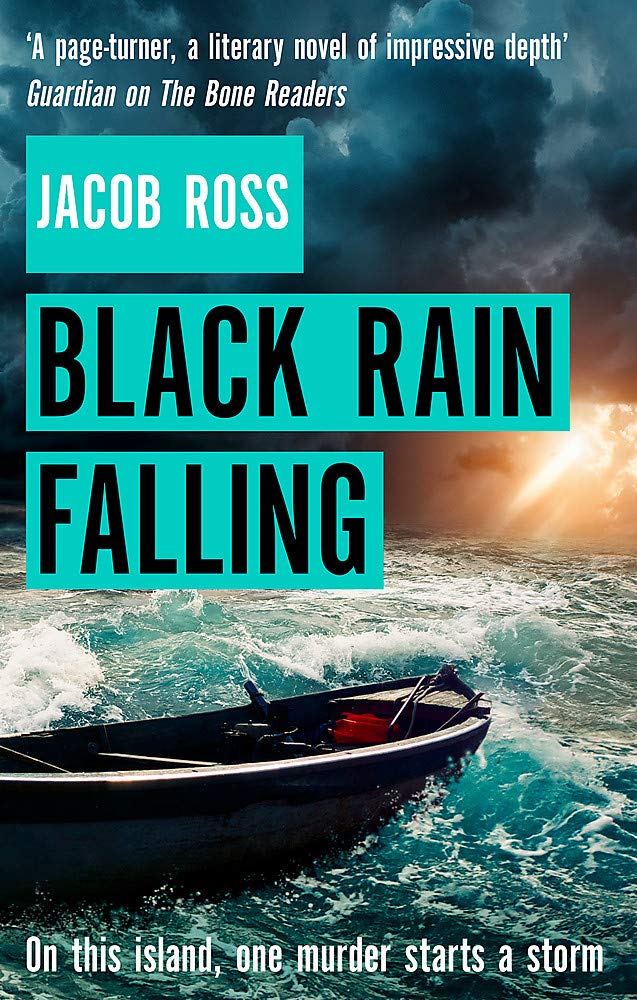
BOOK REVIEW: Black Rain Falling (DC Digger, #2) by Jacob Ross

Black Rain Falling is the sequel to The Bone Readers, the first two in what is apparently designed to be four novels collectively called the Camaho Quartet. These books were written by Jacob Ross, a Grenadian-born, award-winning author and poet who lives in Britain. They are police procedural novels, crime thrillers set on an island called Camaho (which is clearly a thinly disguised version of Grenada) featuring two psychologically wounded and ethically complicated detective protagonists in Detective Constables Michael "Digger" Digson and Kathleen Stanislaus and a host of colorful supporting characters and criminals.

The Bone Readers was memorable for its immersive depiction of island life while unspooling a captivating, suspenseful story and introducing the reader to DC Digger and DC Stanislaus (who is invariably referred to as "Miss Stanislaus" in the text). In Black Rain Falling, the stakes are higher for our main characters as Miss Stanislaus fatally shoots in self defense a known criminal (who was also responsible for her traumatic sexual assault when she was a teenager) and Digger’s frenemy/boss/rival Malan Greaves uses this incident to make his move to advance his career while crippling Digger’s and Stanislaus’ by dissolving the special criminal justice investigative unit that all three of them worked at by having them all transferred to a new police station where he gets a promotion and Digger's enemies get easier access to him.

However, the central mystery in Black Rain Falling is about how the international drug trade is bringing increased crime that is beginning to impact life on Camaho and neighboring islands. For example, there is a shockingly violent killing, an abundance of “hush money” and an incredibly powerful speedboat that can be used to ferry drugs between multiple islands. Digger and Stanislaus are trying to puzzle out the connections between these pieces before the corrupt powers that be strip them of their ability to do anything about it. 

By the end of the book both Digger and Stanislaus, who have complicated and ambivalent relationships with their fathers will need to rely on familial connections in order to persevere and ultimately succeed.

As with the first book, the reader can come for the compelling characters and thrilling plot but what really sets these mysteries apart from others in the genre is 1) Digger and Stanislaus’ chemistry and teamwork; 2) the verisimilitude of the depiction of the island setting of Camaho (Grenada) and 3) Ross' lyrical writing; the author is an award-winning poet and it shows in the quality of the prose.

Overall, Black Rain Falling is another excellent police procedural written by Jacob Ross, set in the Caribbean with two compelling characters in DC Digger and Miss Stanislaus whom I hope to spend a lot more time with in future installments of the Camaho Quarter.

Title: Black Rain Falling.
Author: 
Jacob Ross.
Format: Kindle.
Length: 432 pages.
Publisher: Mullholland Books.
Date Published: March 5, 2020.
Date Read: December 30, 2021.

GOODREADS RATING: ★★★★  (5.0/5.0).

OVERALL GRADE: A- (3.67/4.0).

PLOT: A-.
IMAGERY: A.
IMPACT: A-.
WRITING: A.

Thursday, May 13, 2021

BOOK REVIEW: The Fires of Vengeance (Burning, #2) by Evan Winters


The Fires of Vengeance by Evan Winter is the sequel to the author’s debut novel The Rage of Dragons. These books are firmly in the category of epic fantasy: they are both chockfull of dragons, swords, metaphysical powers, gods and warfare. The books are set in something resembling a Bronze Era civilization, with a strict caste-based society that appears to modeled on an ancient African culture. Winter is one of the very few African-American writers working in this genre and he makes it very clear that the characters in his books are primarily what we could call “people of color” with skin tones of various hues from very light brown (tea with lots and lots of milk) to the darkest black (fire-scorched wood).

The main character in the series is Tau Solarin, who in The Rage of Dragons had a fairly familiar plot of the lowly outsider underdog who eventually becomes a celebrated champion after overcoming multiple trials and tribulations. In The Fires of Vengeance, Tau’s developing relationship with his Queen, Tsiora Omehia, becomes one of the primary threads of the complicated plot. In addition to this romantic intrigue plot line, the story in the second book also includes political intrigue between Tsiora and her sister Esi who has claimed she is the rightful claimant to the throne and the intercultural intrigue of the ongoing disintegration of the Omehi caste system. However, all of these other threads are overshadowed by the imminent battle between the Omehi people and the more populous indigenous inhabitants of the Xidda continent. And in addition to the struggles between different factions of the Omehi and the future struggle between the Omehi and Xiddans , there’s a non-negligible threat from the Cull, the near-omniscient murderous beings who drove the Omehi from their ancestral land of Osonte, decimating them in the process. It was that fabled escape from Osonte, dozens of generations before the events told in The Burning books that caused the Omehi to arrive to Xiddan and displace the indigenous folks on the peninsula, who unsurprisingly view them as colonizing marauders who should be exterminated.The Omehi feel like the Xiddan pensinsula is overrun by godless, murderous heathens who don't deserve to occupy the land their forefathers fought and died for so the stage is set for genocidal war.  Because its been so long, many Omehi don’t even think The Cull are real (which is a dead giveaway that at some point these Big Baddies are gonna show up at some point!)

A key feature of the books is the existence and prominence of Isihogo, the Underworld, where time runs faster than the real world and where the power of gods and demons manifest themselves. Generally, only priestesses with a rare ability and years of training are able to enter Isohogo but Tau has been using it as a means to hone his fighting skills to the point where he is the best fighter the Omehi have seen in generations, perhaps ever. (When you get killed by Demons in the spirit world it doesn’t physically harm you and you wake up back in the real world with the memory of what happened; many people can become susceptible to emotional and mental damage from the experience. Because Tau is fueled by a volcanic level of rage and vengeance he thinks that the costs, such as the hallucinations he regularly suffers, are worth the enhanced fighting prowess and imperviousness to pain he gains.)

As I mentioned, Omehi society is strictly caste-based, with two primary groups, Nobles and Lessers. The author is somewhat vague about whether the castes are actually biologically distinct, or whether, like race, the caste divisions in Omehi society are socially constructed identities reified by cultural norms and historical tradition. Nobles are generally larger, faster and stronger than Lessers, but a key point we learn in the first book is that the two groups can procreate with each other (although of course this is strongly discouraged). There are various strata in both of the two primary castes, with the absolute lowest being “Drudges” who are basically outcasts from Lesser society and the highest are the Royal Nobles, which includes Tsiora. In both books, one of the central fights Tau has to take on is the assumption that as a Lesser he has no chance of besting a Noble (of any level) in combat. This of course turns out to be spectacularly untrue and is the primary plot device of The Rage of Dragons. However, we do learn in The Fires of Vengeance that Nobles have stronger connections Isihogo which may account for their advantages (and also would tend to lend credence to the idea that the caste divisions are “real”). However, like race, just because one group of people who are racialized into a particular group tend to have more or less of a particular trait or tendency does not mean that race is not a fiction. The clever and conspicuous depiction and deployment of race is one of the most attractive features of the series for me, especially since any depiction of difference from a white heteronormative ideal is so rare in most fantasy and science fiction.

Although the two books share numerous similarities (depiction of multiple battles and one-on-one skirmishes, political and romantic intrigues, cultural/ethnic stereotyping and demons, dragons and disasters, oh my!) The Fires of Vengeance improves on The Rage of Dragons by de-centering Tau slightly and making it clear that two of the most important characters from the first book are both gay (and a couple!). Of course, Tau in his single-minded focus on getting revenge for the deprivations he suffered in the first book is one of the last to figure out the situation but he takes it completely in stride. As a gay reader of the books, the complete absence of homosexuality in the all-male military settings of the first book was a curious and problematic defect that I’m very happy was corrected in the second book.

I suppose one of the (slight) quibbles one could have with The Fires of Vengeance is that it doesn’t resolve most of the larger tensions in the plot and ends with the inclusion of a huge, paradigm-shifting twist. That said, there’s a lot that does happen in the second book of The Burning, with multiple significant characters dying and/or having life-altering consequences due to the action. Winter is not one to provide his characters with plot armor, which is a refreshing change.  Apparently the series may become a quartet instead of the expected trilogy, which is fine by me, because The Burning is fast becoming one of my favorite epic fantasy series. For people who like the work of Brent Weeks (Lightbringer series, Night Angel trilogy) and Peter Brett (Demon Cycle) I’m confident you will also enjoy these action-packed, engaging books by Evan Winter!

Title: The Fires of Vengeance (The Burning, #2).
Author: 
Evan Winter.
Format: Kindle.
Length: 528 pages.
Publisher: Orbit Books.
Date Published: November 10, 2020.
Date Read: May 2, 2021.

GOODREADS RATING: ★★  (4.0/5.0).

OVERALL GRADE: A- (3.67/4.0).

PLOT: A-.
IMAGERY: A-.
IMPACT: A-.
WRITING: A-.

Thursday, March 18, 2021

BOOK REVIEW: Real LIfe by Brandon Taylor


Real Life by Brandon Taylor seems like it is a book that was designed in a lab to appeal to me. It’s a fictional account of a Black gay graduate student who likes to play tennis and is working on getting his Ph.D. in a STEM discipline at a predominantly white institution in a small town somewhere in the northeast. 30 years ago I was a black gay graduate student who liked to watch tennis and was working on getting his Ph.D. in a STEM discipline (applied mathematics) at a predominantly white institution (Rensselaer Polytechnic Institute) in a small town in the northeast (Troy, NY).

However, Wallace, the protagonist of Real Life, is very different from the person I was then, and since the book is set in a contemporary context, his experience is very different from my graduate days. That said, the situations that Wallace experiences as well as the descriptions of some of the characters he interacts with seem very familiar. Wallace is a graduate student in biochemistry and has a cadre of white friends, most of whom are also graduate students (in various fields). The group contains a gay couple named Cole and Vincent, another named Lukas and Nathan, and a gay international couple named Klaus and Roman, a straight couple named Emma and Thom, two “straight” guys named Yngve and Miller and then there’s Wallace. Almost all of Real Life is told through Wallace’s eyes as he observes how his friends interact with him, as the only black guy in a group of white people. Wallace is from the South, and we learn he is the first in his family to have ever gone to graduate school, and perhaps the first to go to college. His life experience is very different from the people he hangs out with when he’s not working in the lab and he is also very different from the people he works with in the lab as well. Later we learn that he was basically abandoned by his father and that his parents apparently blamed him for the fact that a family friend molested the tween-aged Wallace. The key material of the book is sourced in the tension caused by the ways Wallace’s identity and temperament distort and disrupt his experience of everyday social interactions with those around him, especially the ways these are frequently leavened with micro-aggressions and not-so-micro aggressions. And that’s when he’s with his “friends”!

Relatively early in Real Life, Miller and Wallace hook up sexually, a somewhat surprising event initiated by the putatively heterosexual Miller. Both Miller and Wallace have some warped ideas about sexuality, to my somewhat prudish sensibilities. Suffice it to say, even though their sexual activities are consensual, afterwards one or both of them are sore or bruised. (Not exactly my idea of a good time, but “different strokes for different folks.”) Near the end of the book I wasn’t completely convinced both of them would survive its conclusion. The sexual fluidity of Wallace’s coterie of friends is an interesting feature of the books, and is another example of unspoken tension that animates some of the peculiar social dynamics in the group. For example, even though Yngve is straight, it is a commonly understood fact in the group that Yngve and Lukas are often together, hanging out publicly. Lukas' boyfriend Nathan doesn't seem to be bothered by this situation, since Yngve is "straight." However one of the other gay guy, Roman, is a troublemaker. He says something explicitly racist to Wallace, and he causes tension among the other gay couples by remarking on how happy he is that he is in an open relationship with Klaus. (Or as he puts it, "Nothing is better than f***ing someone while my boyfriend watches.") This completely sets Cole off, who is a bit strait-laced and prone to jealousy about his relationship with Vincent, who seems fascinated by the idea of something other than a monogamous relationship, while Cole seems to be a gay Republican in training. Cole is probably the gay guy Wallace is closest to. There's a very fun scene where there is a very detailed description of a tennis match the two play together which appears as if it could lead to something else, and definitely reveals the evanescent sexual tension that can arise in non-sexual interactions between gay men who are friends. In some instances Wallace deliberately chooses to exacerbate not ameliorate the conflicts that arise from these tensions. To me it seems clear that Taylor is portraying Wallace as a masochist, both sexually and emotionally. There are several examples in the book where painful things happen to Wallace and even when he could try to take action or respond to reduce the pain, he doesn’t, instead he “simply takes it,” as if he deserves (or enjoys?) being victimized.

Overall, Real Life is a quick, compelling and insightful read. The writing sometimes tends to the florid, and there's not much of a plot. (The central question is, "(How long) Can Wallace survive interacting with these people?") Wallace is in a bad situation, made worse by the cluelessness and casual racism of his “friends” as well as the precarious and disempowered nature of graduate education. I was hoping for a happy ending, but this is really not that kind of book. I’m somewhat surprised at the level of acclaim Real Life has received (such as being shortlisted for the Booker Prize) but I would definitely recommend the book to people, especially well-meaning white people who think the reason for underrepresentation of racial and ethnic minorities and women in STEM academic circles is a “pipeline” problem. Taylor provides real insight that rings true for me about what it’s like being “the only one” in certain academic settings as well as the complicated nature of gay male friendships. Since this is his debut novel, I look forward to reading future books by him.

Title: Real Life.
Author: 
Brandon Taylor.
Format: Kindle.
Length: 335 pages.
Publisher: Mullholland Books.
Date Published: February 18, 2020.
Date Read: March 3, 2021.

GOODREADS RATING: ★★☆  (4.0/5.0).

OVERALL GRADE: A-/B+ (3.5/4.0).

PLOT: B+.
IMAGERY: A-.
IMPACT: B+.
WRITING: A-.

Monday, December 02, 2019

EYE CANDY: Simeon Panda (6th Time!)


Simeon Panda is one of my all-time favorite models. His body is ridiculous, but as you can see, he is extremely handsome as well. This is his sixth appearance as Eye Candy. Surprisingly, he has not graced these pages in over 2 years (February 6, 2017)! Most likely it will be his last, since I am planning on ending my blog on January 1, 2020.

Thursday, October 24, 2019

BOOK REVIEW: Heads of the Colored People by Nafissa Thompson-Spires


I was only supposed to read two stories, “Belles Lettres” and “The Necessary Changes Have Been Made” in order to decide which should be included in a collection of texts that address race, white supremacy and (mis)representation of Black people in the media. While both of these stories are good (and "Belles Lettres" is particularly trenchant) they imbricate race with so many other issues that I felt the primary point would’ve been lost or “diluted.”

So I continued reading the collection and when I got to the title piece knew I had found what I was looking for. The first story “The Heads of Colored People: Four Fancy Sketches, Two Chalk Outlines, and No Apology” also weaves in other issues (police shooting, intraracial dynamics, Blerd culture) with multiple depictions of Black masculinity that I found quite compelling. The only other story which I felt could have satisfied my requirements is “Fatima The Biloquist.” I love that we get to see multiple depictions of Fatima in various stories in the collection. I connected with this  particular story because it does such a clever job of discussing racial representation in the context of class, phenotype and language.
However, the standout stories in this collection (for me), apart from the aforementioned “Heads of the Colored People” and “Fatima The Biloquist” were “Suicide, Watch” and “Not Today, Marjorie.”
When I reached the last paragraph of “Suicide, Watch” I burst out laughing so loudly my husband laying next to me said “What happened?” Even when I recounted the story I couldn’t stop giggling at the brilliant premise and payoff of that story. "Suicide, Watch" is worth the price of the entire collection.

Many of the stories are about unlikable people or people in uncomfortable situations and not every story is great or memorable. (But one of the joys of short story collections is that if you don’t like what you’re currently reading, it will be over pretty soon.) Some of the more memorable stories may be ones I didn’t particularly like, such as “This Todd” and “The Subject of Consumption.”

Overall, I would definitely recommend the collection as a whole and I know I am going to be anticipating reading what Nafissa Thompson-Spires writes in the future.


Title: Heads of the Colored People.
Author: 
Nafissa Thompson-Spires.
Paperback: 203 pages.
Publisher:
 37 INK/ Atria.
Date Published: April 10, 2018.
Date Read: April 21, 2019.

GOODREADS RATING: 
★★½☆  (4.5/5.0).

OVERALL GRADE: A/A- (3.83/4.0).

PLOT: A-.
IMAGERY: A.
IMPACT: A-.
WRITING: A.

Monday, October 14, 2019

Eye Candy: Corey Upton


Corey Upton is a model and professional body builder. He has roughly 20k followers on Instagram (@thecoreyupton).

Monday, September 16, 2019

EYE CANDY: Kalmon Stokes


Kalmon Stokes is a model I initially found on Instagram (@kalmonstokes). He has been featured in Obvious magazine (in 2018) when they said he was 24 years old and 6-foot-3. Enjoy!

Monday, September 02, 2019

EYE CANDY: Joel Green


Joel Green is a hottie that I discovered at Instagram (@green.joel), where he has over 100,000 followers. He is clearly devoted to fitness and bodybuilding. He appears to be a personal trainer located in Europe.

Monday, August 19, 2019

EYE CANDY: Chadoy Leon


Chadoy Leon has 700,000 followers on Instagram (@chadoyleon) and is making his first appearance as Eye Candy on the blog. According to BodySize.org, Chadoy is 27 years old, 5-foot-9 and 192 pounds. Clearly, he is a tattoo enthusiast.

Wednesday, August 07, 2019

UPDATE: Michael Johnson (Black, Gay ,HIV+ Man) Released From Prison Early!

Michael Johnson (left) with Dr. Steve Thrasher

There's an exciting update in the ongoing saga of Michael Johnson (also known as "Tiger Mandingo"), a Black gay man with HIV who at the age of 23 in 2015 was sentenced to 30-years in prison for knowingly exposing several gay men to HIV (some of whom subsequently tested positive for HIV later). Johnson's case was a textbook case of HIV stigma combined with racial animus leading to a problematic criminal justice result. Happily, this conviction was overturned in 2016 and last year Johnson agreed to a 10-year Alford plea deal with the last 3 years converted to parole.

One of the key journalists and activists who raised the media profile of the Johnson case was Steve Thrasher (@thrasherxy) (seen pictured with Johnson above the day he was released from prison on July 9, 2019).

A New York Times report on Johnson's release said:
In theory, H.I.V. exposure laws are meant to encourage H.I.V.-positive individuals to disclose their status before having sex, and to practice safer sex, with the ultimate goal of preventing the spread of the virus.
But there is no evidence that these laws have reduced risky behavior or encouraged disclosure, said Catherine Hanssens, the executive director of the Center for H.I.V. Law and Policy, which provided legal support for Mr. Johnson’s case.
In the eyes of the law, an H.I.V. diagnosis is conflated with malice, she added.
“These laws effectively treat an H.I.V. diagnosis itself as evidence that the person acted with bad intentions when sex or other types of physical contact are involved in a crime,” she said.
Congratulations to everyone who worked on this case. Johnson will be moving to and living in Indiana with a friend and says he plans to continue his education and would like to share his story as part of advocacy for HIV prevention and treatment,

Friday, June 28, 2019

CELEBRITY FRIDAY: Alphonso David, 48, Named President Of HRC, Largest LGBT Lobby In The USA


Alphonso David, a 48-year-old Liberian refugee and civil rights attorney who served as counsel to New York Governor Andrew Cuomo has been named the next president of the Human Rights Campaign, America's largest LGBT political advocacy organization.


I haven't given HRC a red cent since they endorsed a Republican senator (Al D'Amato) instead pf a Democratic challenger (Liz Holtzman) in 1992! This decision may cause me to reconsider my boycott.

Monday, June 10, 2019

EYE CANDY: Nana-Kofi Adams (3rd time)


Nana-Kofi Adams  is a British-African bodybuilder who has appeared as Eye Candy twice before (February 25  2019 and October 8, 2018). Nana-Kofi is on Instagram (@nanakofi_adams) where to my surprise he only has 16K followers. Trust me, dear readers, you will not regret checking it out!

Monday, May 13, 2019

EYE CANDY: Nathan Mozango (reprise)


Natahan Mozango is a bodybuilder and Instagram thirst trap (@nathanmozango) who has appeared as Eye Candy only once before (May 29, 2017).

Monday, April 15, 2019

EYE CANDY: Pierre Vuala (4th time!)


Pierre Vuala has appeared as Eye Candy three times before (September 17, 2018; May 7, 2018; August 25, 2014). This Wilhelmina male model has 63,000 followers on Instagram (@pierre_vuala) but I am surprised it's not more, considering his physique compares positively with people like Jordan Torres (281k) or Brazilian hotties like Maxs Souza (85k) and Robert Oliveira (258k).

Monday, February 25, 2019

EYE CANDY: Nana-Kofi Adams (black/white)


Nana-Kofi Adams has appeared as Eye Candy only once before (October 8, 2018). He is a British bodybuilder of African descent who has more than 12,000 followers on Instagram (@nanakofi_adams). He takes great pictures in color and in black-and-white (as seen here).

Friday, December 07, 2018

CELEBRITY FRIDAY: Black AIDS Institute Names New Executive Director (Raniyah Copeland)


The new executive director of the Black AIDS Institute has been named as Raniyah Copeland. The president and chief executive officer of BAI has been Phil Wilson since its founding in 1999. The BAI is the nation's first  and only "national HIV/AIDS think tank focused on Black communities." Copeland, 34, has worked at The Institute for the last ten years. Wilson announced his retirement last year and the board conducted an extensive 10-month process to find a new leader for the organization.

The announcement was made at BAI's signature event "Heroes in the Struggle" last Saturday December 1.

Monday, December 03, 2018

EYE CANDY: Jacob Sumana (5th time!)


Jacob Sumana is one of my Eye Candy favorites, since he has made four(!) previous appearances here (December 30, 2013; March 31, 2014; February 2, 2015May 9, 2016). He has over 300,000 followers on Instagram (@jacobsumana). Enjoy!

LinkWithin

Blog Widget by LinkWithin