Showing posts with label female protagonist. Show all posts

Sunday, December 24, 2023

BOOK REVIEW: Holly by Stephen King


Holly is another entry by Stephen King into the universe in which the Bill Hodges trilogy (Mr. Mercedes, Finders Keepers, End of Watch) was set, although this time Holly Gibney is the primary character. Gibney is also featured  in The Outsider  and one of the four novellas that make up the 2020 collection If It Bleeds.  Even though I am not a fan of the horror genre or supernatural stories in general, I now consider myself a fan of King’s. In the last few years I have read and reviewed Fairy Tale (2023), Billy Summers (2022) and The Institute (2020) I appreciate what an amazing storyteller he is. Even so, I generally restrict myself to his non-supernatural fare, which I enjoy tremendously, and Holly is no exception.

The Bill Hodges trilogy were some of the first books by King that I read, primarily because they are in the mystery/detective/thriller genre. They feature Bill Hodges as a former cop who opens his own private detective agency (called Finders Keepers) and features Holly as his shy but capable assistant who becomes his partner as well as Jerome Robinson, a computer savvy Black teenager who does odd jobs for Bill.  Although Bill was the main character of the series, my favorites were always Jerome and Holly and I hoped that King would return to them in future work, which he has done with the publication of Holly.

Holly is the main character in Holly, which is set in July 2021 smack dab in the middle of the COVID-19 pandemic and the Trump era. Holly is mourning the death of her mom (due to COVID after refusing to get vaccinated) when she gets a call at the detective agency from a mother panicked about the disappearance of her adult daughter, Bonnie Dahl, who worked at the library of the local small college in town. Holly, who King himself has described as “obsessive compulsive with a huge inferiority complex,” is very careful about getting COVID and a fair amount of her internal monologue is about masking and her interactions with folks around her and their thoughts about COVID and Trump. This makes Holly a “political book” in the sense that  King (through Holly as his avatar) makes his thoughts about his views on these topics very clear. (Since I share these views I didn't find this aspect distracting or problematic.)

Some reviewers of  Holly question King’s choice to begin a detective mystery novel by revealing that the culprits are a pair of murderous, cannibalistic, septuagenarian professors, Rodney and Ellen Harris, who select their victims from the itinerant human flotsam available to them in the wake of a small town dominated by a prestigious college. But the detective story where the reader knows who did it from the beginning and the suspense is sourced in how and when (not really whether) the protagonist will figure it out (and stop the criminal before they crime again) is a tried and true trope of the genre. (Val McDermid is a Master at this form.) Here, I think this story structure works quite well, and especially when the reader gets first-person perspective from more than one character who is caught in the devilish flytrap of the Professors Harris.

An interesting feature of Holly is that it features not one but two subplots about young writers who are both experiencing their first successful encounters with the publishing industry. King often writes about writers in his books and his enthusiasm for this aspect of the story was palpable.

A surprising feature of Holly is that it features absolutely no supernatural phenomena. The Harrises have a reason for why they are periodically enticing, trapping, and culling people and it is because they believe that eating the human flesh of people significantly younger than they are will improve their health. For a significant fraction of the book King makes it appear as if they may be right, since they do appear to be experiencing  some relief, perhaps supernatural in nature, from their multiple health ailments not unfamiliar to people as old as the Harrises (mind-numbingly painful sciatica for her, and the numbing of the mind of dementia for him). But in the end King (again via his avatar Holly) points out that the bad guys’ evil, false beliefs are trumped [sic] by science: they were experiencing the placebo effect, completely dismantling any imagined rationale they could have posited to justify their murderous actions of killing and eating their neighbors. To me it is clear that King is trying to demonstrate that fact-based reality can be used to explain that people who do awful things (like deny the reality of COVID and the effectiveness of vaccines or vote for Trump or kill and eat fellow humans) are really doing it because they are awful people, despite what they tell themselves the reasons for doing these things are.

Title: Holly
Author: Stephen King.
Format: Kindle.
Length: 464 pages.
Publisher: Scribner.
Date Published: September 5, 2023.
Date Read: December 10, 2023.

GOODREADS RATING: ★★★★  (5.0/5.0).

OVERALL GRADE: A/A- (3.83/4.0).

PLOT: A-.
IMAGERY: A-.
IMPACT: A.
WRITING: A.

Thursday, May 18, 2023

BOOK REVIEW: Planetfall (Planetfall, #1) by Emma Newman


Planetfall is the first book in the acclaimed  Planetfall series written by Emma Newman.  It is the fourth of her books that I have read; Newman has stated the Planetfall books are written to be read in any order. I read them in the order second (After Atlas), fourth ( Atlas Alone), third (Before Mars ), and first (Planetfall). It’s curious because all the books reference the main event of the series, which is the departure of the interstellar rocket Atlas with roughly 1000 colonists under the guidance of the Pathfinder Lee Suh-mi to a planet where Lee claims they will find God. So, one would think that the first book is about this seminal event in the series, but it’s not. Even the main events in Planetfall take place several decades after the seminal event (it turns out that all four books are set roughly in a time frame under a year or so from each other, just in very different locations).

In Planetfall, most of the events happen roughly two decades after the colonists arrive on the planet. They seem to be well acclimated to their extraterrestrial environs. They have deliberately engineered their living conditions to be such that it is sustainable and low-impact  or no-impact on the environmental resources of their new home world. However, at the point the reader enters the story this comfortable lifestyle is disrupted by the appearance of an outsider, someone who is the grandson of the Pathfinder herself, and bears a clear familial resemblance to her.

We are primarily told the story of events from the perspective of Ren (Renata Ghali) whom we discover was one of the chief engineers responsible for the successful Atlas mission to the planet and has served as one of the primary technological resources and fix-it mechanics for the colony since they landed.

Having read all of the four books in the series I realize now a common theme is that the protagonist/main character in each book  is an unreliable narrator; each one has either had mental health issues or a medical history is revealed that causes the reader to question the veracity and accuracy of what we are being told about events. Interestingly, in three of the four books this protagonist has been female. In Planetfall, it takes quite a while before the reader realizes the extent to which Ren has been hiding important information from the reader that reveals she has a serious mental condition. I don't want to reveal what it is but one of the most significant impacts of the book is when the reader is allowed to fully perceive reality from Ren's perspective as mediated by her mental condition; the effect is devastating.

However, Ren’s issues are really a side issue to the primary plot of Planetfall; the last 20 pages has multiple extremely significant revelations and stunning dénouements. Again I don't want to be too specific about details in order to spoil things but suffice it to say that we learn why the Pathfinder felt that she was bringing humanity to meet God, and we get information and see events that have potentially irreversible consequence for the long term survival of the colony (and thus humanity itself). In fact, it's the ending of Planetfall that makes this entry the most impactful of the books in the series in my opinion. I strongly hope that the author goes on to continue the story beyond where the events in Planetfall, After Mars or Atlas Alone conclude. Overall, that should tell you all you need to know about the Planetfall  books: they leave you wanting more!

Title: Planetfall.
Author: Emma Newman.
Format: Kindle.
Length: 328 pages.
Publisher: Scribner.
Date Published: September 6, 2015.
Date Read: May 1, 2023.


GOODREADS RATING: 
★★½☆ (4.5/5.0).

OVERALL GRADE: A- (3.83/4.0).

PLOT: A-.
IMAGERY: A-.
IMPACT: A.
WRITING: A-.

Thursday, May 11, 2023

BOOK REVIEW: A Dying Fall (Ruth Galloway, #5) by Elly Griffiths


A Dying Fall is the fifth book in author Elly Griffiths' murder-mystery series starring Dr. Ruth Galloway, head of Forensic Archaeology at the University of Northern Norfolk, and DCI Harry Nelson, head of the major crimes squad of the Norfolk Police Department. These books are known as the Ruth Galloway mysteries and they are generally cold case murders (Ruth is an archaeologist after all) with a smidgen of romance (the relationship between Ruth and Harry is complicated--they hooked up once and the married police detective is the unacknowledged father of unmarried Ruth's daughter named Kate.)

I read and enjoyed the first four books in the Ruth Galloway series in quick succession (The Crossing PlacesThe Janus Stone ,The House at Sea's End, A Room Full of Bones) but put the series on a backburner when supernatural elements became a bit too central to the story for my taste in Book 4. (Longtime readers will know I am not a fan of supernatural elements, especially in murder-mysteries, because of the way it revises the implicit contract between author and reader in a whodunnit mystery. (If reality is subject to supernatural revision then how can the reader have a chance of solving the mystery?)

Anyway, the primary appeal of the Galloway books has always been the no-nonsense personalities of Ruth and Nelson, who the reader generally gets first-person perspectives on in every book. The secondary appeal are the rotating cast of secondary characters, primarily Cathbad, the sensitive and strange Druid who always seems to be in the right place at the right time, Ruth’s obnoxious department chair Phil Trent, various police officers who work with Nelson (Judy Johnson, Dave Clough, Tanya Fuller, and his boss Gerry Whitcliffe).

In  A Dying Fall an old schoolmate of Ruth’s from university named Dan Golding is killed by setting his house on fire with all the exits locked and blocked, soon after he made what he thought could be a blockbuster archaeological discover in the Lancashire area near where Nelson grew up and used to serve in the Blackpool police department when he was much younger. Ruth decides to go north to Blackpool with her young daughter Kate and Cathbad as guest babysitter after she is invited by Dan’s department chair to serve as an expert evaluator of his potential discovery. Of course, coincidentally Nelson and his wife Michelle decide to take a vacation to his hometown around the same time to go on a long-delayed visit to see Nelson’s mum.

With Nelson and Ruth in the same area when more bodies start appearing there are multiple opportunities for awkward run-ins and suspicious behavior as they both try to solve their respective mysteries. Tensions run even higher when just as their separate investigations cross paths, Kate goes missing, after being left in the care of Cathbad while Ruth was sleuthing.

Overall, this is one of the better entries in the series, which is becoming even more familiar and likeable as I read more of the books. The supernatural elements were kept to a minimum, and primarily involved Cathbad, who is so weird and wacky it’s hard to dislike. I’m pretty sure I won’t wait another 18 months to read the next book, The Outcast Dead!

Title: A Dying Fall.
Author: 
Elly Griffiths.
Paperback: 400 pages.
Publisher:
 Houghton Mifflin Harcourt.
Date Published: March 5, 2013.
Date Read: April 23, 2023.


GOODREADS RATING: 
★★★½☆  (4.5/5.0).

OVERALL GRADE: A- (3.67/4.0).

PLOT: A-.
IMAGERY: A-.
IMPACT: A-.
WRITING: A-.

Thursday, April 20, 2023

BOOK REVIEW: Before Mars (Planetfall, #3) by Emma Newman


Before Mars is the third book in Emma Newman’s loosely related Planetfall series. Curiously, I still have not read the titular first book in the series, Planetfall. There are a  number of reasons for that, but the primary one is that despite having the most number of ratings (11,056) and reviews (1,654) on Goodreads of any of the books in the series, Planetfall also has the lowest average rating, 3.72, which is slightly lower than the 3.75 threshold that I typically use for deciding on whether to start reading a new book. With that said, since I have now read the other books in the series, curiosity will almost certainly lead me to conclude the series by reading the work that was written and published first.


Regarding reading order, the author herself says that the Planetfall books can be read in any order. I'm actually not sure I agree with this view that it would lead to the optimal enjoyment of the series. The events of Book 3, Before Mars, and Book 4, Atlas Alone, clearly happen after most of the events of Book 2, After Atlas, and the events of Book 3 and Book 4 overlap somewhat so that these two can be read in any order. Clearly, the events of Book 1, Planetfall, happen before the other three books, but since its primary event (the Pathfinder project leaves Earth on the Atlas spaceship on an interstellar journey to “find God” out among the stars) is referred to in each of the subsequent books in the series, this means that Book 1 can be read at any time. Books 2 and 4 are the ones where there's a definite causal relationship that precludes reading them in a different order. I know this is a bit long, but I think I have talked myself into recommending this reading order: 1, 2, 4, 3. (This is roughly the temporal order in which the events depicted in each book occur.) I also think that books 3 and 4 can be read in any order but must come after book 2. After I read Book 1 I will discuss whether it would be best read before or after the other 3. My reading order will have been 2,4,3,1.


This review is about book 3, Before Mars, which I think is the most effective of the four books. The story in Before Mars is told from the perspective of Anna Cubrin, a geologist and painter. Cubrin is the latest addition to a small group of specialists at a Mars base named Principia that is exclusively run and operated by people loyal to Stefan Gabor, a multi-billionaire who I'm pretty sure is one of the rare characters who has a speaking role in all four books.


Cubrin is the prototypical unreliable narrator; we discover that her father experienced some kind of mental collapse that led to a near-fatal attack on his wife/Anna’s mother and his subsequent incarceration. As soon as Cubrin arrives at Principia, strange things start to happen which causes her to question her grip on reality and it is during this period that her father’s mental problems are revealed to the reader, as well as Cubrin's fervent wish that the mental collapse that happened to him will not happen to her too. By centering Cubrin’s mental state so early, the author makes it clear that Before Mars will be more of a psychological thriller than its preceding books. The reader also begins to question whether how well Cubrin’s perception of events jibes with reality, which is what the character also does.

The vast majority of the content of Before Mars either takes place in Cubrin’s head or is communicated to the reader in her voice. Oftentimes, this literary device would be unappealing to me but the circumstances here are so unusual and the character is so unlike others that I have spent time with in the first-person in a science fiction story that this time it kept me engrossed in the book.

As the plot proceeds the reader gets more and more examples of things that are not what they seem at Principia, and we also learn more about the other members of the Principia team. We also learn more about Cubrin’s relationship with her husband and infant daughter that she left on Earth and spent 9 months traveling to the red planet to be on Gabor’s payroll to produce paintings of Mars that he intends to send exclusively to private collectors. When events come to a head towards the end of the book (reflecting the effects of events that happened at the end of Book 2), the emotional impact on the reader is immense.

Overall, I think Before Mars is the best of the three Planetfall books I have read so far because while it still contains the technological advances of the other books (machine-neural interfaces that allow artificial intelligence to directly monitor bodily functions and mental well-being; augmented virtual reality called “immersives”; and interplanetary space travel) it has a more compelling (if less likable) central character in Anna Cubrin than Book 2's Carlos Moreno and does a better job of being a psychological thriller than Book 2 did in being a police procedural murder mystery. However, I definitely am curious to see what genre categories Book 1 (Planetfall) straddles and to find out how well it is done.

Title: Before Mars (Planetfall, #3).
Author: 
Emma Newman.
Format: Kindle.
Length: 352 pages.
Publisher: Ace Books.
Date Published: April 17, 2018.
Date Read: April 13, 2023.

GOODREADS RATING: ★★½☆  (4.5/5.0).

OVERALL GRADE: A- (3.67/4.0).
PLOT: A-.
IMAGERY: A-.
IMPACT: A-.
WRITING: A-.

Thursday, August 25, 2022

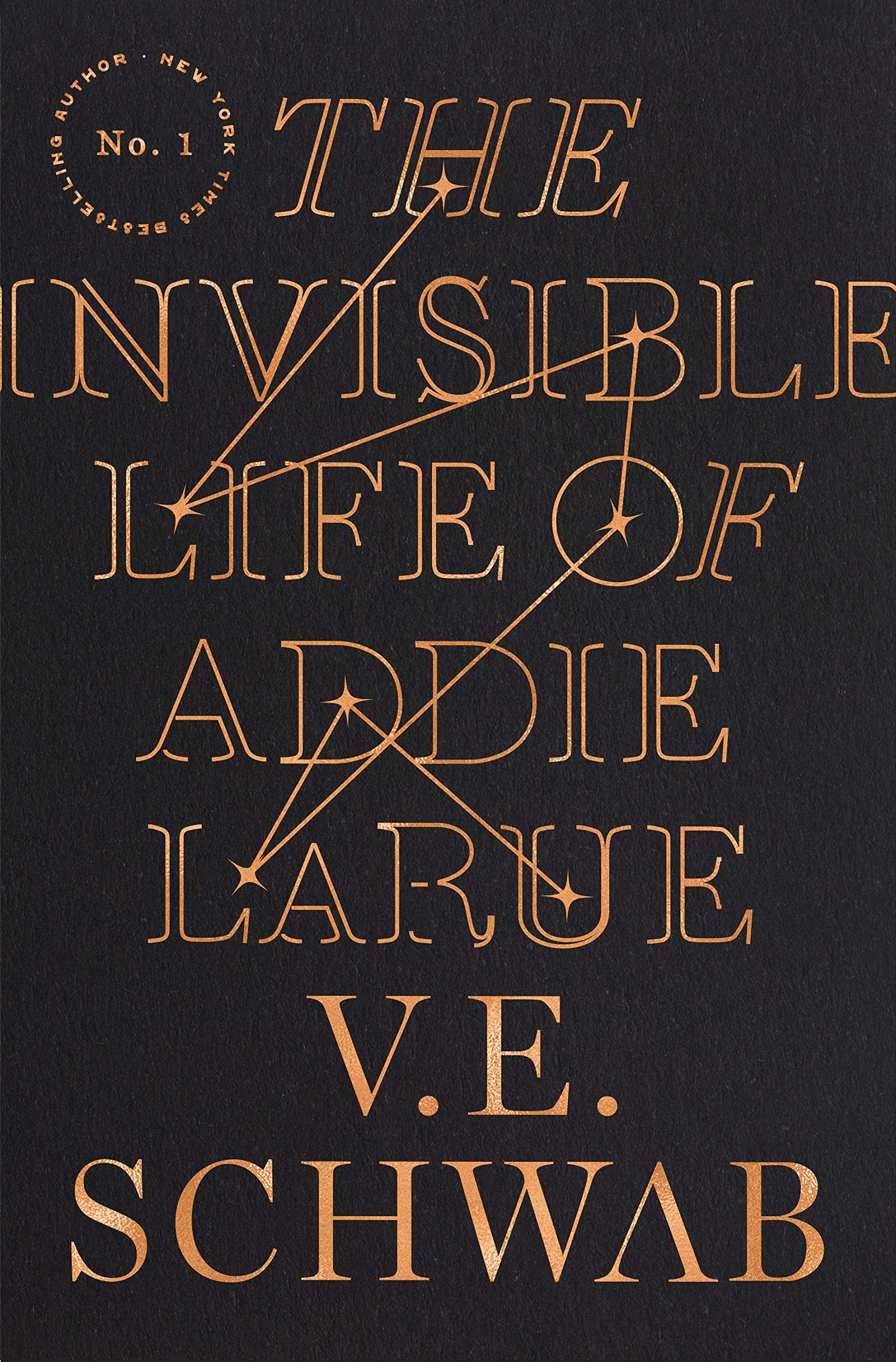
BOOK REVIEW: The Invisible Life of Addie LaRue by V.E. Schwab

The Invisible Life of Addie LaRue is a stand-alone speculative fiction novel by V.E. Schwab, the author of The Shades of Magic trilogy (A Darker Shade of Magic, A Gathering of Shadows, A Conjuring of Light) and other epic fantasy books. The Invisible Life of Addie LaRue is qualitatively different from these works; it’s more reminiscent of books written by Claire North, like The First Fifteen Lives of Harry August, which often have an intriguing supernatural premise or gimmick with a somewhat shallow depiction of the characters. In The Invisible Life of Addie LaRue the main character makes a deal with the devil to live forever but the catch is that it will be an “invisible life.”


Addie LaRue is a young woman in 1714 who asks the gods to save her from an arranged marriage and her wish is granted in that she will never age or die but the conditions are that no one will ever remember her, she can own no property, make new things or leave a mark on the world. The devil, who she comes to know as Luc (short for Lucifer, get it?), appears to her as a dark, handsome stranger on the anniversary of the granting of the wish and asks Addie if she’s ready to give him her soul yet. Addie’s first year living invisibly is incredibly tough as she figures out the rules of her situation and tries to do basic things like eat and find a place to live in a world where everyone forgets her the moment she leaves their sight. However, even though she is now a stranger to her mother and father and everyone she has ever known or will know, Addie declines Luc’s offer to give up (her soul and her life) after one year of living an invisible life.


One interesting aspect of the book for me is when we discover how Addie finds a large loophole in one aspect of the devil's deal. She can make a mark on the world, but she can only do so by serving as a muse and inspiration for works of art created by other people. It turns out that Addie happens to have seven freckles on her face in a distinctive (and memorable) pattern, and although she can’t be remembered, this motif can be, and is, included in multiple works of art (depicted in the pages of the novel) over the next 300 years as we follow Addie’s life.


The fact that we follow Addie for centuries without the basic contours of the story changing is a downside of the impact of The Invisible Life of Addie LaRue for me. The middle section of the book is somewhat repetitive (we see how Addie has lots and lots of one-night stands, how she has repeated "first-time" interactions with people over and over again). I'm sure this repetition is intention, used by the author to give the reader a taste of how repetitive Addie's life is for her as well. The primary change to the routine is that eventually Luc and Addie have a relationship (after all, he is literally the person who she interacts with the most often, and is the only person who can actually remember her after spending any significant amount of time with her). It doesn’t end well, because even though Luc says he’s in love with her after they have basically been together for twenty years, he still asks her for her soul, and Addie suspects the love affair may have just been a ruse to get her to lower her defenses to his desire.


Another weakness in the book is Addie herself. Even though the passage of time has less significance for her and the rules about her having possessions or leaving a mark on the world are difficult challenges to overcome, I was still disturbed by the lack of growth in Addie’s personality. She’s alive for long enough that she has seen astonishing technological advances and societal changes but she doesn’t seem world-weary or wise beyond her (apparently youthful) age. I suspect this may be a specific authorial choice to have Addie’s personality frozen in time as the 23-year-old woman from a small French village she was when she first gained immortality, but this is not made explicit, so the lack of development of Addie’s character over the course of the book is a puzzling and disappointing choice, to me.


The most interesting part of the novel occurs when Addie returns to a downtown Manhattan used bookstore the day after walking out without paying for a book she picked up and the manager remembers her name, something which hadn’t happened in three centuries. It turns out that Henry, the manager of the bookstore, has made his own deal with Luc, one in which he will forfeit his soul after spending one year in which everyone who sees him will see their heart’s greatest desire. Since Addie’s greatest desire is to be remembered, Henry is able to remember her. Of course, Addie immediately becomes infatuated with Henry and soon they become lovers. As things progress, they each start to become more aware of the magic deal the other had made with Luc. For example, Henry introduces his girlfriend to his friends and family and they only remember her existence for brief moments and so he has to do it over and over again. She sees the way people look at Henry and what special treatment he gets because he is literally the embodiment of all they want, at all times.


************************************SPOILER ALERT**********************************

In the end, Addie realizes that since she knows Luc so well, she can make a bargain that may be able to save Henry's soul (and life). She finally agrees to be “his” for as long as Luc is interested in having her at his side, but she draws the line at giving up her soul and she has one condition: Henry must be allowed to remember her and the time they spent together even though he will never see her again. Luc agrees to the deal and then we learn that the book we have been reading, The Invisible Life of Addie LaRue, is the true story of Addie’s life as told to Henry.

************************************SPOILER ALERT**********************************


This was a nice twist at the end, but for me it didn’t make up for other problematic aspects of the book (the slow pacing through the middle 200 pages, the fact Addie never really matures despite hundreds of years of experience and the way it treats both Luc's and Henry’s characters somewhat superficially). I think I’m in a distinct minority in my opinion of the book as “interesting, somewhat slow and flawed, but worth reading” in that it has over 650,000 ratings with an average of over 4.2 in August 2022 and a cinematic adaptation has been announced

Regardless, I encourage you to read the book yourself to see if you agree with my review.

Title: The Invisible Life of Addie LaRue.
Author: V.E. Schwab.
Format: Hardcover.
Length: 444 pages.
Publisher: Tor Books.
Date Published: October 6, 2020.
Date Read: January 29, 2022.

GOODREADS RATING: ★★½☆  (3.5/5.0).

OVERALL GRADE: A-/B+ (3.5/4.0).

PLOT: B+.
IMAGERY: A-.
IMPACT: B+.
WRITING: A-.

Thursday, August 11, 2022

BOOK REVIEW: The Trials of Koli (Rampart Trilogy, #2) by M.R. Carey


The Trials of Koli is the second book in the Rampart trilogy by M.R. Carey, author of The Girl with All the Gifts, The Boy on the Bridge and The Book of Koli. Despite being the second book in a trilogy (or maybe because of it), Trials expands the story of the adventures of a somewhat naive boy in a post-apocalyptic Britain in multiple ways. The most significant change is that instead of everything being told in first-person by Koli we also get first-person accounts by Spinner Vennastin. Spinner is the girl Koli left behind in his village of Mythen Rood when he was banished after revealing at her wedding to his best friend Haijon Vennastin that he had stolen some old tech from the Ramparts and could control it. This fact alone challenged one of the central organizing principles of Koli’s village that the Vennastins had exploited to maintain power and control of Mythe Rood for generations (i.e., that only certain people can control old tech and thus chosen individuals should be granted power to make decisions for the village). This event almost led to Koli's execution but the Vennastins were merciful" and granted him exile and ostracization instead. Book tells the story of what happens to Koli after he leaves Mythen Rood, while Trials continues that story, it also depicts what happens at Mythen Rood after Koli left, from Spinner’s perspective.  

One of the weaknesses of the trilogy as a whole is that Koli is a bit naive and often slower to realize the significance of events than the reader. (I am sure that this is narrative device an d stylistic choice by the author to engage the reader more firmly in the novel but it can be annoying/disconcerting at times.) In Book this is balanced by the expansion of Monono’s intelligence after she is able to get access to the remnants of the internet and the epxonenial increase in her abilities and agency. Monono’s worldliness compensates for Koli’s wide-eyed bewilderment in various situations in both Book and Trials. However, the inclusion of Spinner as another main character in Trials lets the reader access the story through someone who is also the smartest person in the room, which is quite refreshing and a clear strong point. 

Although the reader hopes that the Vennastins will get their comeuppance for unfairly keeping secrets about how the old tech works and maintaining control of the Rampart title through deception and secrecy, I sort of understood when Spinner made the decision to not reveal the treachery when she discovered it. She basically has to make this difficult choice after being thrust into the role of being responsible for the continued the existence of the village when everyone’s lives are in danger from external forces; Spinner decides unity among the villagers is required in order to have a chance of victory. 

It’s very interesting how the two main threads of the story follow different paths as they follow our two main characters. Koli meets many different people and gets exposed to different social situations as he, Ursula, Cup and Monono travel hundreds of miles to find London and the Sword of Albion, which is referenced in a mysterious signal/transmission they have been receiving more and more clearly as they get closer to London. Back in Mythen Rood we learn more about the individual characters of the inhabitants (especially Jon, who in the first book seemed like a bit of an asshole but in Trials he is shown to be a loving husband and father). This happens as Spinner also learns (and understands) more about how the old tech she has access to works and uses it to defend the village and her people. Spinner is also lucky in that they discover some more powerful tech that greatly helps her in the war against invaders from Half Ax.

The Trials of Koli has more action and suspense than The Book of Koli, since much of the important character development happened in the first book. The primary exception is Cup, who becomes a much more rounded and sympathetic character than the brainwashed cultist she was introduced as. Overall, I’d say the second book in the Rampart trilogy is even better than the first and ends on such a cliffhanger that it makes one anxious and eager to read the final book, The Fall of Koli.

Title: The Book of Koli.
Author: 
M.R. Carey.
Format: Kindle.
Length: 418 pages.
Publisher: Orbit Books.
Date Published: April 14, 2020.
Date Read: February 28, 2022.

GOODREADS RATING: ★★  (5.0/5.0).

OVERALL GRADE: A- (3.67/4.0).

PLOT: A-.
IMAGERY: A-.
IMPACT: A-.
WRITING: A-.

Thursday, June 16, 2022

BOOK REVIEW: Sea of Rust by C. Robert Cargill


Sea of Rust by Robert Cargill is set in a post-apocalyptic future where robots have completely exterminated humans. It’s a fascinating premise because it literally flips the script of the generic post-apocalyptic novel. The story is not about whether or how the few remaining humans will survive the dystopian future, because there are no humans left! Instead, all the central characters in Sea of Rust are “silicon-based life forms.” But that doesn’t mean that this sameness results in peace and a lack of tension among the various, computers, thinking machines and artificial intelligences. Even among computers, there is difference: in processing power, uniqueness, robustness/interoperability, former utility to humans and other factors. And where there is difference there is the potential for conflict.

Sea of Rust follows the path of a particular robot named Brittle who is something of a bounty hunter of and among other robots. Unsurprisingly, when there are no humans left, one of the most important things in the world is spare parts (and electricity/power). Brittle is a robot who hunts/tracks/finds other robots in order to salvage their parts. Brittle makes it clear that she (Brittle has picked her gender identity to be female) waits for the machines she is potentially getting parts from to have stopped operating before she disassembles them, but some of her fellow/rival salvagers are not so scrupulous. (It’s not completely clear whether Brittle is always so scrupulous herself, actually.)

When we meet Brittle, she is being hunted down by Mercer, who is the same Caregiver model of robot as Brittle is and thus needs the exact same parts. It’s pretty clear Mercer is perfectly happy to accelerate the process by which Brittle will become unoperational in order to reduce the time he will have to wait to gain access to the important parts (that are currently inside Brittle!) that he needs to remain functional. Basically, both Brittle and Mercer are facing the inexorable march of time and their inevitable obsolescence. This is an example of interesting philosophical question the author raises in the book: is cannibalism morally okay when practiced among robots?

However the existential battle between Brittle and Mercer is put on hold when a larger more dangerous threat arrives suddenly. One of the primary threats to the continued existence of individual robots like Brittle and Mercer are artificial intelligences that are attempting to dominate the planet and become a OWI (one world intelligence). Typically OWI (or their subsumed representatives, called "subs") approach other machine intelligences and offer them a “choice” to either join the OWI by subsuming their individuality to become a sub of the OWI or to be destroyed. (Not much of a choice, actually!)

The existence of potential OWIs as the villain(s) of Sea of Rust make it easier to see Brittle and Mercer as the heroes of the story. Because then the story becomes one of scrappy, independent David(s) fighting against a Goliath hive mind with orders of magnitude more resources, processing power and strength. However, at its core Sea of Rust is still a story about which of two silicon-based life forms will survive after human life has been removed from the equation. As a human reader it becomes difficult to be (and remain) very emotionally invested in the ultimate result, regardless of how unusual and compelling the setting is. As I mentioned earlier, another interesting aspect of the book is its incorporation of philosophical ideas and questions about the nature of intelligence and life itself in the context of an Earth where human life has been extinguished but artificial intelligence still flourishes.

Title: Sea of Rust.
Author: 
C. Robert Cargill.
Format: Kindle.
Length: 384 pages.
Publisher: Harper  Voyager.
Date Published: September 5, 2017.
Date Read: April 15, 2022.

GOODREADS RATING: ★½☆  (3.5/5.0).

OVERALL GRADE: B+ (3.33/4.0).

PLOT: B+
IMAGERY: B+.
IMPACT: B+.
WRITING: B+.


Thursday, June 09, 2022

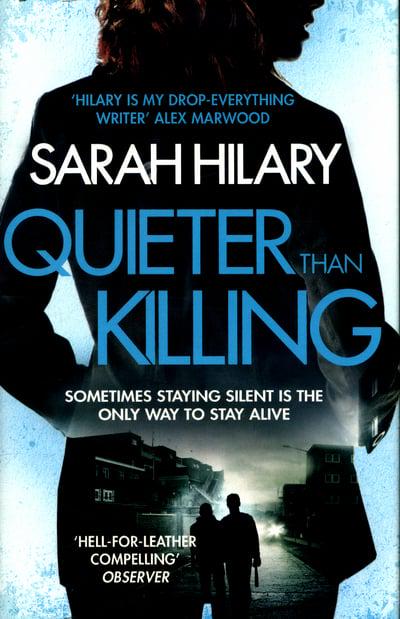
BOOK REVIEW: Quieter Than Killing (DI Marnie Rome, #4) by Sarah Hilary

The fourth book in the DI Marnie Rome series written by Sarah Hilary is Quieter Than Killing. (I have enjoyed the others, Someone Else's Skin, No Other Darkness, and Tastes Like Fear,) This time the story is about a series of violent attacks of people who have previously been accused or convicted of violent or criminal behavior. DI Rome and her partner DS Noah Jake realize that they are looking for a vigilante, someone who has taken the law into their own hands (and decided to break the law in order to punish others they think deserve it).
As they try to find the vigilante, Rome and Jake are also faced with the kidnapping of the 10-year-old so of a jailhouse informant as well as the trashing of the house where Rome’s parents were murdered by her adopted brother, Stephen Keele, who has been moved to an adult prison now that he’s over 18.
There are multiple strengths in these Sarah Hilary mystery thrillers and many of these strengths appear in Quieter Than Killing.
First among these is the depiction of Marnie as a strong female protagonist, working in a predominantly male environment of a police department that solves major crimes in London. Another strong feature of these books is the inclusion of Noah as an openly gay, Black police officer who serves as her deputy. (There are multiple references to how good looking Noah is, as well as his boyfriend Dan, but this doesn’t mean that he’s not subject to both racism and homophobia while doing his job.) Hilary does an excellent job of fleshing out many of the characters in these books, especially in the ways she provides enough information to give the reader insight into their psyches, this includes the criminals and the police officers who try to catch them. One other compelling aspect of the Marnie Rome books is the backstory of Marnie and Noah, and as the books have progressed, there have been developments in how these characters have dealt with and adapted to changes.
I would definitely place these books in the genre of psychological thriller. In Quieter Than Killing, like in her other books, the author presents the crimes (and the criminals) in such a way that their psychologies are revealed and this has quite a memorable impact on the reader. I recommend this book and the others in the series (you don’t have to read them in sequence but why wouldn’t you?) to people who like the work of Jane Casey and Val McDermid, who are other British mystery authors with female protagonists in their books.

Title: Quieter Than Killing (DI Marnie Rome, #4).
Author: 
Sarah Hilary.
Format: Kindle.
Length: 432 pages.
Publisher: Headline.
Date Published: March 19, 2017.
Date Read: February 19, 2022.

GOODREADS RATING: ★★★★☆  (4.0/5.0).

OVERALL GRADE: A- (3.67/4.0).

PLOT: A-.
IMAGERY: B+.
IMPACT: A-.
WRITING: A.

LinkWithin

Blog Widget by LinkWithin