Showing posts with label fantasy. Show all posts

Sunday, November 19, 2023

BOOK REVIEW: Babel, Or The Necessity of Violence by R.F. Kuang

Babel is the bestselling fantasy novel by R.F. Kuang, the author of The Poppy War trilogy. Babel won the 2023 Nebula award for Best Novel and was a #1 New York Times bestseller. It is set in alternate version of 1828 Great Britain where the country is the greatest Colonial power in the world (similar to our timeline) but the difference in Babel is the reason that Britain leads the world is the ability to manipulate silver using magic to produce technological wonders.

In the Babel timeline silver is the most important commodity in the world, and the knowledge of how to exploit silver to produce useful devices and effects is the most important technology in the world. This “technology” involves exploiting the differences in interpretation between meanings of words in two different languages. Kuang has crafted one of the most astonishing and creative magic systems ever deployed in epic fantasy, while also cleverly designing something that would appeal to book lovers and word enthusiasts everywhere. The Tower of Babel, located on the campus of Oxford, houses the Institute of Translation where academics with linguistic knowledge can try to find word pairs in different languages that produce magical, beneficial effects in the real world. Because Babel is in England, the United Kingdom is able to leverage their monopoly over this knowledge to dominate the globe economically, militarily, and culturally.

The story of Babel is told through and by following the fortunes of four teenage students who have been accepted to and attend Oxford’s Institute of Translation. In this way, the story becomes a familiar tale of students navigating their way through a complicated and unfamiliar/familiar academic system (e.g., the Harry Potter series, Ender’s Game, the author’s own The Poppy War, etc) and young people maturing and experiencing different aspects of life for the first time (many, many coming of age novels, like The Wise Man’s Fear).

In an interesting twist, the four protagonists of the novel are all members of groups that are marginalized in the time Babel is set in. They are Robin, an orphaned Chinese boy who is brought to England from Shanghai by an Oxford professor, Ramy, a Muslim boy from Calcutta; Victoire, a Creole-Haitian girl and Letty, a British girl who applies to Oxford after her older brother is killed in a freak horse and buggy accident in his second year at the University. Kuang expertly uses the identities of the four main characters to reveal, highlight, and dramatize the various ways oppression and power can interact with race, gender, class, and national origin. This is an extremely important and effective aspect of the book; it is thrilling to see these topics depicted (especially so well and in such a nuanced fashion) in an award-winning, best-selling novel of speculative fiction.

For example, the girls in the group, Victoire and Letty, are forced to live nearly two miles away from Oxford because there are no student residences that are “suitable” for unmarried women. Of course, it is considered completely impossible for female and male students to live in the same building, even if they each had their own quarters with locked doors. Even in the lodging that they were able to find the girls are subject to suspicion about their “propriety” and are expected to do some fraction of the cooking and cleaning, even though they are paying rent. Additionally, female students are so rare at Oxford that some of the professors refuse to interact with them, pretending not to hear them or see their raised hands in class. When in the Oxford library, the girls need to be accompanied by one of their male student colleagues at all times in order to use the study areas and access the reading materials found there.

However, while Robin and Ramy have male privilege that affords them the ability to be viewed as “proper” Oxford students in most academic settings that matter, their class, religious, and racial identities cause them to suffer a whole host of indignities on and off campus. Ramy, being a dark-skinned South Asian man, is regularly rejected admission to cafes and eateries when he attempts to enter on his own; he is only grudgingly allowed to socialize with his peers when accompanied by Robin or Letty who are ostensibly white. This is a curious situation, because Robin is Chinese, and really only appears white from a distance, so it is merely the unfocused blurry image of an all-white space that the proprietors are trying to maintain. In fact, Robin is the character the reader spends the most time with  and we get to see the many ways his foreignness and assumed inability to assimilate as an Asian man of Chinese descent leads to multiple awkward social interactions with Oxford students, faculty and townspeople.

The central dramatic tension in the novel is the question of how our quartet of outsiders will handle the contradictions of being members of marginalized groups who have been granted access to the most elite halls of power and sources of knowledge that the Oxford Institution of Translation represents. They are expected to use this power and knowledge to assist Britain in maintaining hegemonic control over their countries of origin, or at the very least, over other people who belong to the marginalized groups they belong to (Chinese nationals, Indian nationals, American nationals). It’s quite interesting the way that the important international conflicts are represented by the individual members of the central quartet of main characters.

Of course, the book is called Babel and the story's plot is centered around the act of translation between myriad languages, in a place that is literally an ivory tower. Kuang's riff on the story of the Tower of Babel is thrilling, but even though we know how the story must end, the path that Babel takes to get there is well worth the time invested.

 
Title: Babel, or the Necessity of Violence: an Arcane History of the Oxford Translators’ Revolution.
Author:
R.F. Kuang .
Format: Kindle.
Length: 560 pages.
Publisher: Harper Voyage.
Date Published: August 23, 2022.
Date Read: July 29, 2023.

GOODREADS RATING: 
★★★★  (5.0/5.0).

OVERALL GRADE: A- (4.0/4.0).

PLOT: A-.
IMAGERY: A-.
IMPACT: A+.
WRITING: A.

Tuesday, May 09, 2023

BOOK REVIEW: Fairy Tale by Stephen King

Although I am not a fan of the horror genre I have become a relatively enthusiastic fan of Stephen King after having read some of his books released in the last decade, like Billy Summers (2021), The Institute (2019), The Outsider (2018), 11/22/63 (2011), and of course the Bill Hodges Trilogy (Mr. Mercedes, Finders Keepers, and End of Watch). These books mostly eschewed the horror genre for the ones I typically read: speculative fiction, thriller, mystery, and science fiction. However, even when he's not writing horror, King does often tend to bring in supernatural elements, but in the books of his that I have read and enjoyed this has not been a fatal impediment to completion. 2022’s  Fairy Tale is one of King’s rare forays into epic fantasy which by its very definition allows for supernatural themes.

Fairy Tale has a story that can  be divided into three parts relatively easily. The three parts are very different from each other and  provoked very different reactions in me as a reader. The first part introduces us to the protagonist of the novel, 17-year-old Charlie Reade. Charlie is on the football team and has been raised by his alcoholic father alone since his mother died in a hit-and-run car accident about 10 years before. We also meet Howard Bowditch, an elderly gentleman who lives up the hill from Charlie with his elderly German Shepherd Radar. About 5 years ago Charlie made a promise to God that if his dad stopped drinking then Charlie would owe him a favor, and he thinks taking care of Mr. Bowditch (and Radar) after he suffers a near-fatal fall that leaves him with a broken leg is his way to repay his debt. This first part of Fairy Tale is a heart-warming tale about a teenaged boy falling in love with a dog and selflessly taking care of a senior citizen. It is absolutely delightful to read and an uplifting, enjoyable experience. Five stars.

The second part of Fairy Tale begins with the inevitable death of Mr. Bowditch several months after his recovery from the injury and his revelation to Charlie that the old man had many secrets, the most significant of which is that in his shed contains an underground portal to another land, a mystical and magical place where there is a source of eternal youth. (Bowditch had used the process himself and was well over 120 years old when he died.) Unable to bear the thought of losing Radar to die from old age, Charlie embarks on a mission to take her to the land of Empis to rejuvenate her. When Charlie reaches Empis he encounters several unusual people and places  that are reminiscent of or drawn from classical fairy tales. He also discovers that there is a horrible blight on the land called “the gray” which is afflicting the populace, causing pain and disfigurement to all it touches. However, there is a prophecy that a fair and true prince will come to Empis and restore it to its glory and destroy “the gray” which has been caused by someone called Flight Killer. Charlie succeeds in revitalizing Radar by exposing her to the age-reversal process Bowditch had used at great personal risk to them both. After that deed is done he tries to escape but he is caught (and Radar escapes) by a group of zombies  known as the Night Soldiers. The second part of Fairy Tale is less enjoyable than the first as we learn more about the impacts of the gray and the plot becomes more suspenseful as Charlie races against time to save Radar's life. The people and characters Charlie encounters in Empis range from the outré to the outlandish and odd. Between three and four stars.

The third and final part of Fairy Tale is really difficult to get through. It becomes a story of incarceration, torture, and violence. Charlie is held captive by the Night Soldiers and forced to fight to the death in repeated one-on-one gladiatorial combat sessions against his fellow prisoners  for the amusement of the Flight Killer and his claque of supporters. This section of the book is way too long, and full of death, despair, and disappointment. During this period, Charlie gets in touch with his inner violent self, and, mysteriously his dark hair and dark brown eyes mysteriously starts turning into a blonde, blue-eyed boy. (Part-way through the book I thought that Charlie might be Black or multiracial and that King was doing something interesting with racial assumptions but then this made it clear that Charlie is--and views himself as--a white guy.) Eventually, Charlie leads a successful escape of the few surviving (and strongest) prisoners and destroys most of the Night Soldiers in the process. After reuniting with some of the “good guys” we met in Part 2 (including the revitalized Radar), Charlie and others successfully kill Flight Killer and rid Empis of “the gray” forever. Charlie is gravely injured but manages to make it back to “the real world” with Radar. Through the magic of fairy tales, the time that he spent in Empis converts to only four months in our world, and he is happily reunited with his father in the end. In order to explain his whereabouts (and Radar’s miraculous transformation into a younger dog), Charlie shows his Dad Empis and then they concrete over the entrance to protect both worlds from future contact. The last sections is probably between one and three stars, so probably two stars.

Overall, it’s hard to give a summary evaluation of the Fairy Tale. The book starts off so bright and lovely but gets increasingly dark and difficult as it proceeds. It (amazingly) does end with a happy ending (Radar gets to be young again and Charlie survives), so that probably rounds up the score. It’s a hard book to recommend to others to read, although I would heartily recommend the first 150-200 pages or so to anyone.

Title: Fairy Tale.
Author: 
Stephen King.
Format: Hardcover.
Length: 600 pages.
Publisher: Scribner.
Date Published: September 6, 2022.
Date Read: February 1, 2023.

GOODREADS RATING: ★★½☆  (3.5/5.0).

OVERALL GRADE: B+/A- (3.5/4.0).

PLOT: B.
IMAGERY: B+.
IMPACT: A.
WRITING: A-.


Thursday, August 25, 2022

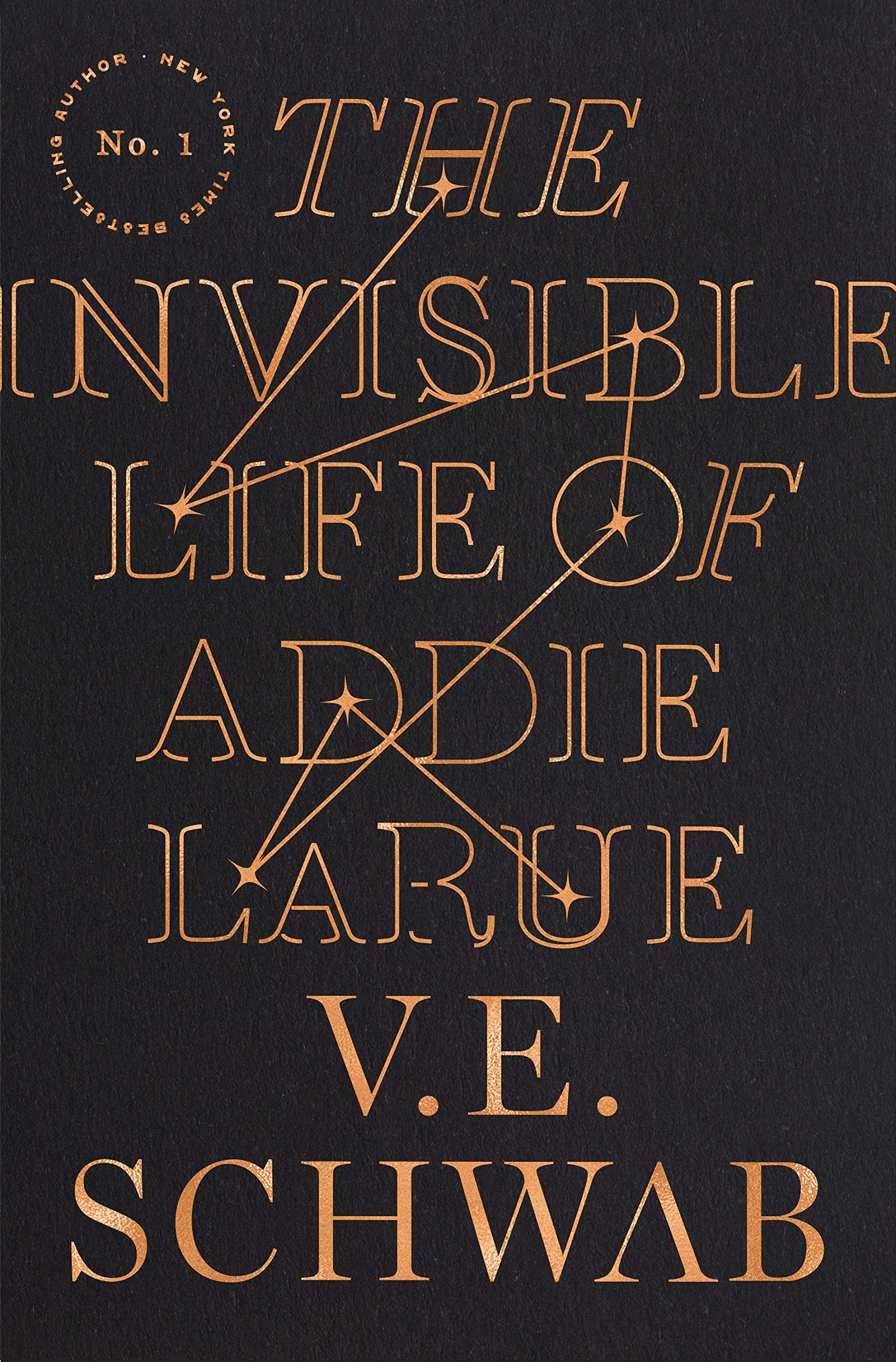
BOOK REVIEW: The Invisible Life of Addie LaRue by V.E. Schwab

The Invisible Life of Addie LaRue is a stand-alone speculative fiction novel by V.E. Schwab, the author of The Shades of Magic trilogy (A Darker Shade of Magic, A Gathering of Shadows, A Conjuring of Light) and other epic fantasy books. The Invisible Life of Addie LaRue is qualitatively different from these works; it’s more reminiscent of books written by Claire North, like The First Fifteen Lives of Harry August, which often have an intriguing supernatural premise or gimmick with a somewhat shallow depiction of the characters. In The Invisible Life of Addie LaRue the main character makes a deal with the devil to live forever but the catch is that it will be an “invisible life.”


Addie LaRue is a young woman in 1714 who asks the gods to save her from an arranged marriage and her wish is granted in that she will never age or die but the conditions are that no one will ever remember her, she can own no property, make new things or leave a mark on the world. The devil, who she comes to know as Luc (short for Lucifer, get it?), appears to her as a dark, handsome stranger on the anniversary of the granting of the wish and asks Addie if she’s ready to give him her soul yet. Addie’s first year living invisibly is incredibly tough as she figures out the rules of her situation and tries to do basic things like eat and find a place to live in a world where everyone forgets her the moment she leaves their sight. However, even though she is now a stranger to her mother and father and everyone she has ever known or will know, Addie declines Luc’s offer to give up (her soul and her life) after one year of living an invisible life.


One interesting aspect of the book for me is when we discover how Addie finds a large loophole in one aspect of the devil's deal. She can make a mark on the world, but she can only do so by serving as a muse and inspiration for works of art created by other people. It turns out that Addie happens to have seven freckles on her face in a distinctive (and memorable) pattern, and although she can’t be remembered, this motif can be, and is, included in multiple works of art (depicted in the pages of the novel) over the next 300 years as we follow Addie’s life.


The fact that we follow Addie for centuries without the basic contours of the story changing is a downside of the impact of The Invisible Life of Addie LaRue for me. The middle section of the book is somewhat repetitive (we see how Addie has lots and lots of one-night stands, how she has repeated "first-time" interactions with people over and over again). I'm sure this repetition is intention, used by the author to give the reader a taste of how repetitive Addie's life is for her as well. The primary change to the routine is that eventually Luc and Addie have a relationship (after all, he is literally the person who she interacts with the most often, and is the only person who can actually remember her after spending any significant amount of time with her). It doesn’t end well, because even though Luc says he’s in love with her after they have basically been together for twenty years, he still asks her for her soul, and Addie suspects the love affair may have just been a ruse to get her to lower her defenses to his desire.


Another weakness in the book is Addie herself. Even though the passage of time has less significance for her and the rules about her having possessions or leaving a mark on the world are difficult challenges to overcome, I was still disturbed by the lack of growth in Addie’s personality. She’s alive for long enough that she has seen astonishing technological advances and societal changes but she doesn’t seem world-weary or wise beyond her (apparently youthful) age. I suspect this may be a specific authorial choice to have Addie’s personality frozen in time as the 23-year-old woman from a small French village she was when she first gained immortality, but this is not made explicit, so the lack of development of Addie’s character over the course of the book is a puzzling and disappointing choice, to me.


The most interesting part of the novel occurs when Addie returns to a downtown Manhattan used bookstore the day after walking out without paying for a book she picked up and the manager remembers her name, something which hadn’t happened in three centuries. It turns out that Henry, the manager of the bookstore, has made his own deal with Luc, one in which he will forfeit his soul after spending one year in which everyone who sees him will see their heart’s greatest desire. Since Addie’s greatest desire is to be remembered, Henry is able to remember her. Of course, Addie immediately becomes infatuated with Henry and soon they become lovers. As things progress, they each start to become more aware of the magic deal the other had made with Luc. For example, Henry introduces his girlfriend to his friends and family and they only remember her existence for brief moments and so he has to do it over and over again. She sees the way people look at Henry and what special treatment he gets because he is literally the embodiment of all they want, at all times.


************************************SPOILER ALERT**********************************

In the end, Addie realizes that since she knows Luc so well, she can make a bargain that may be able to save Henry's soul (and life). She finally agrees to be “his” for as long as Luc is interested in having her at his side, but she draws the line at giving up her soul and she has one condition: Henry must be allowed to remember her and the time they spent together even though he will never see her again. Luc agrees to the deal and then we learn that the book we have been reading, The Invisible Life of Addie LaRue, is the true story of Addie’s life as told to Henry.

************************************SPOILER ALERT**********************************


This was a nice twist at the end, but for me it didn’t make up for other problematic aspects of the book (the slow pacing through the middle 200 pages, the fact Addie never really matures despite hundreds of years of experience and the way it treats both Luc's and Henry’s characters somewhat superficially). I think I’m in a distinct minority in my opinion of the book as “interesting, somewhat slow and flawed, but worth reading” in that it has over 650,000 ratings with an average of over 4.2 in August 2022 and a cinematic adaptation has been announced

Regardless, I encourage you to read the book yourself to see if you agree with my review.

Title: The Invisible Life of Addie LaRue.
Author: V.E. Schwab.
Format: Hardcover.
Length: 444 pages.
Publisher: Tor Books.
Date Published: October 6, 2020.
Date Read: January 29, 2022.

GOODREADS RATING: ★★½☆  (3.5/5.0).

OVERALL GRADE: A-/B+ (3.5/4.0).

PLOT: B+.
IMAGERY: A-.
IMPACT: B+.
WRITING: A-.

Thursday, March 03, 2022

BOOK REVIEW: The Empire's Ruin (Ashes of the Unhewn Throne, #1) by Brian Staveley


Brian Staveley is the author of the epic fantasy series The Chronicles of the Unhewn Throne (The Providence of Fire, The Emperor’s Blades, The Last Mortal Bond.) The Empire’s Ruin is the first book in a new series called Ashes of the Unhewn Throne that is set five years after the conclusion of the previous one.

The first series was primarily a trilogy centered around the three children of the Annurian Emperor (Adare, Kaden, and Valyn) and the ways their lives change following the assassination of their father and the subsequent struggle for power and control of Annur that follows. The three Malkeenian siblings are very different from each other. Adare is the oldest and only daughter, she was closest to their father and a consummate insider, familiar with and adept at palace intrigue and royal politics. Kaden is the oldest son and heir to the throne but has been sent years ago to the distant mountains of Ashk’lan to be trained as a Shin monk. Valyn is the youngest of the family and has been training for years to be a Kettral, one of the near-mythical, elite soldiers who ride the gargantuan raptors of the same name.

In The Empire’s Ruin, Staveley uses a similar tripartite structure, with the narrative following three characters, this time ones whom we don’t know whether they have (or will have) connections to each other. Gwenna Sharpe is a Kettral who fought alongside Valyn in the battles depicted in the earlier trilogy and in the very opening scene of The Empire’s Ruin her Kettral wing suffers a devastating military failure under her command. Ruc Lankatur Lan Luc is a priest of Eria, the Goddess of Love, in Dombâng, the culturally diverse, strategically located city in which the events of Skullsworn (Staveley’s fourth and most controversial book set in the same Annurian Empire as his other works) occurred. Ruc was raised by the Vuo Ton, a tribe of indigenous people who can survive living in the swamps surrounding Dombâng which are full of literally dozens of different species of deadly fish, snakes, insects and plants. Last is Akiil, a liar/thief/con man and former Shin monk (all known living Shin monks were massacred in one of the opening sequences of The Providence of Fire) who knew Kaden, the Heir Apparent to the throne in the Chronicle trilogy. One interesting aspect of the main characters in The Empire’s Ruin that I realized in writing this review that I hadn’t noticed before was that all 3 of the protagonists, Akiil, Gwenna, and Ruc have an important/central other person they are attached to/care for very deeply. With Ruc his “person” is Bien, a fellow priest of Eria who he apparently loves, perhaps in a brother-sister way but we discover may be less chaste as the story progresses. For Akiil, his person is Yerrin, a Shin monk that Akiil rescued from Ashk’lan but who has a decidedly unusual relationship with reality. Akiil also grew up in the slums of the capital city before going to join the Shin monks and he has a definite connection to Skinny Quinn, a girl who used to be part of his close-knit friends when they were young. Gwenna was attached to members of her Wing (the name of the cadre of soldiers she commanded in the Kettral) but the primary attachment she demonstrates in The Empire’s Ruin is to a young orphan girl she names Rat and whom she does her best to raise and protect on an incredibly dangerous and harrowing journey she takes with a group of men who generally would not be sad if she (or Rat) died or if they did the killing.

After the events of the Chronicle trilogy the only remaining Malkeenian sibling who is believed to be alive is Adare, who is now the Annurian Emperor. She is desperately trying to keep the Empire together but has lost the use of the kenta gates (these are special portals that allow certain people, namely Shin monks, to travel instantaneously between gates) and thus the ability to obtain current/relevant intelligence on the state of affairs in the far-flung sectors of her empire. Since Adare was in the first series, she is a familiar character to those readers and even if this time we don’t have access to her inner thoughts as we did when she was a central protagonist she definitely drew me into the story. Gwenna is also a somewhat known quantity so I think I identified with her section(s) of the book the most, although I rooted for Ruc the hardest to succeed. It’s difficult to root for Akiil because he’s literally a crook and he’s trying to trick/swindle Adare. Why should we care about him since he’s an asshole?

One of the strongest features of Staveley’s writing is his depiction of action. There are numerous fight set pieces that are simply stunning. He has set up the story in ways that lead to his characters often being in perilous situations that lead to action scenes. For example, Ruc and Bien are literally forced to become gladiators in a kill-or-be-killed religious ceremony in Dombâng. Gwenna is on a continent where the flora and fauna are warped by the environment to become deadly monsters. Akiil is trying to steal from a ewan who has a literal army of heavily muscled well-trained men who will kill for her at a glance.

Another strong feature of Staveley’s books is what is usually referred to as “worldbuilding.” He includes a dizzying array of cultural and religious beliefs and their nuanced depiction despite how abhorrent some would appear to the reader communicates a sense of verisimilitude to Annur as a real place (for the characters). In the Chronicle trilogy we were introduced to people who worship Ananshael, the God of Death, who are both priests and assassins. (Later, Staveley wrote an entire book called Skullsworn with one of these priests-assassins, Pyrre Lankatur, as the main character.) In this first book of the Ashes trilogy we discover that public death matches are a popular cultural and religious practice in Dombâng.

In the end, I found The Empire’s Ruin, the first book in the Ashes of the Unhewn Throne, to be a worthy successor to the first series and I am very confident that I will be reading more books Staveley writes in this series. As with the Chronicle series it’s clear that in addition to the main plot(s) involving the three main characters, there’s another one involving the gods (this time it’s the Nevariim, who are even more mysterious, and potentially even more evil, than the Csestriim from the first series). I’m hopeful that more information will be revealed about both groups, and their relationship to humans before the Ashes series ends.

Title: The Empire's Ruin (Ashes of the Unhewn Throne, #1).
Author: Brian Staveley
.
Format: Kindle.
Length: 624 pages.
Publisher: Tor Books.
Date Published: July 6, 2021.
Date Read: January 9, 2022.

GOODREADS RATING: ★★★★  (5.0/5.0).

OVERALL GRADE: A/A- (3.83/4.0).

PLOT: A-.
IMAGERY: A-.
IMPACT: A.
WRITING: A.

Thursday, May 13, 2021

BOOK REVIEW: The Fires of Vengeance (Burning, #2) by Evan Winters


The Fires of Vengeance by Evan Winter is the sequel to the author’s debut novel The Rage of Dragons. These books are firmly in the category of epic fantasy: they are both chockfull of dragons, swords, metaphysical powers, gods and warfare. The books are set in something resembling a Bronze Era civilization, with a strict caste-based society that appears to modeled on an ancient African culture. Winter is one of the very few African-American writers working in this genre and he makes it very clear that the characters in his books are primarily what we could call “people of color” with skin tones of various hues from very light brown (tea with lots and lots of milk) to the darkest black (fire-scorched wood).

The main character in the series is Tau Solarin, who in The Rage of Dragons had a fairly familiar plot of the lowly outsider underdog who eventually becomes a celebrated champion after overcoming multiple trials and tribulations. In The Fires of Vengeance, Tau’s developing relationship with his Queen, Tsiora Omehia, becomes one of the primary threads of the complicated plot. In addition to this romantic intrigue plot line, the story in the second book also includes political intrigue between Tsiora and her sister Esi who has claimed she is the rightful claimant to the throne and the intercultural intrigue of the ongoing disintegration of the Omehi caste system. However, all of these other threads are overshadowed by the imminent battle between the Omehi people and the more populous indigenous inhabitants of the Xidda continent. And in addition to the struggles between different factions of the Omehi and the future struggle between the Omehi and Xiddans , there’s a non-negligible threat from the Cull, the near-omniscient murderous beings who drove the Omehi from their ancestral land of Osonte, decimating them in the process. It was that fabled escape from Osonte, dozens of generations before the events told in The Burning books that caused the Omehi to arrive to Xiddan and displace the indigenous folks on the peninsula, who unsurprisingly view them as colonizing marauders who should be exterminated.The Omehi feel like the Xiddan pensinsula is overrun by godless, murderous heathens who don't deserve to occupy the land their forefathers fought and died for so the stage is set for genocidal war.  Because its been so long, many Omehi don’t even think The Cull are real (which is a dead giveaway that at some point these Big Baddies are gonna show up at some point!)

A key feature of the books is the existence and prominence of Isihogo, the Underworld, where time runs faster than the real world and where the power of gods and demons manifest themselves. Generally, only priestesses with a rare ability and years of training are able to enter Isohogo but Tau has been using it as a means to hone his fighting skills to the point where he is the best fighter the Omehi have seen in generations, perhaps ever. (When you get killed by Demons in the spirit world it doesn’t physically harm you and you wake up back in the real world with the memory of what happened; many people can become susceptible to emotional and mental damage from the experience. Because Tau is fueled by a volcanic level of rage and vengeance he thinks that the costs, such as the hallucinations he regularly suffers, are worth the enhanced fighting prowess and imperviousness to pain he gains.)

As I mentioned, Omehi society is strictly caste-based, with two primary groups, Nobles and Lessers. The author is somewhat vague about whether the castes are actually biologically distinct, or whether, like race, the caste divisions in Omehi society are socially constructed identities reified by cultural norms and historical tradition. Nobles are generally larger, faster and stronger than Lessers, but a key point we learn in the first book is that the two groups can procreate with each other (although of course this is strongly discouraged). There are various strata in both of the two primary castes, with the absolute lowest being “Drudges” who are basically outcasts from Lesser society and the highest are the Royal Nobles, which includes Tsiora. In both books, one of the central fights Tau has to take on is the assumption that as a Lesser he has no chance of besting a Noble (of any level) in combat. This of course turns out to be spectacularly untrue and is the primary plot device of The Rage of Dragons. However, we do learn in The Fires of Vengeance that Nobles have stronger connections Isihogo which may account for their advantages (and also would tend to lend credence to the idea that the caste divisions are “real”). However, like race, just because one group of people who are racialized into a particular group tend to have more or less of a particular trait or tendency does not mean that race is not a fiction. The clever and conspicuous depiction and deployment of race is one of the most attractive features of the series for me, especially since any depiction of difference from a white heteronormative ideal is so rare in most fantasy and science fiction.

Although the two books share numerous similarities (depiction of multiple battles and one-on-one skirmishes, political and romantic intrigues, cultural/ethnic stereotyping and demons, dragons and disasters, oh my!) The Fires of Vengeance improves on The Rage of Dragons by de-centering Tau slightly and making it clear that two of the most important characters from the first book are both gay (and a couple!). Of course, Tau in his single-minded focus on getting revenge for the deprivations he suffered in the first book is one of the last to figure out the situation but he takes it completely in stride. As a gay reader of the books, the complete absence of homosexuality in the all-male military settings of the first book was a curious and problematic defect that I’m very happy was corrected in the second book.

I suppose one of the (slight) quibbles one could have with The Fires of Vengeance is that it doesn’t resolve most of the larger tensions in the plot and ends with the inclusion of a huge, paradigm-shifting twist. That said, there’s a lot that does happen in the second book of The Burning, with multiple significant characters dying and/or having life-altering consequences due to the action. Winter is not one to provide his characters with plot armor, which is a refreshing change.  Apparently the series may become a quartet instead of the expected trilogy, which is fine by me, because The Burning is fast becoming one of my favorite epic fantasy series. For people who like the work of Brent Weeks (Lightbringer series, Night Angel trilogy) and Peter Brett (Demon Cycle) I’m confident you will also enjoy these action-packed, engaging books by Evan Winter!

Title: The Fires of Vengeance (The Burning, #2).
Author: 
Evan Winter.
Format: Kindle.
Length: 528 pages.
Publisher: Orbit Books.
Date Published: November 10, 2020.
Date Read: May 2, 2021.

GOODREADS RATING: ★★  (4.0/5.0).

OVERALL GRADE: A- (3.67/4.0).

PLOT: A-.
IMAGERY: A-.
IMPACT: A-.
WRITING: A-.

Thursday, February 25, 2021

BOOK REVIEW: The Rage of Dragons (The Burning, #1) by Evan Winter

The Rage of Dragons is the debut novel by Evan Winter, one of the few African-American authors working in the epic fantasy genre. This 2019 work made quite a splash, and when I read it in February 2021 it had well over 16,000 ratings with a very impressive 4.37 average on Goodreads’ 5-point scale. I had made the decision to try and read as many Black authors as I could during Black History Month and selecting Winter’s well-regarded fantasy novel from my burgeoning Kindle TBR pile seemed like a no-brainer.

Most of my reading these days is in genre fiction, but typically I would say I spend more time reading crime fiction, then science fiction and rarely fantasy. However I was impressed very early on by Winter’s characterization of the protagonist of The Rage of Dragons, Tau Solarin. I was even more impressed by the world-building in the novel.

The story in The Rage of Dragons is set in a satisfyingly complex society which has two primary castes: Lessers and Nobles. The two are physically distinctive, although it is clear that both groups would be racialized as “Black” in our contemporary society. Almost all Nobles are taller, faster, stronger than most Lessers. Both are part of the Chosen people or Omehei. Omehei society appears to have a level of technological advancement equivalent to the Bronze Age on Earth. In addition to a society chock full of complicated moral questions Winters adds dragons and a spiritual realm that allows certain Gifted Omehei to practice powerful, specific magical effects such as Enraging (making someone physically bigger and stronger), Enervating (stripping someone of their will and ability to act on their own), Edifying (communicating information over long distances) and Entreating (taking over conscious control of another living thing’s body). Winter situates his story in a historical context where the Omehei have spent 200 “cycles” (presumably solar years) trying to keep control over land on the Xiddan Peninsula that they think they should get to keep because it’s where they landed after they were hunted and nearly exterminated in a land called Osonte located far across the sea by creatures they call The Cull. Omehei believe they were "Chosen" by the Goddess to survive the Cull and their faith in her is why some have been "gifted" with powers and why they survived the rough sea passage from Osonte and also believe they have a right to claim Xiddan as their own.  Unfortunately, it was already occupied by another group of humans, who (rightly, IMO) view the Omehei as invaders and colonizers and have been fighting for generations to expel or exterminate the Omehei. The Omehei also seem to be able to convince dragons to fight on their side fairly regularly and this behavior is viewed as further evidence the Omehei are "chosen by the Goddess."

The Rage of Dragons is an intricate, multi-layered story with several fascinating creations combined together to produce a compelling setting for what is at its heart a fairly traditional plot ("Local boy makes good"). These layers include class (there’s a very explicit and strongly enforced caste system among the Omehei AND a Royal sovereign!); race (almost all the Omehei are described as having skins of various hues ranging from tan to pitch-black); religion (belief in a spiritual world called Isihogo, the realm of demons, as well as an omnipotent, omnipresent, invisible "Goddess."); magic (the previously mentioned Gifted abilities); and war (the Omehei are in a generations-long battle with the original inhabitants of the Xiddan peninsula whom they call “hedeni” who they think are over abundant, light-skinned heathens and savages).

The main character Tau is an 18-year-old Lesser whose best friend Jabari is a Petty Noble and Winter does an excellent job of depicting the unequal opportunities and futures Lessers and Nobles have in Omehei society. Through an unfortunate interaction with a less open-minded Noble than Jabari, Tau’s father is killed early in the book in order to assuage a Noble ego and Tau vows revenge on three specific Noblemen who he sees as ultimately responsible for his father’s thoughtless murder.

The primary animating force of Tau's actions in The Rage of Dragons is revenge against his “betters” and he sets off to prove that he will literally do whatever it takes, no matter how painful or difficult, in order to have an opportunity to strike back at the men who destroyed his family. This makes Tau a sympathetic but also problematic figure. There’s an entire arc of the story which is about how Tau becomes a great warrior, not through some innate or genetic or magical ability but through intense, obsessive hard work, day-in and day-out. This is a nice choice by the author, because although Winter is duplicating a common trope of epic fantasies (the downtrodden orphan who grows up to become more powerful than anyone or he could ever have dreamed) he also subverts the trope by making it clear Tau is NOT the biggest, smartest or “most special” character in the book. Tau makes mistakes and wrong choices, more than once, but these humanize him and greatly strengthened my interest and connection with the character.

I only have a few quibbles with The Rage of Dragons (obviously, since I gave it the highest possible rating of five out of five stars on Goodreads). First of these quibbles are the too-frequent, detailed descriptions of hand-to-hand combat and fight scenes. In some sense it follows because Tau is in military training for more than half the book, but I think the number of paragraphs describing precisely how, who and with what Tau is fighting could have been reduced by half (or more!) with very little reduction in my enjoyment of the book. My second quibble is with the ending and the author’s penchant of raising the stakes by literally killing off multiple major characters in the last 5% of the book; some of the characters killed had been around since the first 5% of the book. This is incredibly gutsy, I guess, and I understand the dilemma the author is in. If he puts all of the characters in peril (or at the very least the vast majority of the ones we care about) and never kills off any, then the peril isn’t real, and the reader may feel cheated. But if he kills off major characters that we have known for the vast majority of the book in a shocking denouement towards its conclusion then it feels overwhelming and the reader feels somewhat cheated for investing in certain relationships that had built up as the story progressed. Winter made the latter choice in The Rage of Dragons and it definitely increased the emotional wallop the book delivers, so maybe he made the "right" choice in this case. I’m not sure there really exists an optimal choice for an author here.

Overall, The Rage of Dragons is an incredibly well-written and powerful debut novel. As I said at the beginning, epic fantasy is not particularly one of my favorite genres but I was thoroughly entertained and entranced by this book and look forward to reading The Fires of Vengeance as soon as the price for the Kindle edition goes on sale!

Title: The Rage of Dragons (The Burning, #1).
Author: 
Evan Winter.
Format: Kindle.
Length: 544 pages.
Publisher: Orbit.
Date Published: July 16, 2019.
Date Read: February 16, 2021.

GOODREADS RATING: ★★★★★ (5.0/5.0).

OVERALL GRADE: A (4.0/4.0).

PLOT: A-.
IMAGERY: A.
IMPACT: A+.
WRITING: A.

Thursday, December 31, 2020

BOOK REVIEW: Age of Empyre by Michael J. Sullivan


Age of Empyre is the culmination of a six-book epic fantasy series written by Michael J. Sullivan. It's been a long journey from the first book, Age of Myth which was released in 2016. (I didn't start reading the series until 2017, but have enjoyed every entry since then. The other books in the series are Age of Swords, Age of War, Age of Legend and Age of Death

The series is officially known as Legends of the First Empire. It is set a few thousand years before the events of the Riyria stories featuring Royce and Hadrian that are told in Theft of Swords, Rise of EmpireHeir of Novron. Those books are some of the most enjoyable epic fantasy books I have ever read, and has permanently affixed the name Michael Sullivan to my list of must-read authors.

So, I was very excited to hear about and read the Age of books and quite anxious as the end of series approached in Age of Empyre. Another interesting aspect of Sullivan's books is that he basically writes all the books in a series before he self-publishes them, so there really wasn't any doubt that the entire six-book series was going to be available to be read. (Take that, George R.R. Martin!)

The main characters in the series have been Persephone, Brin, Raithe, Suri, Arion, Nyphron, Mawyndule  and Malcolm. The primary story is about relations between the various inhabitants on the world (which they call Elan). Those species are humans (called Rhune), elves (called Fhrey) and dwarves (called Dherg or Belgriclungreians). Basically, the Fhrey are the most powerful, because they have access to magic, which they call The Art. The Art uses the energy of the world to can re-channel it to do incredible things: move heavy objects, change the weather, set things on fire or make things very cold, etc). There are different "tribes" of Fhrey, and only one of the tribes, the Miralyith have the power to do the Art, but all Fhrey are extremely long-lived. In fact, some of the Fhrey from this series are still very much alive in the Riyria Revelations series and part of the fun in reading these books is seeing how events and people depicted in the ancient past in one series are similar/different than how they are portrayed in real time. 

And by relations between the species, I really mean "war." The Rhunes basically thought that the Fhrey were gods, and the Fhrey thought that the Rhunes were basically dirty animals. The Rhunes vastly outnumber the Fhrey and their lives are a fratction of a Fhrey's. However, in Age of Myth a Rhune kills a Fhrey (mostly by accident) and when that information gets back to the main group of humans where Persephone, Suri and Brin live it changes everything. 

The main tension in the series is between the Fhrey and the Rhunes. The first surprise is that the Rhunes actually have a chance to survive. In the earlier books, the Rhunes' ingenuity (invention of the wheel and steel) are able to balance out the Fhrey's magical powers such that for a very long time the wars that they fight against each other result in stalemates.

In Age of Empyre the tension between the humans and the elves are resolved in various ways that are surprising. It's hard to say which side "won" the war. What happens is that the relationship between humans and elves is resolved in such a way that the future existence of humans is assured, and there is "regime change" at the head of the elves so that the policy of Rhune extermination is rescinded. The borders of where each of the species (humans, dwarves and elves) should live are clarified and agreed to. I don't want to say more than that or else I will be including too many spoilers.

I do want to remark on another aspect of the books, which is its mythology. In the 5th book, Age of Death, there are several characters that "die"--by this I mean that they go into the afterlife. It turns out that there are three afterlives and our characters have to make it through all three in order to find a macguffin. Not all the characters make it through all three afterlives, and there is a  great deal of thoughtful (and thought-provoking) rumination on the nature of life and death and teleology (fancy word for purpose and the meaning of life). That Sullivan can include these elements successfully in the middle of a rip-roaring, action-packed epic fantasy is a testament to his skills as a writer. Even a jaded atheist as myself was willing to go along with the worldview the author promulgated in the last two books.

Overall, I felt that Age of Empyre was a suitable and well-done conclusion to the Legends of the First Empire series of sux books, with multiple, satisfying payoffs for readers who had made it through all six books (and even more for readers who have also read the other six books of the Riyria Revelations and Riyria Chronicles). Interestingly, Sullivan has announced a new epic trilogy called The Rise and Fall which will bridge the thousands of years between the events of the Legends of the First Empire series just concluded and the Riyria stories which were published first but are far in the future. I am definitely looking forward to reading those!

Title: Age of Empyre (Legends of the First Empire, #6).
Author: 
Michael J. Sullivan.
Paperback: 395 pages.
Publisher:
 Riyria Enterprises.
Date Published: May 5, 2020.
Date Read: August 10, 2020.
GOODREADS RATING: ★★ (5.0/5.0).

OVERALL GRADE: A/A- (3.83/4.0).

PLOT: A.
IMAGERY: A-.
IMPACT: A-
WRITING: A.

LinkWithin

Blog Widget by LinkWithin